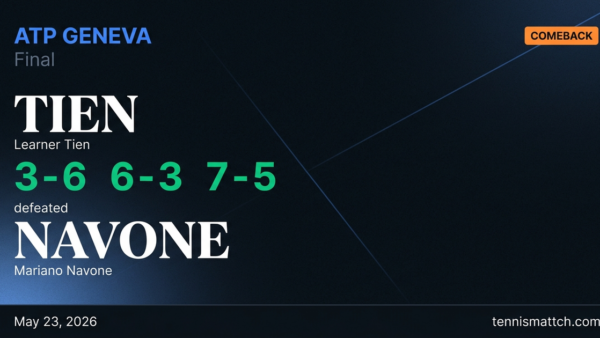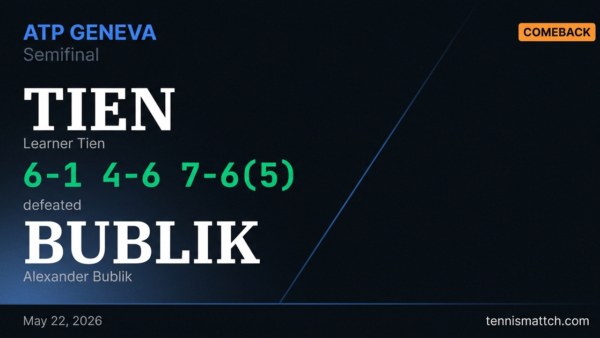



Learner Tien faces Alexander Bublik in the Geneva ATP semifinal on Friday, May 22, with the American holding a 1-0 career edge after defeating the Kazakh 4-6 6-3 7-5 at Rome just 11 days ago. The prediction model gives Tien a narrow 55.1% win probability despite Bublik’s superior overall Elo rating, driven by Tien’s dominant 1735-1713 advantage in hard court Elo and his exceptional break point conversion rate of 52.0% versus Bublik’s 37.9%.
Both players arrive in identical form, each riding two-match winning streaks through Geneva. Tien dispatched Stefanos Tsitsipas and Alex Michelsen in straight-set tiebreak battles, showcasing his ability to close tight sets—a skill that proved decisive in their Rome meeting. Bublik has navigated a steadier path with victories over C.H. Tseng and Arthur Rinderknech, but his 37.9% break point conversion remains a vulnerability Tien exploited ruthlessly in Italy. The model projects 25.9 total games with a 50% probability of a straight-sets finish, suggesting this could swing either direction.
The tactical contrast is stark: Bublik marginally outserves Tien in raw power (11.1 aces per match versus 10.9), yet Tien’s superior consistency—averaging 2.6 fewer unforced errors per match—allows him to construct longer rallies and apply relentless return pressure. On hard courts where both players hold identical 60% first-serve percentages, Tien’s 14.1-point edge in break point conversion becomes the decisive factor. Bublik will need to elevate his return aggression and minimize the service lapses that cost him in Rome.
Key Takeaways
- Tien’s 52.0% break point conversion rate versus Bublik’s 37.9% could prove decisive—a 14.1-point gap that mirrors his ability to capitalize on return opportunities in their Rome clash.
- The model’s 55.1% win probability for Tien is driven by his superior hard court Elo (1735 vs 1713) and recent form (70% vs 60% over last 10 matches), despite Bublik’s higher overall Elo rating of 1779.
- Bublik’s marginal serving advantage (11.1 aces, 4.1 double faults) is neutralized by Tien’s cleaner baseline play—the American averages 2.6 fewer unforced errors per match (32.7 vs 35.3), enabling him to extend rallies and force errors.
- Monte Carlo simulation data projects 25.9 total games with a 50% straight-sets probability, suggesting a tight match where the Rome H2H (Tien won 4-6 6-3 7-5) provides crucial tactical familiarity for the American.
Player Analysis
Learner Tien
The 19-year-old American has matured rapidly in 2026, compiling a 46-27 hard court record and reaching the Indian Wells quarterfinals before losing to Jannik Sinner. His Geneva run showcases tactical versatility: back-to-back tiebreak victories over Tsitsipas (7-6 7-6) and Michelsen (6-4 3-6 6-1) demonstrate composure in clutch moments. Tien’s 52.0% break point conversion is elite-level efficiency, allowing him to punish opponents’ second serves and extract breaks in tight sets. His 10.9 aces per match on hard courts confirm legitimate serving weapons, though 5.1 double faults per match remain a manageable liability.
The Rome victory over Bublik validated his ability to win contested three-setters through persistence rather than firepower. Averaging 38.0 winners against 35.3 unforced errors, Tien plays a high-volume baseline game predicated on depth and consistency. His vulnerability lies in extended service pressure—Bublik’s 11.1 aces could test Tien’s return positioning. Yet with three consecutive wins and tactical familiarity from Rome, Tien enters with psychological momentum and surface-specific confidence.
Alexander Bublik
The enigmatic Kazakh remains one of tour tennis’s most unpredictable talents, capable of serving 20 aces or double-faulting away service games with equal probability. His 11.1 aces per match and 60% first-serve percentage provide a solid platform, yet his 37.9% break point conversion exposes a chronic inability to capitalize on return opportunities. Bublik’s 127-114 career hard court record reflects a player who wins when his serve fires but falters when forced into baseline exchanges against consistent opponents like Tien.
Geneva has seen a more composed Bublik, dispatching Tseng and Rinderknech without drama. Yet the Rome loss 11 days ago revealed his blueprint for vulnerability: when opponents neutralize his first serve and force second-serve pressure, Bublik’s 32.7 unforced errors per match begin to accumulate. His 37.4 winners per match nearly mirror Tien’s 38.0, but the American’s superior error management tilts lengthy rallies in his favor. Bublik must elevate his return aggression and avoid the passive stretches that allowed Tien to break late in the Rome decider.
Head-to-Head Record
| Date | Tournament | Surface | Winner | Score |
|---|---|---|---|---|
| 2026-05-10 | Rome | Clay | Learner Tien | 2 – 1 |
Match Prediction
| Learner Tien | Alexander Bublik | |
|---|---|---|
| Elo Rating | 1756 | 1779 |
| Hard Elo | 1735 | 1713 |
| Last 10 Win% | 70% | 60% |
Frequently Asked Questions
Who will win Learner Tien vs Alexander Bublik at Geneva 2026?
The prediction model gives Learner Tien a 55.1% win probability, driven by his superior hard court Elo rating (1735 vs 1713) and exceptional 52.0% break point conversion rate compared to Bublik’s 37.9%. Tien defeated Bublik 4-6 6-3 7-5 at Rome on May 10, demonstrating his ability to outlast the Kazakh in contested three-setters. However, Bublik’s marginal serving advantage (11.1 aces per match vs 10.9) and higher overall Elo (1779 vs 1756) keep this semifinal competitive. Monte Carlo simulations project 25.9 total games with a 50% straight-sets probability, suggesting the match could swing either direction based on break point efficiency.
What is the head-to-head record between Learner Tien and Alexander Bublik?
Learner Tien leads the career head-to-head 1-0, with his sole victory coming at the Rome Masters 1000 on May 10, 2026. Tien won 4-6 6-3 7-5 on clay, rallying from a set down to break Bublik’s serve late in the third set. That match revealed Tien’s superior break point conversion (52.0% vs 37.9%) and ability to sustain baseline consistency under pressure. The Geneva semifinal marks their first meeting on hard courts, where Tien holds a 1735-1713 surface-specific Elo advantage over Bublik.
Learner Tien vs Alexander Bublik Geneva 2026 semifinal prediction
Key factors favor Tien: his 70% recent form over the last 10 matches compared to Bublik’s 60%, a dominant break point conversion rate (52.0% vs 37.9%), and tactical familiarity from defeating Bublik at Rome 11 days ago. The model’s 54.7% Monte Carlo simulation win percentage for Tien aligns with his hard court Elo edge and three-match winning streak. However, Bublik’s serving metrics (11.1 aces, 4.1 double faults) could neutralize Tien’s return pressure if the Kazakh finds rhythm. The projected 25.9 total games and 50% straight-sets probability suggest a tight contest decided by break point efficiency—Tien’s proven strength in their Rome meeting.
When is Learner Tien vs Alexander Bublik at Geneva 2026?
The semifinal is scheduled for Friday, May 22, 2026, at the Geneva ATP tournament on hard courts. The winner advances to Sunday’s final. Both players are riding two-match winning streaks through the tournament, with Tien defeating Stefanos Tsitsipas and Alex Michelsen, while Bublik dispatched C.H. Tseng and Arthur Rinderknech.
What’s Next
The Geneva ATP semifinal between Learner Tien and Alexander Bublik is scheduled for Friday, May 22, 2026, on hard courts. The winner advances to Sunday’s final, positioning themselves for a second ATP title of the season. For Tien, a victory would mark his first ATP final appearance and validate his rapid ascent as a hard court threat. Bublik seeks his first final since 2025, aiming to leverage his serving power to reverse the Rome result and reclaim momentum ahead of the clay-to-grass transition.