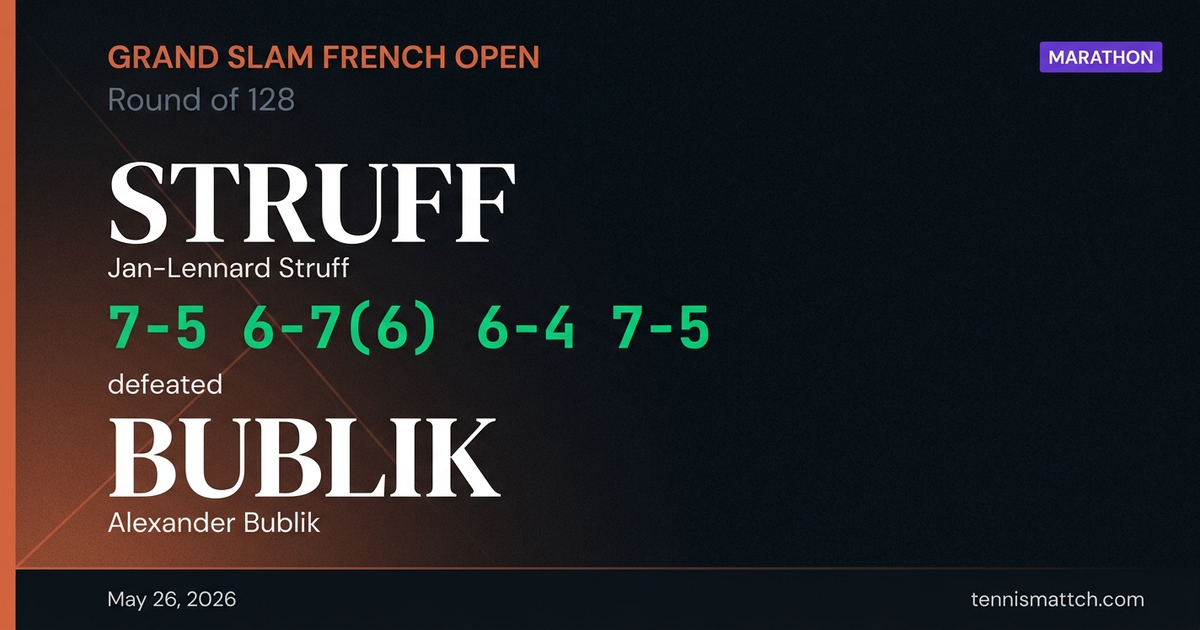



Jan-Lennard Struff defeated Alexander Bublik 7-5, 6-7(6), 6-4, 7-5 in the French Open first round on May 26, 2026. The German converted 7 of 19 break point opportunities and dominated on second serve returns (58% points won vs. Bublik’s 45%) to overcome the Kazakh’s 25 aces in a match that lasted three hours and 38 minutes.
Bublik struck more aces and winners, but his 10 double faults and vulnerable second serve proved costly across four closely contested sets. After splitting the opening two sets—Struff taking the first 7-5 before Bublik edged a tight second-set tiebreak 8-6—the momentum tilted decisively toward the 34-year-old German. Struff broke twice in the third set to seize control at 6-4, then held firm in the fourth despite Bublik’s late resistance, closing out the match 7-5 to advance to the second round.
The victory marks a crucial turnaround for Struff, who arrived at Roland Garros with just two wins in his previous ten matches. His ability to neutralize Bublik’s aggression—the Kazakh averaged 34.5 winners per match on clay this season—through steadier serving (51% first serves in vs. Bublik’s 60%, but far more consistent under pressure) and opportunistic break point conversion proved the difference in a battle of contrasting styles on Court Philippe-Chatrier.
Key Takeaways
- Second serve dominance decided the match: Struff won 58% of second serve points compared to Bublik’s woeful 45%, a 13-percentage-point gap that translated to crucial breaks in the third and fourth sets. This advantage neutralized Bublik’s 25 aces.
- Break point efficiency nearly identical, but volume favored Struff: Both players converted roughly 37% of their break chances, but Struff faced 19 opportunities to Bublik’s 11, reflecting the German’s relentless pressure on the Kazakh’s inconsistent second delivery.
- Unforced errors tilted the four-setter: Bublik committed 51 unforced errors to Struff’s 45 despite hitting virtually the same number of winners (57 vs. 58), indicating the German played cleaner tennis in the decisive moments of tight sets.
- Struff’s clay court steadiness emerged despite recent struggles: Arriving with a 2-8 record in his last 10 matches, Struff’s 60% first serve percentage on clay (above his season average of 60% exactly) and lower double fault count (6 vs. Bublik’s 10) proved more reliable than Bublik’s high-risk, high-reward approach over nearly four hours.
Player Analysis
Jan-Lennard Struff
The 34-year-old German delivered his most composed performance in weeks, using experience and patience to outlast a more explosive opponent. Struff’s 58% second serve points won—13 percentage points higher than Bublik’s—proved the cornerstone of his victory, allowing him to weather Bublik’s 25-ace barrage. His 71% first serve points won matched Bublik’s efficiency, but crucially, Struff committed four fewer double faults and six fewer unforced errors, reflecting sharper decision-making in the match’s pivotal games. The break point conversion numbers tell the story: 7 of 19 breaks converted, a modest 37% rate, but those seven breaks came at critical junctures in sets one, three, and four.
This victory represents a significant mental breakthrough for Struff, who entered Roland Garros having won just two of his previous ten matches, including recent clay losses in Madrid and Hamburg. His ability to stay disciplined against a streaky opponent who averages 34.5 winners per match on clay—far more than Struff’s 25.4—demonstrates the value of consistency on a slow surface that punishes impatience. With 153 total points won to Bublik’s 143, Struff controlled the match’s tempo without needing to out-hit his opponent.
Alexander Bublik
Bublik’s performance encapsulated both his brilliance and his frustrations on clay. The Kazakh struck 25 aces—nearly double Struff’s 13—and matched his opponent with 57 winners, but his second serve remained a glaring vulnerability. Winning just 45% of second serve points, Bublik handed Struff 19 break point opportunities, seven of which the German converted. Those breaks, combined with 10 double faults, undermined an otherwise aggressive display that featured moments of spectacular shot-making.
The loss extends Bublik’s troubling clay court form, dropping him to four losses in his last five matches on the surface following defeats in Rome and Madrid. Despite reaching the French Open quarter-finals last year—where he beat higher-ranked opponents like Alex De Minaur—Bublik’s 27-36 career clay record (42.9% win rate) reflects ongoing struggles to adapt his high-risk game to slower conditions. His 42.9% career break point conversion rate on clay, normally a strength, translated to just 4 of 11 breaks today, as Struff’s steadier serving denied him the rhythm he needed to seize control. The second-set tiebreak victory (8-6) offered a glimpse of what might have been, but consistency eluded him when it mattered most.
Match Statistics
| Jan-Lennard Struff | Stat | Alexander Bublik |
|---|---|---|
| 13 | Aces | 25 |
| 6 | Double Faults | 10 |
| 51% | 1st Serve % | 60% |
| 71% | 1st Serve Points Won | 70% |
| 58% | 2nd Serve Points Won | 45% |
| 7/19 | Break Points Won | 4/11 |
| 58 | Winners | 57 |
| 45 | Unforced Errors | 51 |
| 153 | Total Points Won | 143 |
Frequently Asked Questions
What was the final score of Jan-Lennard Struff vs Alexander Bublik at the French Open 2026?
Jan-Lennard Struff defeated Alexander Bublik 7-5, 6-7(6), 6-4, 7-5 in the first round of the 2026 French Open on May 26.
How many aces did Alexander Bublik hit against Jan-Lennard Struff?
Alexander Bublik struck 25 aces in the match, nearly double Struff’s 13, but could not overcome his 10 double faults and vulnerable second serve (45% points won).
Who won the French Open 2026 first round match between Struff and Bublik?
Jan-Lennard Struff won the match in four sets, converting 7 of 19 break point opportunities and winning 153 total points to Bublik’s 143.
What was the key statistic in Struff’s victory over Bublik at Roland Garros?
Struff’s dominance on second serve returns proved decisive—he won 58% of second serve points compared to Bublik’s 45%, a 13-percentage-point gap that generated 19 break point opportunities.
What’s Next
Struff advances to the second round at Roland Garros, where he will face another grueling test as he seeks to build on this momentum and improve upon last year’s second-round exit to Sebastian Ofner. Bublik’s early departure continues a disappointing clay court swing and raises questions about his preparation for the grass season ahead.
Follow all results: French Open 2026.
Head-to-head history: Alexander Bublik vs Jan-Lennard Struff.