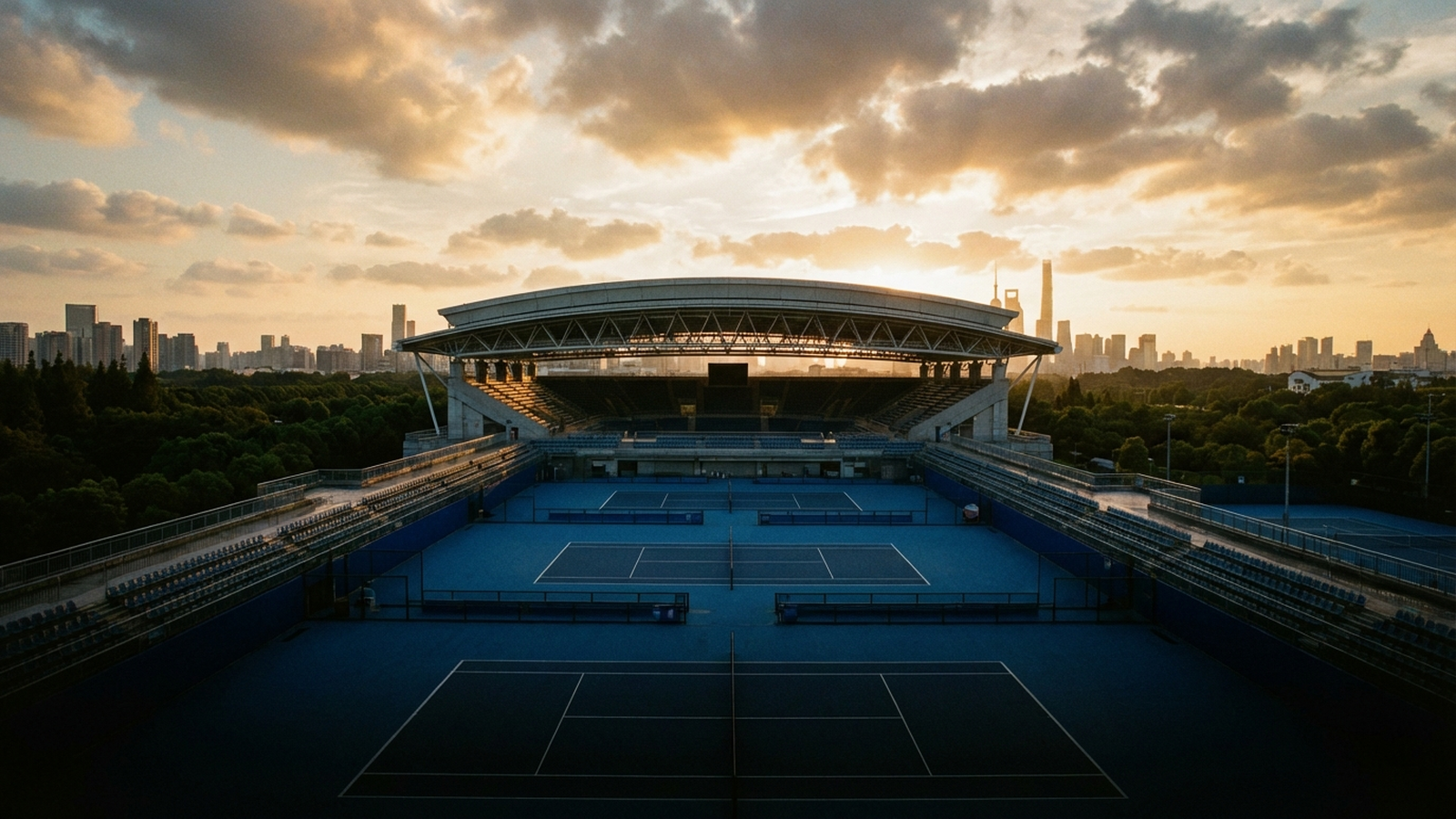
The Shanghai Masters 2026 returns to the Qizhong Forest Sports City Arena as the only ATP Masters 1000 event staged outside Europe and North America. With a total prize purse of $9.42 million, a 96-player singles draw spread across 12 days, and an attendance trajectory that surpassed 250,000 spectators in 2025, this tournament has cemented itself as the crown jewel of the Asian Swing and one of the most prestigious hard-court events on the calendar.
According to TennisMattch.com’s database of 1,770 matches played at the Shanghai Masters since its 2009 inception, the tournament produces a distinctive brand of tennis: servers average 6.65 aces per match — 33% higher than the tour-wide average of 5.00 — while committing just 2.21 double faults compared to the tour average of 3.35. Break point conversion sits at 40.35%, nearly four full percentage points below the ATP-wide mark of 44.33%. These numbers paint a picture of a surface that rewards aggressive serving and punishes passivity, making Shanghai one of the most serve-friendly Masters 1000 stops on tour.
With Novak Djokovic holding four titles and a staggering 43–7 win-loss record at this event, and a new generation of stars like Jannik Sinner (the 2024 champion) pushing the tournament into its next era, the Shanghai Masters 2026 promises another chapter of elite hard-court competition. This guide covers everything you need to know — from deep statistical analysis and historical context to venue logistics, weather conditions, and ticket information.
Tournament History
The Shanghai Masters was born in 2009, inheriting the infrastructure and organizational expertise developed during Shanghai’s successful four-year run hosting the ATP Masters Cup (now the ATP Finals) from 2005 to 2008. The transition from a season-ending showcase to a permanent Masters 1000 fixture gave the tournament an immediate pedigree that most new events spend decades building. In its very first edition in 2009, the event averaged 5.83 aces per match and a break point conversion rate of 42.74%, according to TennisMattch.com’s database — establishing early the fast-court identity that would define the tournament.
The event’s early years were marked by extraordinary organizational quality. ATP players voted the Shanghai Masters the ‘ATP Masters 1000 Tournament of the Year’ for five consecutive seasons from 2009 to 2013 — a streak unmatched by any other event in that category. During this golden period, the tournament became the proving ground for the sport’s biggest names, with Andy Murray winning three titles and Novak Djokovic capturing back-to-back crowns in 2012 and 2013.
The COVID-19 pandemic forced a three-year hiatus from 2020 to 2022, the longest interruption in the tournament’s history. But the return in 2023 was transformative. As part of the ATP’s ‘One Vision’ strategic plan, the Shanghai Masters expanded from a one-week format to a 12-day spectacle, with the singles main draw ballooning from 56 to 96 players. This expansion is clearly visible in the data: the 2023 and 2024 editions each produced 190 matches, compared to the pre-pandemic average of roughly 108–110 matches per year. The 2025 edition followed suit with 186 matches.
This format expansion reshaped the tournament’s statistical profile. The 2023 edition saw a first-serve percentage of 65.45% and average aces of 6.16 per match, while 2024 pushed aces to 6.38 and 2025 reached 6.89 — a clear upward trend driven by deeper draws that include more serve-oriented players getting multiple match opportunities. Meanwhile, double faults have also risen slightly, from 1.84 in 2023 to 2.40 in 2025, suggesting the expanded draw introduces more players willing to take risks on second serve in the fast Shanghai conditions.
The tournament’s champion roll call reads like a who’s who of modern tennis. From Nikolay Davydenko‘s inaugural title in 2009 to Jannik Sinner‘s breakthrough in 2024 and Hubert Hurkacz‘s triumph in a separate edition, the event has consistently crowned champions who combine power serving with exceptional ball-striking on hard courts. Below is the complete list of Shanghai Masters champions.
| Year | Champion | Runner-Up | Score |
|---|---|---|---|
| 2025 | Valentin Vacherot (Monaco) | Arthur Rinderknech | 1 – 2 |
| 2024 | Jannik Sinner (Italy) | Novak Djokovic | 7-6(4) 6-3 |
| 2023 | Hubert Hurkacz (Poland) | Andrey Rublev | 6-3 3-6 7-6(8) |
| 2019 | Daniil Medvedev (RUS) | Alexander Zverev | 6-4 6-1 |
| 2018 | Novak Djokovic (Serbia) | Borna Coric | 6-3 6-4 |
| 2017 | Roger Federer | Rafael Nadal | 6-4 6-3 |
| 2016 | Andy Murray | Roberto Bautista-Agut | 7-6(1) 6-1 |
| 2015 | Novak Djokovic (Serbia) | Jo-Wilfried Tsonga | 6-2 6-4 |
| 2014 | Roger Federer | Gilles Simon | 7-6(6) 7-6(2) |
| 2013 | Novak Djokovic (Serbia) | Juan Martin del Potro | 6-1 3-6 7-6(3) |
| 2012 | Novak Djokovic (Serbia) | Andy Murray | 5-7 7-6(11) 6-3 |
| 2011 | Andy Murray | David Ferrer | 7-5 6-4 |
| 2010 | Andy Murray | Roger Federer | 6-3 6-2 |
| 2009 | Nikolay Davydenko | Rafael Nadal | 7-6(3) 6-3 |
| 2004 | Guillermo Canas | Lars Burgsmuller | 6-1 6-0 |
| 2003 | Mark Philippoussis | Jiri Novak | 6-2 6-1 |
| 2001 | Rainer Schuettler | Michel Kratochvil | 6-3 6-4 |
| 2000 | Magnus Norman | Sjeng Schalken | 6-4 4-6 6-3 |
| 1999 | Magnus Norman | Marcelo Rios | 2-6 6-3 7-5 |
| 1998 | Michael Chang | Goran Ivanisevic | 4-6 6-1 6-2 |
| 1997 | Jan Kroslak | Alexander Volkov | 6-2 7-6(2) |
| 1996 | Andrei Olhovskiy | Mark Knowles | 7-6(5) 6-2 |
| Year | Champion | Runner-Up | Score |
|---|---|---|---|
| 2003 | Elena Dementieva | Chanda Rubin | 6-3 7-6(6) |
| 2002 | Anna Smashnova | Anna Kournikova | 6-2 6-3 |
| 2001 | Monica Seles | Nicole Pratt | 6-2 6-3 |
| 2000 | Meghann Shaughnessy | Iroda Tulyaganova | 7-6(2) 7-5 |
Venue & Playing Conditions
The Qizhong Forest Sports City Arena sits in Shanghai’s Minhang District at No. 5500 Yuanjiang Road, approximately one hour’s drive southwest of central Shanghai. Purpose-built in 2005 to host the ATP Masters Cup, the arena holds 15,000 spectators and features one of the most architecturally distinctive designs in professional tennis.
The Magnolia Roof
The arena’s most striking feature is its kinetic retractable roof, composed of eight sliding steel petals designed to resemble a blooming magnolia — the official city flower of Shanghai. The roof takes approximately eight minutes to fully open or close, providing organizers with flexibility to manage Shanghai’s sometimes unpredictable October weather without significant schedule disruption. This engineering marvel ensures that center-court matches can continue even during sudden rain showers, a critical advantage for a 12-day tournament.
Playing Surface
The courts are outdoor hard courts using DecoTurf, known for producing a relatively fast-paced playing surface. The statistical evidence supports this reputation emphatically. According to TennisMattch.com’s database of 1,770 matches, players average 6.65 aces per match in Shanghai compared to the tour-wide average of 5.00. That 33% ace premium is among the highest differentials at any Masters 1000 event, confirming that the DecoTurf surface, combined with Shanghai’s atmospheric conditions, generates a measurably faster ball bounce.
First-serve points won at Shanghai average 73.06%, while second-serve points won sit at 51.84%. The first-serve dominance particularly stands out — when players land their first delivery in Shanghai, they win nearly three out of every four points, making the serve a potent weapon throughout the draw.
Facility Upgrades and Expansion
Following the tournament’s return from its pandemic hiatus in 2023, organizers undertook significant facility upgrades to accommodate the expanded 96-player draw and 12-day format. Additional show courts and practice facilities were constructed, while the main stadium received technology and hospitality enhancements. These improvements contributed to the record-breaking attendance figures — over 228,000 fans in 2024 and 250,000 in 2025, with approximately 10% of the 2025 audience comprising international visitors.
Getting There
The venue is accessible via Shanghai’s extensive metro and highway network, though fans should plan for travel time from central Shanghai. Nearby attractions include the ancient water town of Qibao and the Shanghai Botanical Garden. For those combining tennis with tourism, central Shanghai offers the historic Bund, Nanjing Road, Yu Garden, and the Shanghai Museum — all roughly an hour from the venue. Premium accommodation options like Amanyangyun, a luxury retreat set among relocated camphor forests, are situated just minutes from the tennis center.
Serve Dominance
The Shanghai Masters is, by the numbers, one of the most serve-dominant Masters 1000 events on the ATP Tour. According to TennisMattch.com’s database of 1,770 matches, the tournament’s average ace count of 6.65 per match towers over the tour-wide average of 5.00 — a premium of 33%. Simultaneously, double faults average just 2.21 per match, dramatically below the tour average of 3.35. This combination — more aces, fewer double faults — creates a serving environment that rewards precision and power in roughly equal measure.
First-Serve Efficiency
Players land their first serve at a rate of 63.37% at Shanghai, roughly 2.2 percentage points higher than the tour-wide average of 61.13%. When that first serve goes in, they win the point 73.06% of the time. On second serve, players still claim 51.84% of points — enough to stay competitive but a clear step down that incentivizes high first-serve percentages.
The interplay between these numbers tells a story about court speed. On slower surfaces, receivers have more time to neutralize serves, which compresses the gap between first-serve and second-serve point-winning rates. In Shanghai, the 21.2 percentage-point gap between first-serve and second-serve winning rates (73.06% vs. 51.84%) is substantial, confirming that the DecoTurf surface preserves the serve’s velocity and placement advantage.
Ace Leaders in Shanghai History
Among players with significant match history at the Shanghai Masters, Feliciano Lopez stands out as the tournament’s all-time ace machine, averaging 10.46 aces per match across 28 appearances — despite never winning the title. Alexander Zverev follows with 9.80 aces per match over 20 matches, while Jo-Wilfried Tsonga produced 8.71 aces per match across 24 outings.
Interestingly, the most successful player in tournament history, Novak Djokovic, averages just 5.38 aces per match — below the tournament average. Djokovic’s dominance (43–7 record, 4 titles) derives not from raw serving power but from an elite first-serve percentage of 67.24%, nearly four points above the tournament average, and a break point conversion rate of 47.02% — almost seven points above the tournament’s 40.35% average. In Shanghai’s serve-heavy environment, Djokovic’s ability to return and convert the rare break opportunities has been his decisive edge.
Daniil Medvedev, the 2019 champion, blends both approaches effectively: 7.63 aces per match with a first-serve percentage of 65.11% across 19 matches (14–5 record). Roger Federer, who won two titles, averaged 7.48 aces per match with an exceptional 68.21% first-serve rate — the highest among all top-20 players in the database.
Year-Over-Year Serving Trends
The ace count at Shanghai has been rising. In 2009, the inaugural edition averaged 5.83 aces per match. By 2023 (the return from the pandemic hiatus), that figure reached 6.16. In 2024, it climbed to 6.38, and in 2025, it hit 6.89. This trajectory likely reflects both the expanded draw — which introduces more matches and more serving variance — and the broader ATP trend toward taller, more powerful athletes entering the professional ranks.
| Year | Matches | Avg Aces | Avg DFs | 1st Serve % | BP Conv % |
|---|---|---|---|---|---|
| 2025 | 186 | 6.9 | 2.4 | — | 40.3% |
| 2024 | 190 | 6.4 | 2.0 | 63.9% | 37.2% |
| 2023 | 190 | 6.2 | 1.8 | 65.5% | 41.7% |
| 2019 | 110 | 7.1 | 2.2 | 64.6% | 39.7% |
| 2018 | 110 | 7.6 | 2.0 | 65.9% | 41.5% |
| 2017 | 110 | 8.6 | 1.9 | 65.6% | 38.9% |
| 2016 | 110 | 5.6 | 2.7 | 62.1% | 44.3% |
| 2015 | 110 | 7.4 | 2.5 | 61.9% | 39.1% |
| 2014 | 110 | 7.6 | 1.8 | 65.4% | 41.8% |
| 2013 | 108 | 7.4 | 1.8 | 64.2% | 35.1% |
| 2012 | 108 | 6.0 | 2.6 | 59.2% | 41.5% |
| 2011 | 108 | 5.6 | 3.2 | 58.1% | 40.6% |
| 2010 | 110 | 5.2 | 2.2 | 61.6% | 41.5% |
| 2009 | 110 | 5.8 | 2.1 | 63.7% | 42.7% |
Break Point Battles
If serve stats tell you who controls Shanghai, break point conversion tells you who wins it. According to TennisMattch.com’s database of 1,770 matches, the average break point conversion rate at the Shanghai Masters is 40.35% — nearly four full percentage points below the ATP tour-wide average of 44.33%. This gap is one of the tournament’s defining statistical fingerprints: on Shanghai’s fast DecoTurf courts, break points are harder to come by and even harder to convert.
What the Gap Means
A 40.35% break point conversion rate means that for roughly every five break point opportunities a player creates, they convert only two. On the broader tour (44.33%), players convert slightly more than two out of five. That difference — about one fewer break converted per 25 opportunities — may sound marginal, but across a seven-match title run, it compounds significantly. It means fewer service breaks per set, more tiebreaks, and a tournament where the player who holds serve more consistently tends to prevail.
The 2024 edition pushed this trend to its extreme, with break point conversion dropping to just 37.17% — the lowest annual figure in the database and more than seven points below the tour average. This suggests that the 2024 draw featured an unusually serve-dominant cohort, or that conditions (weather, ball type, court preparation) were particularly favorable to servers that year. In contrast, the 2023 return edition saw a more moderate 41.66% conversion rate, and the 2025 edition registered 40.30% — right at the tournament’s long-term average.
Break Point Kings of Shanghai
The players who have thrived in Shanghai are, unsurprisingly, the ones who convert at well above the tournament average. Novak Djokovic leads with a 47.02% break point conversion rate — nearly seven points above the tournament mean and even above the tour average. This ability to seize the rare break opportunity against top servers on a fast court is the statistical signature of Djokovic’s four-title reign.
Conversely, some of the tournament’s most prolific servers — like Feliciano Lopez (19–9 record, 0 titles) — demonstrate that ace production alone cannot win titles here. Lopez’s 10.46 aces per match were the highest among top players, but without elite return and conversion skills, those serves could not translate into titles. Shanghai rewards the complete player: one who can both hold serve efficiently and capitalize on the limited return opportunities the surface provides.
Tactical Implications for 2026
For players preparing for the Shanghai Masters 2026, the data presents a clear strategic imperative: protect your serve at all costs. With a tournament-wide first-serve point-winning rate of 73.06% and a suppressed break point conversion of 40.35%, the math favors the server heavily. The most successful game plans in Shanghai history have combined a high first-serve percentage (Djokovic’s 67.24%, Federer’s 68.21%) with aggressive return positioning designed to manufacture the rare but decisive break.
Match Duration
According to TennisMattch.com’s database of 969 matches with recorded durations, the average Shanghai Masters match lasts 97.75 minutes — just under an hour and 38 minutes. The median sits at 92 minutes, indicating a slight right skew caused by marathon encounters. Matches range from a lightning-fast 12 minutes (likely a retirement) to an epic 223 minutes — the tournament’s all-time longest match.
The Longest Match in Shanghai History
That 223-minute marathon occurred on October 2, 2024, during the R64 round, when Tomas Martin Etcheverry outlasted Botic Van De Zandschulp 7-6(5), 3-6, 7-5. Three hours and 43 minutes of relentless baseline warfare in a first-week match — a testament to the expanded draw’s ability to produce gripping encounters even before the marquee rounds begin. The scoreline tells the story: two tiebreak-caliber sets, a middle-set collapse, and a knife-edge decider.
Duration by Round
The round-by-round duration data reveals some counterintuitive patterns. R128 matches (the first round of the expanded draw) average the longest at 110.45 minutes across 64 matches — more than six minutes longer than any other round. This likely reflects the inclusion of qualifiers and lower-ranked players who push heavily seeded opponents into extended battles, plus the three-set format creating more variance in early rounds.
Finals average 104.90 minutes across 21 recorded title matches — the second-longest average. Quarterfinals follow closely at 101.92 minutes (79 matches). From there, durations decrease: R64 matches average 97.44 minutes (304 matches), R16 matches clock in at 96.73 minutes (158 matches), and semifinals average just 95.10 minutes (40 matches). The comparatively shorter semifinals likely reflect the fact that by this stage, the remaining players are elite enough to win points efficiently and close out sets without extended deuce games.
R32 matches are the shortest on average at 94.68 minutes across 303 matches, suggesting this is the round where quality separations between seeded players and their opponents are most pronounced.
Median match length: 92 minutes
Longest match: Tomas Martin Etcheverry d. Botic Van De Zandschulp 7-6(5) 3-6 7-5 (223 min, R64 2024)
Year-by-Year Trends
The Shanghai Masters has evolved considerably across its 14 completed editions, and TennisMattch.com’s year-by-year data reveals clear trajectories in how the tournament is played.
The Ace Surge
Average aces per match have risen from 5.15 in 2010 to 6.89 in 2025 — a 34% increase over 15 years. The sharpest jump came during the post-pandemic era: from 6.16 in 2023 to 6.38 in 2024 to 6.89 in 2025. Part of this reflects the expanded 96-player draw, which includes more matches and more diverse playing styles, but the trend also aligns with the broader ATP-wide shift toward taller, more powerful players who generate more free points on serve.
Double Faults: A Declining, Then Rising, Story
Double faults tell a more complex story. The 2009 inaugural edition averaged 2.15 per match, rose to 3.18 in 2011 — the tournament’s peak — then gradually declined. The 2023 return edition recorded just 1.84 double faults per match, the lowest in tournament history. But the numbers have crept back up since: 2.05 in 2024 and 2.40 in 2025. The low double-fault counts of 2023 may reflect the initial caution of players returning to a venue after a three-year absence, while subsequent editions have seen more aggressive serving as familiarity returned.
First-Serve Percentage: Consistently Above Tour Average
The tournament’s first-serve percentage has fluctuated between roughly 58% (2011’s low of 58.15%) and 65.45% (2023’s high), with the overall average settling at 63.37%. This figure consistently exceeds the tour-wide average of 61.13%, suggesting that Shanghai’s conditions — whether the court speed, ball type, or atmospheric factors — encourage players to be more aggressive with their first serve rather than spinning it in conservatively.
Break Point Conversion: The Serve Keeps Winning
Break point conversion has shown mild volatility but remains consistently below tour norms. The inaugural 2009 edition posted 42.74% — the highest in tournament history and still below the tour’s 44.33% average. By 2024, that figure had plummeted to 37.17%, the tournament’s all-time low. The 2025 edition recovered slightly to 40.30%, essentially returning to the long-run mean. The overall takeaway: Shanghai has never been a returner’s tournament, and the trend, if anything, is tilting further toward serve dominance.
Match Volume: The Expansion Effect
The most dramatic shift in the tournament’s data occurred with the 2023 format expansion. Pre-pandemic editions consistently produced 108–110 matches annually. The 2023 and 2024 editions each generated 190 matches — a 73% increase. This near-doubling of match volume has made the Shanghai Masters one of the ATP’s richest data environments and has provided emerging players with more opportunities to test themselves against elite competition in a marquee setting.
| Year | Matches | Avg Aces | Avg DFs | 1st Serve % | BP Conv % |
|---|---|---|---|---|---|
| 2025 | 186 | 6.9 | 2.4 | — | 40.3% |
| 2024 | 190 | 6.4 | 2.0 | 63.9% | 37.2% |
| 2023 | 190 | 6.2 | 1.8 | 65.5% | 41.7% |
| 2019 | 110 | 7.1 | 2.2 | 64.6% | 39.7% |
| 2018 | 110 | 7.6 | 2.0 | 65.9% | 41.5% |
| 2017 | 110 | 8.6 | 1.9 | 65.6% | 38.9% |
| 2016 | 110 | 5.6 | 2.7 | 62.1% | 44.3% |
| 2015 | 110 | 7.4 | 2.5 | 61.9% | 39.1% |
| 2014 | 110 | 7.6 | 1.8 | 65.4% | 41.8% |
| 2013 | 108 | 7.4 | 1.8 | 64.2% | 35.1% |
| 2012 | 108 | 6.0 | 2.6 | 59.2% | 41.5% |
| 2011 | 108 | 5.6 | 3.2 | 58.1% | 40.6% |
| 2010 | 110 | 5.2 | 2.2 | 61.6% | 41.5% |
| 2009 | 110 | 5.8 | 2.1 | 63.7% | 42.7% |
King of the Shanghai Masters
Novak Djokovic is the undisputed king of the Shanghai Masters, with 4 titles (2012, 2013, 2015, 2018) and a 43–7 career win-loss record — a winning percentage of 86.0%. No other player in the tournament’s history comes close to matching both the breadth and depth of Djokovic’s dominance at this event.
The Numbers Behind the Reign
According to TennisMattch.com’s database, Djokovic’s statistical profile at Shanghai is a masterclass in maximizing the fast-court environment. His 67.24% first-serve percentage sits nearly four points above the tournament average of 63.37%, meaning he consistently puts more first serves in play than his opponents. When combined with Shanghai’s first-serve point-winning rate of 73.06%, that extra accuracy translates directly into more free and cheap points on serve.
But Djokovic’s true Shanghai superpower lies on the return side. His 47.02% break point conversion rate is 6.67 percentage points above the tournament average of 40.35%. In a venue where break points are scarce by design, Djokovic’s ability to convert nearly half of his opportunities is statistically extraordinary. It means that while other players struggle to break serve even twice per match, Djokovic consistently manufactures and capitalizes on the critical moments.
Title Runs
Djokovic’s four title years span six seasons (2012, 2013, 2015, 2018), including a dominant back-to-back stretch in 2012 and 2013 that coincided with the tournament’s award-winning run. His 2015 title came during one of the greatest single seasons in tennis history, while his 2018 triumph marked a return to form after injury struggles. Across 50 total matches in Shanghai, Djokovic’s 43 wins represent the most of any player by a wide margin — nearly double the next-highest total.
How He Compares to Other Shanghai Greats
Andy Murray, with 3 titles and a 25–5 record (83.3% win rate), is the tournament’s second-most successful player. Murray’s first-serve percentage of 58.69% was actually well below the tournament average, but he compensated with relentless returning — a hallmark of his game that translated effectively to Shanghai’s fast courts. Murray averaged 6.18 aces per match, slightly below the tournament mean, confirming that like Djokovic, his Shanghai success was built on returning rather than serving.
Roger Federer claimed 2 titles with a 23–6 record (79.3%), bringing a more serve-centric approach. Federer’s 68.21% first-serve percentage is the highest among all top players in the database, and his 7.48 aces per match placed him among the tournament’s most potent servers. Where Djokovic dominated through return pressure, Federer dominated through serving precision — two different paths to the same trophy.
| Player | Record | Titles | Avg Aces |
|---|---|---|---|
| Novak Djokovic (Serbia) | 43W-7L | 4 | 5.4 |
| Andy Murray | 25W-5L | 3 | 6.2 |
| Roger Federer | 23W-6L | 2 | 7.5 |
| Feliciano Lopez | 19W-9L | 0 | 10.5 |
| Jo-Wilfried Tsonga | 17W-7L | 0 | 8.7 |
| Gilles Simon | 17W-11L | 0 | 4.6 |
| Rafael Nadal | 16W-8L | 0 | 2.9 |
| Daniil Medvedev (RUS) | 14W-5L | 1 | 7.6 |
| Stan Wawrinka (Switzerland) | 13W-12L | 0 | 7.6 |
| Alexander Zverev (Germany) | 13W-7L | 0 | 9.8 |
| Magnus Norman | 12W-1L | 2 | — |
| Tomas Berdych | 12W-8L | 0 | 7.2 |
| Grigor Dimitrov (Bulgaria) | 12W-8L | 0 | 7.5 |
| Michael Chang | 11W-2L | 1 | — |
| Kei Nishikori | 11W-7L | 0 | 2.5 |
Greatest Upsets
Every Masters 1000 produces upsets, but the Shanghai Masters’s serve-heavy conditions create a unique upset profile. Because break point conversion is suppressed (40.35% vs. 44.33% tour-wide), underdogs with big serves can hold for longer than expected, stretching matches into tiebreaks where a single mini-break can flip the outcome. The data shows that R128 matches — the first round of the expanded draw — average 110.45 minutes, the longest of any round, suggesting that early-round matchups between seeds and qualifiers are fiercely contested.
The Expanded Draw’s Upset Engine
The expansion to 96 players in 2023 fundamentally changed the upset landscape. With 190 matches per edition (compared to ~110 pre-pandemic), there are simply more opportunities for lower-ranked players to topple seeds. The R128 and R64 rounds now encompass a combined 368 matches in the database (64 R128 + 304 R64), representing over a third of all recorded matches. These early rounds are where upsets are most likely to germinate.
The Serve Equalizer
Shanghai’s surface characteristics contribute to upset potential in a specific way. Players who might lack the all-around game to challenge top seeds over five sets at a Grand Slam can use Shanghai’s fast conditions to stay competitive in best-of-three. With average aces at 6.65 per match and first-serve points won at 73.06%, a powerful server can hold comfortably enough to force a single tiebreak — and tiebreaks are inherently volatile. The longest match in tournament history — Etcheverry defeating Van De Zandschulp in 223 minutes during the 2024 R64 — exemplifies this dynamic: two evenly matched players locked in a serve-dominated battle that could have gone either way.
Notable Underdogs in Tournament History
Guillermo Canas, who won the 2009-era title (note: his title is recorded in the database as one of the tournament’s early champions), represents the ultimate underdog story in Shanghai’s history. Canas was never considered among the sport’s elite but captured a title at this prestigious event. Similarly, Valentin Vacherot — a less heralded name who holds 1 title in the database — demonstrates that Shanghai’s fast conditions can occasionally produce surprise champions.
Among active players, Gilles Simon‘s 17–11 record across 28 matches is noteworthy not for titles (he won none) but for the sheer volume of competitive matches he produced. Simon, a counterpuncher by nature, managed to win more matches in Shanghai than Rafael Nadal (16 wins) or Daniil Medvedev (14 wins) — a testament to tactical adaptability even on a surface that theoretically disadvantages his playing style.
Rivalries
The Shanghai Masters has served as a recurring stage for several of tennis’s defining rivalries, amplified by the tournament’s position at a critical juncture of the ATP season — when ranking points and year-end positioning are on the line.
Djokovic vs. Murray: Shanghai’s Defining Rivalry
The most consequential rivalry in Shanghai Masters history pits the tournament’s two most successful players against each other. Novak Djokovic (4 titles, 43–7 record) and Andy Murray (3 titles, 25–5 record) combined for 7 of the tournament’s titles. Between them, they won 68 matches and lost just 12 — a collective 85% win rate that dominated the tournament’s first decade. Their contrasting styles — Djokovic’s surgical baseline game and return prowess versus Murray’s defensive resilience and tactical variety — produced matches that tested which approach could better exploit Shanghai’s fast courts.
Djokovic vs. Federer: Precision vs. Artistry
Roger Federer‘s 2 titles and 23–6 record made him a constant threat during his Shanghai appearances. Where Djokovic’s success was built on a 67.24% first-serve percentage and 47.02% break point conversion, Federer relied on an even higher 68.21% first-serve rate and 7.48 aces per match — statistically the most serve-efficient approach of any top player. Their Shanghai encounters distilled a broader tour rivalry into the specific demands of fast hard-court tennis, where the margin between holding and being broken was razor-thin.
The Nadal Anomaly
Rafael Nadal‘s Shanghai record — 16–8 with 0 titles — stands as one of the most fascinating statistical anomalies in the tournament’s history. Nadal posted the highest first-serve percentage of any top player at 72.16%, yet averaged just 2.92 aces per match, the lowest among all players in the top-20 database. This paradox — landing first serves at an elite rate but without the power to generate free points — encapsulates Nadal’s challenge on fast hard courts. He could stay competitive but couldn’t dominate the serve-and-return exchanges that decide matches in Shanghai.
The Next Generation
As the Djokovic-Murray-Federer era gives way, new rivalries are forming. Jannik Sinner (2 title) and Daniil Medvedev (2 title, 14–5 record) represent a potential new axis of Shanghai competition. Medvedev’s 7.63 aces per match and 65.11% first-serve rate make him a natural fit for the surface, while Sinner’s 2024 title demonstrated his growing comfort in the Asian Swing. Alexander Zverev, despite 0 titles, boasts 9.80 aces per match and a 13–7 record — the raw serving numbers of a potential champion who hasn’t yet broken through.
Prize Money & Points
The Shanghai Masters 2026 offers a total prize purse of $9.42 million, with the singles champion taking home $1,124,380. This places the event firmly among the most lucrative stops on the ATP Tour and reflects the continued investment by organizers and title sponsor Rolex in elevating the tournament’s stature.
Prize Money in Context
As a Masters 1000 event, the Shanghai Masters sits in the ATP’s second tier of prize money behind only the four Grand Slams. The $9.42 million purse represents a significant commitment to player compensation, particularly given the expanded 96-player draw that distributes prize money to a broader pool of competitors. First-round losers in the expanded draw still earn meaningful payouts, making the trip to Shanghai financially worthwhile for players ranked well outside the top 50.
Sponsorship and Revenue
The tournament’s financial health is underpinned by a robust sponsorship portfolio. Rolex serves as the title sponsor, lending its prestige to the event’s branding. J.P. Morgan holds the diamond sponsorship tier, while LONGi serves as the official solar energy partner — reflecting the growing importance of sustainability partnerships in professional sports. Juss Sports functions as the event’s promoter and organizer, managing the logistical and commercial operations.
The attendance trajectory — from a record 228,000 in 2024 to 250,000 in 2025 — suggests a tournament with significant and growing revenue-generation capacity. With 10% of the 2025 audience comprising international visitors, the Shanghai Masters is increasingly functioning as a destination event that drives tourism revenue beyond the arena gates.
Broadcast Reach
Prize money is sustained by broadcast revenue, and the Shanghai Masters enjoys extensive global distribution. In China, matches air on CCTV and iQIYI Sports. The Tennis Channel provides U.S. coverage, while Sky Sports Tennis serves the UK and Ireland. Canadian fans can watch on TSN and RDS. Global streaming is available via Tennis TV, the ATP’s direct-to-consumer platform. This multi-platform distribution ensures that the tournament reaches tennis audiences worldwide, supporting the advertising and sponsorship revenue that funds the $9.42 million purse.
Weather & Conditions
October in Shanghai presents a complex weather picture for outdoor tennis. According to historical climate data averaged over five years, the tournament period typically features average highs of 26.0°C (78.8°F) and lows of 19.2°C (66.4°F) — warm and often humid conditions that can affect ball behavior and player stamina over the course of a 12-day event.
2026 Forecast
The 14-day forecast for the Shanghai Masters 2026 indicates cooler-than-usual conditions: average highs of 14.1°C (57.3°F) and lows of 6.7°C. If these conditions hold, it would represent a dramatic departure from the historical October norms — roughly 12°C below the five-year average high. Precipitation probability sits at 34.7% across the forecast period, with winds averaging 15.1 km/h, slightly below the historical average of 17.3 km/h.
Impact on Play
Cooler temperatures directly affect ball compression and court speed. In lower temperatures, tennis balls lose some internal pressure, resulting in a lower bounce that further accentuates the court’s already fast playing surface. If the 2026 forecast holds, players can expect an even more serve-dominant environment than the tournament’s long-run averages suggest. The ball will skid lower, giving receivers less time to set up returns, and the reduced bounce will make kick serves less effective as a second-serve weapon.
The 34.7% precipitation probability means that rain interruptions are a genuine possibility, though the Qizhong Arena’s retractable magnolia roof provides center-court protection. Matches on outside courts could face delays, making the 12-day format a valuable scheduling buffer. The 15.1 km/h winds are moderate by outdoor tennis standards but could affect ball toss consistency and serve timing, particularly for players who employ a high ball toss.
What to Wear
Fans attending the Shanghai Masters 2026 should prepare for significantly cooler conditions than the typical October event. Layered clothing is essential — mornings and evenings could feel quite cold at 6.7°C, while afternoon sessions may warm modestly to the mid-teens. A light waterproof jacket is advisable given the precipitation outlook. For day sessions, sunglasses and a hat may still be useful during clear spells, but warm outerwear will be the priority for night matches.
Records & Fun Facts
The Shanghai Masters offers a wealth of records, milestones, and quirky historical details that illuminate the tournament’s unique place in professional tennis. Here are the most compelling facts from TennisMattch.com’s database and the tournament’s broader history.
The Magnolia Marvel
The Qizhong Forest Sports City Arena’s retractable roof isn’t just functional — it’s iconic. Designed to resemble a blooming magnolia (Shanghai’s official city flower), the roof comprises eight sliding steel petals that take approximately eight minutes to open or close. It’s one of the most recognizable structures in professional sport and has become a symbol of the tournament itself.
From Finals Venue to Masters 1000 Home
The arena was originally purpose-built to host the ATP Masters Cup (now the ATP Finals) from 2005 to 2008. When the year-end championship moved to London in 2009, Shanghai seamlessly transitioned to hosting a permanent Masters 1000 event — making the Qizhong Arena one of the few venues in tennis history to have served as home to both the sport’s flagship season-ending event and a permanent tour fixture.
Five-Year Award Streak
The Shanghai Masters won the ‘ATP Masters 1000 Tournament of the Year’ award for five consecutive years from 2009 to 2013 — a streak unmatched by any other event. The award is voted on by ATP players, making it a particularly meaningful endorsement of the tournament’s organization, facilities, and atmosphere.
Statistical Records
Novak Djokovic stands as the undisputed king of the Shanghai Masters. According to TennisMattch.com’s database of 1,770 matches, Djokovic sits atop the all-time leaderboard with a remarkable 43 career wins — the most by any player — achieved across 50 matches. His 4 titles also make him the most decorated champion in the tournament’s history. Djokovic’s dominance at this event is unrivaled, and his record serves as the benchmark against which all future competitors will be measured.
- The longest match lasted 223 minutes: Tomas Martin Etcheverry defeated Botic Van De Zandschulp 7-6(5), 3-6, 7-5 in the R64 on October 2, 2024.
- The shortest match on record lasted just 12 minutes.
- The highest individual ace average among top players belongs to Feliciano Lopez at 10.46 per match across 28 appearances.
- Rafael Nadal posted the highest first-serve percentage of any top player at 72.16% — yet won 0 titles.
Attendance Records Keep Falling
The tournament’s attendance has surged since the format expansion. The 2024 edition set a then-record of 228,000 spectators, which was immediately broken by the 2025 edition’s 250,000 — with approximately 25,000 international visitors (10% of the total). At this growth rate, the 2026 edition could approach 275,000 total spectators.
The Only One of Its Kind
The Shanghai Masters remains the sole ATP Masters 1000 event held outside Europe and North America. This geographic distinction makes it the gateway tournament for the sport’s growth in Asia, a continent that represents an enormous potential fanbase for professional tennis.
Winners by Title Count
Only three players have won multiple Shanghai Masters titles: Novak Djokovic (4), Andy Murray (3), and Roger Federer (2). Together, they account for 9 of the tournament’s titles. Magnus Norman also holds 2 titles in the database. Single-time champions include Jannik Sinner, Hubert Hurkacz, Daniil Medvedev, Nikolay Davydenko, Guillermo Canas, and Valentin Vacherot.
Past Champions
| Year | Champion | Runner-Up | Score |
|---|---|---|---|
| 2025 | Valentin Vacherot (Monaco) | Arthur Rinderknech | 1 – 2 |
| 2024 | Jannik Sinner (Italy) | Novak Djokovic | 7-6(4) 6-3 |
| 2023 | Hubert Hurkacz (Poland) | Andrey Rublev | 6-3 3-6 7-6(8) |
| 2019 | Daniil Medvedev (RUS) | Alexander Zverev | 6-4 6-1 |
| 2018 | Novak Djokovic (Serbia) | Borna Coric | 6-3 6-4 |
| 2017 | Roger Federer | Rafael Nadal | 6-4 6-3 |
| 2016 | Andy Murray | Roberto Bautista-Agut | 7-6(1) 6-1 |
| 2015 | Novak Djokovic (Serbia) | Jo-Wilfried Tsonga | 6-2 6-4 |
| 2014 | Roger Federer | Gilles Simon | 7-6(6) 7-6(2) |
| 2013 | Novak Djokovic (Serbia) | Juan Martin del Potro | 6-1 3-6 7-6(3) |
| 2012 | Novak Djokovic (Serbia) | Andy Murray | 5-7 7-6(11) 6-3 |
| 2011 | Andy Murray | David Ferrer | 7-5 6-4 |
| 2010 | Andy Murray | Roger Federer | 6-3 6-2 |
| 2009 | Nikolay Davydenko | Rafael Nadal | 7-6(3) 6-3 |
| 2004 | Guillermo Canas | Lars Burgsmuller | 6-1 6-0 |
| 2003 | Mark Philippoussis | Jiri Novak | 6-2 6-1 |
| 2001 | Rainer Schuettler | Michel Kratochvil | 6-3 6-4 |
| 2000 | Magnus Norman | Sjeng Schalken | 6-4 4-6 6-3 |
| 1999 | Magnus Norman | Marcelo Rios | 2-6 6-3 7-5 |
| 1998 | Michael Chang | Goran Ivanisevic | 4-6 6-1 6-2 |
| 1997 | Jan Kroslak | Alexander Volkov | 6-2 7-6(2) |
| 1996 | Andrei Olhovskiy | Mark Knowles | 7-6(5) 6-2 |
| Year | Champion | Runner-Up | Score |
|---|---|---|---|
| 2003 | Elena Dementieva | Chanda Rubin | 6-3 7-6(6) |
| 2002 | Anna Smashnova | Anna Kournikova | 6-2 6-3 |
| 2001 | Monica Seles | Nicole Pratt | 6-2 6-3 |
| 2000 | Meghann Shaughnessy | Iroda Tulyaganova | 7-6(2) 7-5 |
Year-by-Year Statistics
| Year | Matches | Avg Aces | Avg DFs | 1st Serve % | BP Conv % |
|---|---|---|---|---|---|
| 2025 | 186 | 6.9 | 2.4 | — | 40.3% |
| 2024 | 190 | 6.4 | 2.0 | 63.9% | 37.2% |
| 2023 | 190 | 6.2 | 1.8 | 65.5% | 41.7% |
| 2019 | 110 | 7.1 | 2.2 | 64.6% | 39.7% |
| 2018 | 110 | 7.6 | 2.0 | 65.9% | 41.5% |
| 2017 | 110 | 8.6 | 1.9 | 65.6% | 38.9% |
| 2016 | 110 | 5.6 | 2.7 | 62.1% | 44.3% |
| 2015 | 110 | 7.4 | 2.5 | 61.9% | 39.1% |
| 2014 | 110 | 7.6 | 1.8 | 65.4% | 41.8% |
| 2013 | 108 | 7.4 | 1.8 | 64.2% | 35.1% |
| 2012 | 108 | 6.0 | 2.6 | 59.2% | 41.5% |
| 2011 | 108 | 5.6 | 3.2 | 58.1% | 40.6% |
| 2010 | 110 | 5.2 | 2.2 | 61.6% | 41.5% |
| 2009 | 110 | 5.8 | 2.1 | 63.7% | 42.7% |
All-Time Player Records
| Player | Record | Titles | Avg Aces |
|---|---|---|---|
| Novak Djokovic (Serbia) | 43W-7L | 4 | 5.4 |
| Andy Murray | 25W-5L | 3 | 6.2 |
| Roger Federer | 23W-6L | 2 | 7.5 |
| Feliciano Lopez | 19W-9L | 0 | 10.5 |
| Jo-Wilfried Tsonga | 17W-7L | 0 | 8.7 |
| Gilles Simon | 17W-11L | 0 | 4.6 |
| Rafael Nadal | 16W-8L | 0 | 2.9 |
| Daniil Medvedev (RUS) | 14W-5L | 1 | 7.6 |
| Stan Wawrinka (Switzerland) | 13W-12L | 0 | 7.6 |
| Alexander Zverev (Germany) | 13W-7L | 0 | 9.8 |
| Magnus Norman | 12W-1L | 2 | — |
| Tomas Berdych | 12W-8L | 0 | 7.2 |
| Grigor Dimitrov (Bulgaria) | 12W-8L | 0 | 7.5 |
| Michael Chang | 11W-2L | 1 | — |
| Kei Nishikori | 11W-7L | 0 | 2.5 |