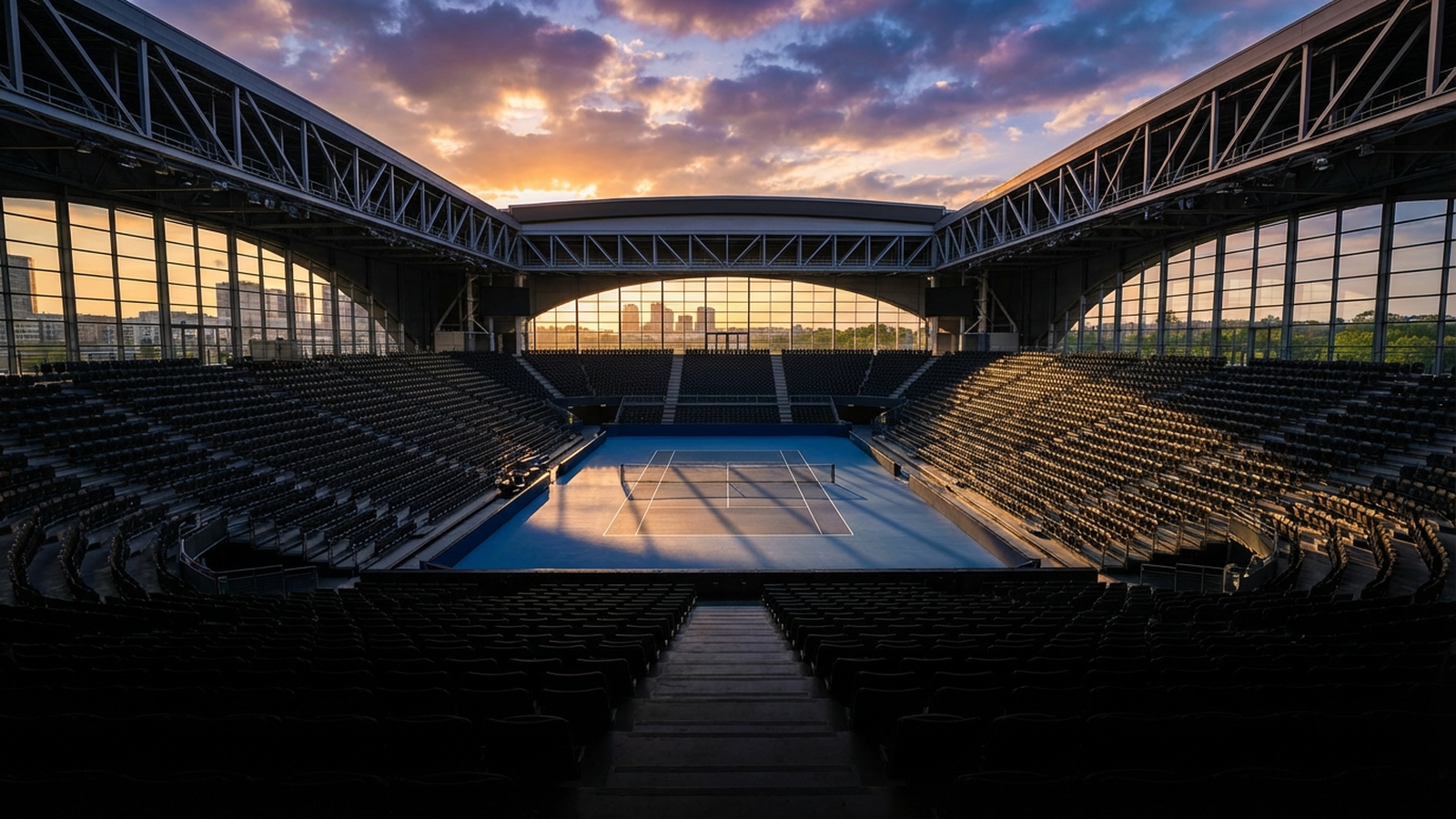
The Rolex Paris Masters is the final curtain call of the ATP regular season — a high-stakes, indoor hard-court showdown that has determined year-end rankings, ATP Finals berths, and legacies since 1968. According to TennisMattch.com’s database of 1,654 matches, this tournament produces a unique statistical fingerprint: players average 7.03 aces per match, a full 41% higher than the tour-wide average of 5.00, while committing just 2.66 double faults compared to the tour norm of 3.35. The fast indoor surface rewards precision serving and aggressive shot-making, making Paris one of the most server-friendly events on the calendar.
The Paris Masters 2026 returns to the Paris La Défense Arena in Nanterre for just its second year at Europe’s largest indoor venue, a seismic upgrade from the beloved but aging Accor Arena in Bercy. With $7.15 million in total prize money on the line and the race to the ATP Finals reaching its climax, every match carries outsized significance. Novak Djokovic, the tournament’s all-time king with 7 titles and a staggering 51–10 win-loss record, may be chasing history once more — but a hungry generation of challengers is eager to etch their names on the iconic Fanti Tree trophy.
This comprehensive guide draws on nearly six decades of match data, historical context, and practical information to prepare you for the 2026 edition. Whether you’re planning a trip to Nanterre, building your fantasy bracket, or simply want to understand what makes this tournament tick, you’ll find everything you need below — backed by numbers, not narratives.
Tournament History
The Paris Masters traces its lineage to 1968, when it debuted as the Open de Paris, an evolution of the older French Covered Court Championships. In those early years, the tournament was staged at the intimate Stade Pierre de Coubertin in the 16th arrondissement, a venue steeped in Olympic history but modest in scale. The event was a gathering place for the game’s elite during the nascent years of the Open Era, with American Brian Gottfried emerging as one of its earliest dominant figures, accumulating 2 titles and a remarkable 25–5 win-loss record, per TennisMattch.com’s database. Another early powerhouse, Stan Smith, compiled 1 title and a 23–7 record, his crafty serve-and-volley game tailor-made for the fast indoor surface.
The tournament underwent its most transformative change in 1986, relocating to the Palais Omnisports de Paris-Bercy (later renamed Accor Arena) in the 12th arrondissement. The move was more than geographic — it signaled the event’s ambition to become the premier indoor tennis spectacle in the world. The cavernous Bercy arena, with its capacity of approximately 15,000, became a cathedral for indoor tennis. Its steep seating bowl amplified crowd noise, creating an atmosphere that players frequently ranked among the most electric on tour.
The Bercy Golden Age
The late 1980s and 1990s were a golden age. Boris Becker, the German serve-and-volley maestro, claimed 3 titles and posted a 29–8 record in Paris, making the indoor hard court his personal playground. His compatriot in indoor dominance, Pete Sampras, captured 2 titles with a 24–8 mark, while Andre Agassi also won 2 titles, adding a baseline counterpoint to the big-serving ethos of the era. One of the tournament’s most legendary finals came in 1991, when hometown hero Guy Forget outlasted Sampras in a five-set thriller lasting 223 minutes — still the longest match in tournament history, with a scoreline of 7-6(9) 4-6 5-7 6-4 6-4.
The turn of the millennium introduced a new brand of dominance. Marat Safin, the explosive Russian, won 3 titles and compiled a 25–5 record, his thunderous serve averaging an astonishing 15.33 aces per match — more than double the tournament average. Safin’s Paris record remains one of the most statistically imposing in the event’s history, a testament to how brutally effective a big serve can be under the Parisian roof.
Sponsorship and Branding Evolution
The tournament has carried several title sponsors throughout its history, with BNP Paribas serving as the marquee partner until 2016. In 2017, Rolex assumed naming rights, rebranding the event as the Rolex Paris Masters, a moniker that has added a layer of prestige befitting the event’s ATP Masters 1000 status. The tournament sits in the highest tier of non-Grand Slam events, alongside Indian Wells, Miami, Monte Carlo, Madrid, Rome, Canada, Cincinnati, and Shanghai.
The Move to La Défense
In 2025, the Rolex Paris Masters made its second historic venue change, relocating from Bercy to the Paris La Défense Arena in Nanterre, just west of central Paris. Europe’s largest indoor arena, with a capacity of 16,500 for tennis, welcomed over 220,000 spectators across the tournament fortnight — a new attendance record. The move was driven by a desire for modernized facilities, enhanced fan experience, and the ability to accommodate the growing commercial scale of a Masters 1000 event. For the 2026 edition, the arena enters its second year as the tournament’s home, with infrastructure and logistics expected to be even more refined.
ATP Champions
| Year | Champion | Runner-Up | Score |
|---|---|---|---|
| 2024 | Alexander Zverev (Germany) | Ugo Humbert | 6-2 6-2 |
| 2023 | Novak Djokovic (Serbia) | Grigor Dimitrov | 6-4 6-3 |
| 2022 | Holger Rune (Denmark) | Novak Djokovic | 3-6 6-3 7-5 |
| 2021 | Novak Djokovic (Serbia) | Daniil Medvedev | 4-6 6-3 6-3 |
| 2020 | Daniil Medvedev (RUS) | Alexander Zverev | 5-7 6-4 6-1 |
| 2019 | Novak Djokovic (Serbia) | Denis Shapovalov | 6-3 6-4 |
| 2018 | Karen Khachanov (RUS) | Novak Djokovic | 7-5 6-4 |
| 2017 | Jack Sock | Filip Krajinovic | 5-7 6-4 6-1 |
| 2016 | Andy Murray | John Isner | 6-3 6-7(4) 6-4 |
| 2015 | Novak Djokovic (Serbia) | Andy Murray | 6-2 6-4 |
| 2014 | Novak Djokovic (Serbia) | Milos Raonic | 6-2 6-3 |
| 2013 | Novak Djokovic (Serbia) | David Ferrer | 7-5 7-5 |
| 2012 | David Ferrer | Jerzy Janowicz | 6-4 6-3 |
| 2011 | Roger Federer | Jo-Wilfried Tsonga | 6-1 7-6(3) |
| 2010 | Robin Soderling | Gael Monfils | 6-1 7-6(1) |
| 2009 | Novak Djokovic (Serbia) | Gael Monfils | 6-2 5-7 7-6(3) |
| 2008 | Jo-Wilfried Tsonga | David Nalbandian | 6-3 4-6 6-4 |
| 2007 | David Nalbandian | Rafael Nadal | 6-4 6-0 |
| 2006 | Nikolay Davydenko | Dominik Hrbaty | 6-1 6-2 6-2 |
| 2005 | Tomas Berdych | Ivan Ljubicic | 6-3 6-4 3-6 4-6 6-4 |
| 2004 | Marat Safin | Radek Stepanek | 6-3 7-6(5) 6-3 |
| 2003 | Tim Henman | Andrei Pavel | 6-2 7-6(6) 7-6(2) |
| 2002 | Marat Safin | Lleyton Hewitt | 7-6(4) 6-0 6-4 |
| 2001 | Sebastien Grosjean | Yevgeny Kafelnikov | 7-6(3) 6-1 6-7(5) 6-4 |
| 2000 | Marat Safin | Mark Philippoussis | 3-6 7-6(7) 6-4 3-6 7-6(8) |
| 1999 | Andre Agassi | Marat Safin | 7-6(1) 6-2 4-6 6-4 |
| 1998 | Greg Rusedski | Pete Sampras | 6-4 7-6(4) 6-3 |
| 1997 | Pete Sampras | Jonas Bjorkman | 6-3 4-6 6-3 6-1 |
| 1996 | Thomas Enqvist | Yevgeny Kafelnikov | 6-2 6-4 7-5 |
| 1995 | Pete Sampras | Boris Becker | 7-6(5) 6-4 6-4 |
| 1994 | Andre Agassi | Marc Rosset | 6-3 6-3 4-6 7-5 |
| 1993 | Goran Ivanisevic | Andrei Medvedev | 6-4 6-2 7-6(2) |
| 1992 | Boris Becker | Guy Forget | 7-6(3) 6-3 3-6 6-3 |
| 1991 | Guy Forget | Pete Sampras | 7-6(9) 4-6 5-7 6-4 6-4 |
| 1990 | Stefan Edberg | Boris Becker | 3-3 RET |
| 1989 | Boris Becker | Stefan Edberg | 6-4 6-3 6-3 |
| 1988 | Amos Mansdorf | Brad Gilbert | 6-3 6-2 6-3 |
| 1987 | Tim Mayotte | Brad Gilbert | 2-6 6-3 7-5 6-7 6-3 |
| 1986 | Boris Becker | Sergio Casal | 6-4 6-3 7-6 |
| 1982 | Wojtek Fibak | Bill Scanlon | 6-2 6-2 6-2 |
| 1981 | Mark Vines | Pascal Portes | 6-2 6-4 6-3 |
| 1980 | Brian Gottfried | Adriano Panatta | 4-6 6-3 6-1 7-6 |
| 1979 | Harold Solomon | Corrado Barazzutti | 6-3 2-6 6-3 6-4 |
| 1978 | Bob Lutz | Tom Gullikson | 6-2 6-2 7-6 |
| 1977 | Corrado Barazzutti | Brian Gottfried | 7-6 7-6 6-7 3-6 6-4 |
| 1976 | Eddie Dibbs | Jaime Fillol | 5-7 6-4 6-4 7-6 |
| 1975 | Tom Okker | Arthur Ashe | 6-3 2-6 6-3 3-6 6-4 |
| 1974 | Brian Gottfried | Eddie Dibbs | 6-3 5-7 8-6 6-0 |
| 1973 | Ilie Nastase | Stan Smith | 4-6 6-1 3-6 6-0 6-2 |
| 1972 | Stan Smith | Andres Gimeno | 6-2 6-2 7-5 |
Venue & Playing Conditions
The Paris La Défense Arena, located at 99 Jardins de l’Arche, 92000 Nanterre, France, is one of the most technologically advanced event venues in the world. Originally opened in 2017 and designed by architect Christian de Portzamparc, the multi-purpose arena features a distinctive curved roof and modular interior that can be reconfigured for concerts, sporting events, and exhibitions. For tennis, the venue seats 16,500 spectators, a meaningful upgrade from the approximately 15,000 capacity at Bercy.
Surface and Playing Conditions
The Paris Masters is played on indoor hard court, using the Dunlop ATP Type 2 ball. The indoor setting eliminates wind and sun as variables, creating a controlled environment where court speed and ball behavior are highly consistent. According to TennisMattch.com’s database of 1,654 matches, this surface strongly favors servers: players average 7.03 aces per match, compared to a tour-wide average of just 5.00. The first serve winning percentage of 74.29% further underscores how dominant the serve becomes under these conditions — each rally shortened, each service game fortified.
The indoor environment also means the ball stays low and fast, with minimal friction from weather or altitude. This creates a premium on flat serves, aggressive return positioning, and the ability to dictate play from the first shot. Baseliners who thrive on high-bouncing topspin often struggle here compared to their clay-court fortresses.
Getting There
Despite the relocation from central Paris to Nanterre, the Paris La Défense Arena remains highly accessible. Metro Line 1 and RER A both serve the La Défense–Grande Arche station, providing direct connections from the heart of the city. The journey from Charles de Gaulle Airport takes approximately 50 minutes via RER B and a transfer, while Orly Airport connects via the Orlyval shuttle and Metro.
Nearby Attractions and Accommodation
The La Défense business district offers a surprisingly vibrant visitor experience. The Grande Arche de la Défense, a monumental civic structure framing the historic Parisian axis from the Arc de Triomphe, is steps from the arena. The Westfield Les 4 Temps shopping center provides dining and retail options. Hotel choices near the venue include the Pullman Paris La Défense, citizenM Paris La Défense, and Renaissance Paris La Défense, all within walking distance. Central Paris, with its museums, restaurants, and landmarks, remains easily reachable — the Champs-Élysées is just a 10-minute Metro ride away.
The arena’s designation as the only ATP Masters 1000 tournament played entirely indoors gives it a singular identity on the tour calendar. No weather delays, no wind interruptions — just pure, fast-court tennis under the lights.
Serve Dominance
If any tournament on the ATP calendar can be called a server’s paradise, it is the Rolex Paris Masters. According to TennisMattch.com’s database of 1,654 matches, players average 7.03 aces per match in Paris, a figure that towers 40.6% above the tour-wide average of 5.00. This isn’t a marginal edge — it represents a fundamental shift in how points play out under the indoor roof.
First Serve Dominance
The first serve is a weapon everywhere on tour, but in Paris it borders on a trump card. Players win 74.29% of first-serve points, a figure that reflects the low, skidding bounce of the indoor hard court and the absence of wind to knock serves off their intended trajectory. When a player finds the first serve consistently — and the average first-serve percentage in Paris is 60.65%, nearly identical to the tour average of 61.13% — they create a virtually unassailable service game.
The second serve, however, tells a more nuanced story. Players win 51.15% of second-serve points, a number that underscores the risk-reward calculus of this surface. A tentative second serve on indoor hard court is an invitation for the returner to step in and attack. The best performers in Paris tend to be those who maintain aggression on the second delivery, refusing to simply spin it in and hope for the best.
Double Faults: A Surprisingly Clean Picture
Despite the temptation to go big on every serve, Paris produces remarkably few double faults. The tournament average is just 2.66 per match, significantly lower than the tour-wide average of 3.35. This 20.6% reduction suggests that the controlled indoor environment actually helps servers maintain consistency — there’s no swirling wind to deflect the ball, no sun glare to disrupt the toss. The result is cleaner service execution across the board.
Individual Server Profiles
The player records illuminate how differently elite players exploit these conditions. Marat Safin, with his explosive service motion, averaged a staggering 15.33 aces per match during his Paris campaigns — more than double the tournament average and triple the tour average. Jo-Wilfried Tsonga, the French fan favorite, averaged 11.76 aces, while Roger Federer delivered 8.42 aces per match with his famously precise placement.
Interestingly, the tournament’s most successful player, Novak Djokovic, averaged just 5.13 aces per match — below the tournament average. His Paris dominance came not from overwhelming power but from an elite first-serve percentage of 63.87%, the highest among top players with significant match samples. Djokovic’s Paris formula demonstrates that on indoor hard courts, serve consistency can be just as devastating as serve speed.
Tomas Berdych, another prolific Paris competitor with a 27–11 record, averaged 7.52 aces per match but posted a first-serve percentage of just 57.41% — the lowest among the top performers. His high-risk, high-reward approach yielded one title but also contributed to his 11 losses. Meanwhile, Grigor Dimitrov, despite never winning the title (24–12 record, 0 titles), averaged 7.50 aces and a 61.95% first-serve rate, suggesting his Paris performances have been strong but perhaps lacking the clutch edge needed in the deepest rounds.
| Player | Record | Titles | Avg Aces |
|---|---|---|---|
| Novak Djokovic (Serbia) | 51W-10L | 7 | 5.1 |
| Boris Becker | 29W-8L | 3 | — |
| Tomas Berdych | 27W-11L | 1 | 7.5 |
| Brian Gottfried | 25W-5L | 2 | — |
| Marat Safin | 25W-5L | 3 | 15.3 |
| Pete Sampras | 24W-8L | 2 | — |
| Roger Federer | 24W-12L | 1 | 8.4 |
| Grigor Dimitrov (Bulgaria) | 24W-12L | 0 | 7.5 |
| Stan Smith | 23W-7L | 1 | — |
| Jo-Wilfried Tsonga | 22W-12L | 1 | 11.8 |
| Andy Murray | 22W-12L | 1 | 7.9 |
| Rafael Nadal | 22W-9L | 0 | 4.8 |
| David Ferrer | 21W-12L | 1 | 2.5 |
| Guy Forget | 20W-10L | 1 | — |
| Arthur Ashe | 19W-3L | 2 | — |
Break Point Battles
Breaking serve in Paris is harder than almost anywhere else on tour — and the numbers prove it. According to TennisMattch.com’s database, the average break point conversion rate at the Paris Masters is just 41.24%, a full 3.09 percentage points below the tour-wide average of 44.33%. That gap may sound modest, but in practical terms it means returners convert roughly 1 fewer break point out of every 14 opportunities — enough to flip the outcome of tight sets and matches.
Why Breaks Are Harder Indoors
The fast indoor surface compresses reaction time for returners. Without wind or sun to disrupt the server’s rhythm, delivery after delivery arrives with metronomic precision. The low bounce minimizes the returner’s ability to generate heavy topspin angles that might pull the server out of position. And when the server does face a break point, the ability to hit an unreturnable first serve under controlled conditions provides a reliable escape valve.
The 2010 edition provides a dramatic illustration. That year’s tournament recorded an average break point conversion rate of just 33.78%, more than 10 percentage points below the tour average. This was also a year with exceptionally high ace counts — 8.64 aces per match — suggesting the ball was playing particularly fast and low, creating a near-impossible environment for returners. By contrast, the 2023 edition saw a conversion rate of 43.76%, closer to tour norms, potentially reflecting the increasing return capabilities of the current generation.
The Djokovic Return Machine
No player has broken the Paris serve code more effectively than Novak Djokovic. His break point conversion rate at the tournament stands at 43.25%, a full two percentage points above the tournament average. Given Djokovic’s well-documented return prowess — his ability to neutralize big first serves and punish second serves — this figure is consistent with his broader career profile. But it takes on special significance in Paris, where every break of serve carries outsized importance. Across his 51 wins and 10 losses, Djokovic’s capacity to convert the rare break opportunity has been the decisive factor in many of his 7 title runs.
Year-Over-Year Trends
The break point data reveals interesting evolution over time. In the 2008 edition, the conversion rate was 42.11%. By 2010, it had plummeted to 33.78%, before recovering to 41.55% in 2009 and stabilizing in the low-to-mid 40s in recent years: 43.77% in 2022, 43.76% in 2023, and 42.25% in 2024. This gradual increase may reflect improvements in return technology, player fitness, and tactical sophistication, but the conversion rate remains stubbornly below tour averages — a testament to the enduring advantage servers hold under the Parisian roof.
Match Duration
The Rolex Paris Masters moves quickly. According to TennisMattch.com’s database of 1,559 matches with recorded durations, the average match lasts 98.23 minutes, with a median of just 92 minutes. The fast indoor surface, the dominance of the serve, and the best-of-three format combine to create a tournament that rarely drags — a stark contrast to the marathon baseline rallies of the clay-court swing.
The Extremes
The shortest match in tournament history lasted a mere 19 minutes, almost certainly a retirement or walkover situation that nonetheless lives in the record books as a testament to the sport’s unpredictability. At the other end of the spectrum sits the longest match ever played in Paris: 223 minutes, the epic 1991 final in which France’s Guy Forget defeated Pete Sampras 7-6(9) 4-6 5-7 6-4 6-4. That match, played across five grueling sets in front of a delirious home crowd, remains one of the most celebrated moments in French tennis history. The first-set tiebreak alone, decided at 11-9, was a rollercoaster that set the tone for nearly four hours of drama.
Duration by Round
Match length scales predictably with round depth, as higher-quality opponents produce closer contests:
Finals average 125.53 minutes across 34 recorded matches — roughly half an hour longer than a typical early-round encounter. Semifinals come in at 108.42 minutes (64 matches), reflecting the reality that only the best remain by this stage and margins shrink accordingly. Quarterfinals average 101.32 minutes (128 matches), while the Round of 16 (96.53 minutes, 257 matches) and Round of 32 (97.76 minutes, 508 matches) cluster closely together. Early first-round matches (Round of 64) average 95.95 minutes across 568 matches, the quickest average in the tournament — often featuring mismatches between seeded players and qualifiers or wild cards.
Median match length: 92 minutes
Longest match: Guy Forget d. Pete Sampras 7-6(9) 4-6 5-7 6-4 6-4 (223 min, F 1991)
What This Means for Spectators
For fans planning their day at the Paris La Défense Arena, these numbers are a practical guide. A day session featuring two early-round matches will typically run approximately 3 to 3.5 hours including changeovers and warm-ups. A night session headlined by a quarterfinal or semifinal might stretch past the 2-hour mark for the feature match alone. Finals day should be planned for a minimum of 2.5 hours of match time, with the possibility of exceeding 3 hours if the match goes the distance. Bring a warm layer — the arena’s air conditioning keeps temperatures comfortable but not tropical during late October and early November.
Year-by-Year Trends
Across nearly two decades of granular data, the Rolex Paris Masters reveals subtle but meaningful statistical shifts. According to TennisMattch.com’s annual trends data, the tournament’s character has evolved in ways that reflect broader changes in the sport — from equipment technology to player physicality to tactical philosophy.
Aces: Fluctuation, Not Decline
The ace count has fluctuated significantly rather than following a clean trend line. In 2009, players averaged 8.31 aces per match; in 2010, the figure climbed to 8.64. But by 2022, it had dropped to just 5.91, before rebounding to 7.09 in 2023 and reaching 7.78 in 2024. The 2022 dip is notable — that year’s ace average fell below the tour-wide average, an extreme rarity for this traditionally serve-dominant event. The subsequent recovery in 2023 and 2024 suggests the dip may have been a one-year anomaly rather than a structural shift, potentially influenced by the specific player composition in the draw.
Double Faults: Getting Cleaner
The double-fault trend tells a cleaner story. In 2009, players averaged 2.14 double faults per match — already low. The figure increased somewhat to 2.90 in 2010, then settled into a narrow band: 2.37 in 2022, 2.60 in 2023, and 2.83 in 2024. Despite some year-to-year variation, the tournament consistently produces fewer double faults than the tour average of 3.35, reinforcing the narrative that indoor conditions enable cleaner serving.
First-Serve Percentage: Remarkably Stable
Perhaps the most striking trend is the stability of first-serve percentage. The tournament average across all years is 60.65%, and individual years rarely deviate more than a few points: 63.21% in 2009, 59.60% in 2010, 63.17% in 2022, 62.58% in 2023, and 60.13% in 2024. This consistency, hovering just below the tour average of 61.13%, suggests that while the Paris surface amplifies the effectiveness of the serve, it doesn’t necessarily change how often players find their first delivery. The advantage comes from what happens after the serve lands, not from landing it more often.
Break Point Conversion: A Gradual Recovery
The break point conversion rate has shown the most dramatic movement. The 2010 edition’s 33.78% marked a nadir — a tournament where servers were nearly untouchable. Over the next decade, conversion rates steadily climbed: 43.77% in 2022, 43.76% in 2023, and 42.25% in 2024. This roughly 10-percentage-point increase from the 2010 low reflects the rise of a generation of elite returners and the general improvement in athletic capabilities that has made the return game more competitive, even on fast indoor surfaces.
| Year | Matches | Avg Aces | Avg DFs | 1st Serve % | BP Conv % |
|---|---|---|---|---|---|
| 2024 | 110 | 7.8 | 2.8 | 60.1% | 42.3% |
| 2023 | 106 | 7.1 | 2.6 | 62.6% | 43.8% |
| 2022 | 110 | 5.9 | 2.4 | 63.2% | 43.8% |
| 2021 | 108 | 6.4 | 2.9 | 61.7% | 43.3% |
| 2020 | 108 | 7.2 | 2.3 | 62.2% | 40.3% |
| 2019 | 92 | 7.3 | 2.1 | 63.7% | 46.7% |
| 2018 | 90 | 6.5 | 3.0 | 59.3% | 40.1% |
| 2017 | 92 | 7.5 | 3.3 | 60.0% | 43.2% |
| 2016 | 92 | 7.6 | 2.9 | 59.4% | 42.0% |
| 2015 | 94 | 6.5 | 2.4 | 59.1% | 39.9% |
| 2014 | 94 | 6.6 | 2.8 | 60.0% | 42.3% |
| 2013 | 94 | 7.2 | 3.2 | 59.8% | 33.5% |
| 2012 | 92 | 6.7 | 2.4 | 58.6% | 41.1% |
| 2011 | 92 | 5.6 | 2.7 | 57.8% | 40.4% |
| 2010 | 94 | 8.6 | 2.9 | 59.6% | 33.8% |
| 2009 | 94 | 8.3 | 2.1 | 63.2% | 41.5% |
| 2008 | 92 | 6.9 | 2.4 | 59.6% | 42.1% |
Match Count Growth
The tournament has also grown in scale. Earlier editions in the database featured around 92–94 matches (2008–2010), while recent editions have expanded to 106–110 matches (2022–2024). This growth reflects the expansion of the draw and qualifying rounds, adding more competitive matches and increasing the tournament’s overall footprint on the calendar.
King of the Paris Masters
Novak Djokovic has won 7 Paris Masters titles — more than any other player in the tournament’s history and more than double the next-best total. His reign spans 14 years, from his first title in 2009 to his most recent in 2023, with additional triumphs in 2013, 2014, 2015, 2019, and 2021. According to TennisMattch.com’s database, Djokovic’s Paris record stands at a stunning 51 wins and 10 losses, an 83.6% winning percentage across 61 total matches.
The Statistical Portrait
What makes Djokovic’s dominance remarkable is how he achieves it. Unlike the big-serving champions who historically thrived in Paris — Safin with his 15.33 aces per match, Becker with his booming serve-and-volley game — Djokovic averages just 5.13 aces per match, below the tournament average of 7.03. His weapon is not the serve itself but what he does with it: a first-serve percentage of 63.87%, the highest among top performers, means he consistently puts the ball in play and starts rallies on his terms.
On the return side, Djokovic’s break point conversion rate of 43.25% exceeds the tournament average of 41.24% by two full percentage points. In a tournament where breaks of serve are precious, this edge has been the difference between winning and losing in countless tight sets. His ability to read serves under the roof, neutralize pace, and turn defense into attack makes him the most complete indoor hard-court player of his generation — perhaps of any generation.
Historical Context
The players closest to Djokovic in the Paris title count are Boris Becker and Marat Safin, each with 3 titles. Andre Agassi, Pete Sampras, and Brian Gottfried follow with 2 titles apiece. Among more recent champions, Alexander Zverev, Holger Rune, Daniil Medvedev, and Karen Khachanov have each captured 7 title. The gap between Djokovic’s 7 and the rest of the field is a chasm that may never be bridged.
Decade of Dominance
Consider the arithmetic of Djokovic’s reign: from 2009 to 2023, a span of 15 tournament editions (excluding the cancelled 2020 event), Djokovic won the title in 7 of them — nearly half. His three-peat from 2013 to 2015 was a feat of sustained indoor excellence, and his ability to reclaim the title in 2019, 2021, and 2023 after gaps demonstrated his capacity to return to peak form at this specific event year after year.
Becker’s 29–8 record (78.4% winning percentage) from an earlier era is impressive, as is Safin’s 25–5 mark (83.3%). But neither compiled the volume of success that Djokovic has. Brian Gottfried’s 25–5 record from the tournament’s early days deserves recognition, as does Sampras’s 24–8 mark, but the modern tournament — with deeper draws, more competitive fields, and higher stakes — makes Djokovic’s numbers all the more imposing.
Heading into the Paris Masters 2026, the question is whether Djokovic, now in the twilight of his career, can add an extraordinary 8th title to his Paris collection. Regardless of what happens, his status as the undisputed King of Paris is etched permanently into the branches of the Fanti Tree.
Greatest Upsets
The Paris Masters, for all its reputation as a venue where the best players tend to prevail, has produced its share of seismic upsets. The indoor hard court, while generally favoring top seeds, also creates conditions where a hot server or fearless returner can shock the establishment in a best-of-three format where one bad service game can mean the end.
Karen Khachanov’s 2018 Breakthrough
Perhaps no Paris upset in recent memory was more dramatic than Karen Khachanov‘s run to the 2018 title. The Russian, ranked outside the top 10 at the time, stormed through the draw and captured his first and only Masters 1000 crown. Khachanov’s powerful game — built on a booming serve and heavy groundstrokes — was perfectly suited to the indoor conditions, and his run demonstrated how the fast surface can elevate a confident ball-striker past more decorated opponents.
Holger Rune’s 2022 Sensation
Holger Rune‘s 2022 Paris title was another seismic moment. The teenage Dane, still establishing himself on tour, blazed through the field to claim his first Masters 1000 title. According to TennisMattch.com’s database, the 2022 tournament saw an average first-serve percentage of 63.17% and a relatively high break point conversion rate of 43.77%, conditions that rewarded Rune’s aggressive return game and fearless shot-making. His victory signaled a generational shift and put the tennis world on notice that the Next Gen had truly arrived.
The Upset-Prone Early Rounds
Historically, the Round of 64 and Round of 32 are where most upsets occur — and the numbers support this. With average match durations of 95.95 minutes (R64) and 97.76 minutes (R32), these rounds feature marginally shorter matches, suggesting that when upsets happen, they often happen decisively. A hot-serving underdog can take an early set, seize momentum, and close out a match before the higher-ranked player can adjust.
The broader database also reveals that players outside the traditional elite can accumulate strong Paris records. Grigor Dimitrov, for example, has posted a 24–12 record at the tournament without ever winning the title — the most wins by a non-champion among the top 20 performers. His consistency suggests he is a perennial threat in Paris without quite having the sustained firepower to claim the trophy, making him both a near-upset artist and a frequent upset target in the later rounds.
Why Paris Produces Occasional Shocks
The best-of-three format is the great equalizer. Unlike Grand Slams, where a top player can survive a bad set and regroup over five sets, the Masters 1000 format means one bad half-hour can end a campaign. Combine this with the fact that Paris sits at the end of a long season — when fatigue, minor injuries, and mental burnout accumulate — and you have a recipe for the occasional stunning result. The data shows break point conversion has gradually increased over time (from 33.78% in 2010 to 42.25% in 2024), suggesting that returners are getting better at seizing their chances, which inherently creates more upset potential.
Rivalries
The Paris Masters has been the stage for some of the ATP’s most compelling rivalries, its indoor hard court serving as a neutral proving ground where contrasting styles collide under the lights.
Djokovic vs. The Field
Any discussion of Paris rivalries must begin and end with Novak Djokovic. With 51 wins and 10 losses, Djokovic’s Paris career reads less like a rivalry and more like a reign. But those 10 losses represent the moments when rivals managed to crack the code. His battles with players like Roger Federer (24 wins, 12 losses in Paris overall for the Swiss) were marquee events that routinely filled the arena to capacity. Federer’s 1 Paris title and 8.42 aces per match represented a more serve-dependent approach, contrasting with Djokovic’s return-oriented dominance. Their Paris encounters were chess matches between two fundamentally different playing philosophies, both elevated by the fast indoor surface.
Becker vs. Sampras: The Indoor Titans
In the 1990s, Boris Becker (3 titles, 29–8) and Pete Sampras (2 titles, 24–8) represented the gold standard of indoor tennis. Both serve-and-volley practitioners, their Paris meetings were battles of nerve at the net, with lightning-fast reactions determining the outcome of crucial points. The 1991 final between Sampras and Guy Forget — that 223-minute epic — robbed us of a potential Becker-Sampras final, but their collective Paris records remain among the most impressive in tournament history.
Safin’s Explosive Interludes
Marat Safin‘s 3 titles and otherworldly 15.33 aces per match made him a uniquely explosive force in Paris rivalries. When Safin was locked in — his toss perfect, his motion fluid, his 6’4″ frame generating maximum leverage — he was essentially unplayable on indoor hard courts. His 25–5 record (83.3% winning percentage) matched Djokovic’s rate over a smaller sample, and his Paris appearances often featured the kind of high-risk, high-reward shotmaking that either overwhelmed opponents or led to spectacular self-destruction.
The Next Generation
Recent editions have introduced new rivalry dynamics. Alexander Zverev (7 title), Daniil Medvedev (7 title), and Holger Rune (7 title) represent a new guard of indoor specialists who are beginning to write their own Paris chapters. With Djokovic’s stranglehold potentially loosening, the 2026 edition could mark the beginning of a new rivalry cycle — with several young players hungry to establish themselves as the next King of Paris.
Tsonga and the Home Crowd
Jo-Wilfried Tsonga‘s Paris record — 1 title, 22 wins, 12 losses, 11.76 aces per match — tells the story of a beloved hometown hero whose big-serving, acrobatic game was perfectly calibrated for the indoor hard court. Tsonga’s matches in Paris were events unto themselves, the crowd’s energy lifting him to performances that transcended his ranking. His rivalries with Djokovic and Federer in Paris were enhanced by the passionate French audience, creating an atmosphere that few other tournaments can match. His retirement has left a void in the Parisian tennis narrative, but the tradition of French players rising to the occasion in front of their home crowd endures.
Prize Money & Points
The Paris Masters 2026 offers a total prize pool of $7.15 million, with the singles champion taking home $990,000. These figures position the Rolex Paris Masters firmly in the upper echelon of Masters 1000 events, reflecting both the tournament’s prestige and its commercial importance as the final regular-season event on the ATP calendar.
Prize Money in Context
The $990,000 winner’s check is more than just a payday — it comes with 1,000 ATP ranking points, the maximum available outside of a Grand Slam. For players on the bubble for the ATP Finals, these points can mean the difference between qualifying for the season-ending championship in Turin and watching from home. The financial and competitive stakes make every match in Paris feel like a knockout round.
Sponsorship Ecosystem
The prize money is supported by a robust sponsorship portfolio. Rolex serves as the title sponsor, lending the event its full name: the Rolex Paris Masters. Additional major sponsors include Emirates, Accor, and Hyundai. These partnerships fund not only the prize pool but also the elaborate production values — including the tournament’s famous theatrical player entrances featuring light tunnels and dramatic sound effects — that distinguish Paris from other indoor events.
Distribution Across Rounds
While specific round-by-round prize money breakdowns for 2026 have not been announced at the time of writing, Masters 1000 events typically distribute prize money on a graduated scale. First-round losers generally receive approximately 1.5–2% of the total pool, with each subsequent round roughly doubling the payout. This structure means even early-round exits are financially meaningful for lower-ranked players, while the exponential growth toward the final incentivizes deep runs.
Historical Growth
The total prize pool has grown significantly over the past decade, reflecting the ATP’s commitment to increasing player compensation across all levels of the tour. The move to the Paris La Défense Arena, with its expanded capacity and commercial potential, has likely contributed to this growth, as higher attendance figures and enhanced sponsorship opportunities translate directly into larger prize pools.
Weather & Conditions
The Rolex Paris Masters is played entirely indoors, making weather a non-factor for match play — but it matters enormously for the hundreds of thousands of fans making their way to and from the Paris La Défense Arena in late October and early November.
What to Expect
Based on historical climate data averaged over the past 5 years, late October and early November in Paris brings average highs of 13.4°C (56.2°F) and average lows of 7.7°C (45.9°F). The 2026 forecast data for the tournament window projects slightly warmer conditions, with average highs of 14.3°C (57.7°F) and lows of 5.9°C (42.6°F). Either way, spectators should prepare for cool autumn weather.
Precipitation and Wind
Rain is a moderate concern for travel but not for play. Historical data shows an average daily precipitation of 2.0 mm, while the 2026 forecast indicates a 21.2% average chance of precipitation across the tournament fortnight. This means that while you’re unlikely to face a washout, light rain or drizzle is entirely possible on any given day. An umbrella or waterproof jacket is a sensible addition to your packing list.
Wind is the more notable factor. Historical averages show wind speeds of 20.2 km/h, while the 2026 forecast projects slightly calmer conditions at 14.9 km/h. The walk from the La Défense–Grande Arche Metro station to the arena traverses the open esplanade of the La Défense business district, which can channel wind between the skyscrapers. Dress in layers.
Packing Recommendations
For spectators attending the Paris Masters 2026, here’s a practical guide:
Essentials: A warm jacket or coat, comfortable walking shoes, and layers that can be removed once inside the climate-controlled arena. Nice to have: A compact umbrella, a scarf for the evening sessions (when temperatures drop further), and a portable phone charger for those long days of tennis. Inside the arena: Temperatures are regulated and comfortable, so you’ll want to be able to shed your outer layer. The arena’s seating can get warm during packed evening sessions, particularly in the upper tiers.
Records & Fun Facts
Every great tournament has its quirks, legends, and unlikely stories. The Rolex Paris Masters, with its 58-year history and database of 1,654 recorded matches, offers a treasure trove of trivia and milestones.
Novak Djokovic: The Undisputed King of Paris
Novak Djokovic stands alone atop the Rolex Paris Masters record books with an astonishing 7 titles and 51 wins — both all-time records at this event. No other player has dominated a single Masters 1000 tournament so thoroughly over such an extended period. Djokovic’s mastery of indoor hard courts, combined with his relentless consistency and tactical brilliance, made him virtually unbeatable during his peak years in Paris. His name appears on 7 branches of the iconic Fanti Tree trophy, more than any other player, a visual testament to a reign that may never be matched. To fully appreciate the scale of his dominance, consider that the next most prolific winners at this tournament — Boris Becker with 29 wins and Tomas Berdych with 27 wins — trail him significantly in both victories and titles.
The Fanti Tree Trophy
The winner’s trophy is unlike any other in tennis. Known as the Fanti Tree, it’s a metal sculpture designed by artist Lucio Fanti featuring stylized branches on which the names of past champions are engraved. As the tournament’s history grows, so does the tree — literally. Each year, a new branch or leaf is added to accommodate the champion’s name, making the trophy a living piece of art that evolves with the tournament. With 50 champions entries across the tournament’s history, the tree has grown into an impressive and intricate work of art.
The Theatrical Entrance
The Paris Masters is famous for its immersive player entrance, featuring a light tunnel, dramatic sound effects, and pulsating music that transforms each match into a theatrical event. Players walk through a corridor of flashing lights and fog before emerging onto the court, a spectacle that has been widely imitated but never equaled. The move to the Paris La Défense Arena in 2025 allowed the production team to expand this experience, leveraging the larger venue’s superior technical infrastructure.
The Longest Match: 223 Minutes of Drama
The longest match in tournament history remains the 1991 final between Guy Forget and Pete Sampras. Forget won 7-6(9) 4-6 5-7 6-4 6-4 in 223 minutes, saving the home crowd’s hearts after going down two sets to one. The first-set tiebreak, decided 11-9, is alone a miniature epic. Forget remains a French tennis icon, and this match is a cornerstone of his legacy.
Safin’s Ace Machine
Marat Safin‘s average of 15.33 aces per match in Paris is the highest among any player with a significant match record at the tournament. To put this in perspective, the tournament’s overall average is 7.03, and the tour-wide average is 5.00. Safin’s indoor game was, statistically speaking, operating on a different plane.
The Only Indoor Masters 1000
The Paris Masters holds a unique distinction as the only ATP Masters 1000 event played entirely indoors. While other tournaments may have retractable roofs (Australian Open, Roland Garros), Paris is specifically designed and scheduled as an indoor event. This gives it a singular character on the tour calendar and explains its distinctive statistical profile — more aces, fewer double faults, and lower break point conversion rates than the tour average.
Attendance Record
The move to the Paris La Défense Arena in 2025 shattered attendance records, with the tournament welcoming over 220,000 spectators across the fortnight. The arena’s capacity of 16,500 for tennis, combined with affordable ticket pricing, created a new benchmark for indoor tennis events worldwide.
The 19-Minute Match
At the other extreme from Forget-Sampras, the shortest match in the tournament database lasted just 19 minutes. While the specific circumstances are lost to the vagaries of record-keeping, this remains one of the briefest competitive matches in any Masters 1000 event — a reminder that not every Paris chapter is an epic.
Dimitrov’s Near-Misses
Grigor Dimitrov holds a fascinating and perhaps frustrating Paris record: 24 wins and 12 losses, with 0 titles. He is the player with the most wins among non-champions in the top 20 all-time performers at this event. His consistent deep runs without a trophy make him the ultimate Paris bridesmaid.
The Federer Paradox
Roger Federer, one of the greatest players in tennis history, won just 1 Paris Masters title despite a 24–12 record and an average of 8.42 aces per match. His singular Paris triumph underscores how difficult it is to win this tournament, even for all-time greats — and makes Djokovic’s 7 titles all the more extraordinary.
Past Champions
ATP Champions
| Year | Champion | Runner-Up | Score |
|---|---|---|---|
| 2024 | Alexander Zverev (Germany) | Ugo Humbert | 6-2 6-2 |
| 2023 | Novak Djokovic (Serbia) | Grigor Dimitrov | 6-4 6-3 |
| 2022 | Holger Rune (Denmark) | Novak Djokovic | 3-6 6-3 7-5 |
| 2021 | Novak Djokovic (Serbia) | Daniil Medvedev | 4-6 6-3 6-3 |
| 2020 | Daniil Medvedev (RUS) | Alexander Zverev | 5-7 6-4 6-1 |
| 2019 | Novak Djokovic (Serbia) | Denis Shapovalov | 6-3 6-4 |
| 2018 | Karen Khachanov (RUS) | Novak Djokovic | 7-5 6-4 |
| 2017 | Jack Sock | Filip Krajinovic | 5-7 6-4 6-1 |
| 2016 | Andy Murray | John Isner | 6-3 6-7(4) 6-4 |
| 2015 | Novak Djokovic (Serbia) | Andy Murray | 6-2 6-4 |
| 2014 | Novak Djokovic (Serbia) | Milos Raonic | 6-2 6-3 |
| 2013 | Novak Djokovic (Serbia) | David Ferrer | 7-5 7-5 |
| 2012 | David Ferrer | Jerzy Janowicz | 6-4 6-3 |
| 2011 | Roger Federer | Jo-Wilfried Tsonga | 6-1 7-6(3) |
| 2010 | Robin Soderling | Gael Monfils | 6-1 7-6(1) |
| 2009 | Novak Djokovic (Serbia) | Gael Monfils | 6-2 5-7 7-6(3) |
| 2008 | Jo-Wilfried Tsonga | David Nalbandian | 6-3 4-6 6-4 |
| 2007 | David Nalbandian | Rafael Nadal | 6-4 6-0 |
| 2006 | Nikolay Davydenko | Dominik Hrbaty | 6-1 6-2 6-2 |
| 2005 | Tomas Berdych | Ivan Ljubicic | 6-3 6-4 3-6 4-6 6-4 |
| 2004 | Marat Safin | Radek Stepanek | 6-3 7-6(5) 6-3 |
| 2003 | Tim Henman | Andrei Pavel | 6-2 7-6(6) 7-6(2) |
| 2002 | Marat Safin | Lleyton Hewitt | 7-6(4) 6-0 6-4 |
| 2001 | Sebastien Grosjean | Yevgeny Kafelnikov | 7-6(3) 6-1 6-7(5) 6-4 |
| 2000 | Marat Safin | Mark Philippoussis | 3-6 7-6(7) 6-4 3-6 7-6(8) |
| 1999 | Andre Agassi | Marat Safin | 7-6(1) 6-2 4-6 6-4 |
| 1998 | Greg Rusedski | Pete Sampras | 6-4 7-6(4) 6-3 |
| 1997 | Pete Sampras | Jonas Bjorkman | 6-3 4-6 6-3 6-1 |
| 1996 | Thomas Enqvist | Yevgeny Kafelnikov | 6-2 6-4 7-5 |
| 1995 | Pete Sampras | Boris Becker | 7-6(5) 6-4 6-4 |
| 1994 | Andre Agassi | Marc Rosset | 6-3 6-3 4-6 7-5 |
| 1993 | Goran Ivanisevic | Andrei Medvedev | 6-4 6-2 7-6(2) |
| 1992 | Boris Becker | Guy Forget | 7-6(3) 6-3 3-6 6-3 |
| 1991 | Guy Forget | Pete Sampras | 7-6(9) 4-6 5-7 6-4 6-4 |
| 1990 | Stefan Edberg | Boris Becker | 3-3 RET |
| 1989 | Boris Becker | Stefan Edberg | 6-4 6-3 6-3 |
| 1988 | Amos Mansdorf | Brad Gilbert | 6-3 6-2 6-3 |
| 1987 | Tim Mayotte | Brad Gilbert | 2-6 6-3 7-5 6-7 6-3 |
| 1986 | Boris Becker | Sergio Casal | 6-4 6-3 7-6 |
| 1982 | Wojtek Fibak | Bill Scanlon | 6-2 6-2 6-2 |
| 1981 | Mark Vines | Pascal Portes | 6-2 6-4 6-3 |
| 1980 | Brian Gottfried | Adriano Panatta | 4-6 6-3 6-1 7-6 |
| 1979 | Harold Solomon | Corrado Barazzutti | 6-3 2-6 6-3 6-4 |
| 1978 | Bob Lutz | Tom Gullikson | 6-2 6-2 7-6 |
| 1977 | Corrado Barazzutti | Brian Gottfried | 7-6 7-6 6-7 3-6 6-4 |
| 1976 | Eddie Dibbs | Jaime Fillol | 5-7 6-4 6-4 7-6 |
| 1975 | Tom Okker | Arthur Ashe | 6-3 2-6 6-3 3-6 6-4 |
| 1974 | Brian Gottfried | Eddie Dibbs | 6-3 5-7 8-6 6-0 |
| 1973 | Ilie Nastase | Stan Smith | 4-6 6-1 3-6 6-0 6-2 |
| 1972 | Stan Smith | Andres Gimeno | 6-2 6-2 7-5 |
Year-by-Year Statistics
| Year | Matches | Avg Aces | Avg DFs | 1st Serve % | BP Conv % |
|---|---|---|---|---|---|
| 2024 | 110 | 7.8 | 2.8 | 60.1% | 42.3% |
| 2023 | 106 | 7.1 | 2.6 | 62.6% | 43.8% |
| 2022 | 110 | 5.9 | 2.4 | 63.2% | 43.8% |
| 2021 | 108 | 6.4 | 2.9 | 61.7% | 43.3% |
| 2020 | 108 | 7.2 | 2.3 | 62.2% | 40.3% |
| 2019 | 92 | 7.3 | 2.1 | 63.7% | 46.7% |
| 2018 | 90 | 6.5 | 3.0 | 59.3% | 40.1% |
| 2017 | 92 | 7.5 | 3.3 | 60.0% | 43.2% |
| 2016 | 92 | 7.6 | 2.9 | 59.4% | 42.0% |
| 2015 | 94 | 6.5 | 2.4 | 59.1% | 39.9% |
| 2014 | 94 | 6.6 | 2.8 | 60.0% | 42.3% |
| 2013 | 94 | 7.2 | 3.2 | 59.8% | 33.5% |
| 2012 | 92 | 6.7 | 2.4 | 58.6% | 41.1% |
| 2011 | 92 | 5.6 | 2.7 | 57.8% | 40.4% |
| 2010 | 94 | 8.6 | 2.9 | 59.6% | 33.8% |
| 2009 | 94 | 8.3 | 2.1 | 63.2% | 41.5% |
| 2008 | 92 | 6.9 | 2.4 | 59.6% | 42.1% |
All-Time Player Records
| Player | Record | Titles | Avg Aces |
|---|---|---|---|
| Novak Djokovic (Serbia) | 51W-10L | 7 | 5.1 |
| Boris Becker | 29W-8L | 3 | — |
| Tomas Berdych | 27W-11L | 1 | 7.5 |
| Brian Gottfried | 25W-5L | 2 | — |
| Marat Safin | 25W-5L | 3 | 15.3 |
| Pete Sampras | 24W-8L | 2 | — |
| Roger Federer | 24W-12L | 1 | 8.4 |
| Grigor Dimitrov (Bulgaria) | 24W-12L | 0 | 7.5 |
| Stan Smith | 23W-7L | 1 | — |
| Jo-Wilfried Tsonga | 22W-12L | 1 | 11.8 |
| Andy Murray | 22W-12L | 1 | 7.9 |
| Rafael Nadal | 22W-9L | 0 | 4.8 |
| David Ferrer | 21W-12L | 1 | 2.5 |
| Guy Forget | 20W-10L | 1 | — |
| Arthur Ashe | 19W-3L | 2 | — |