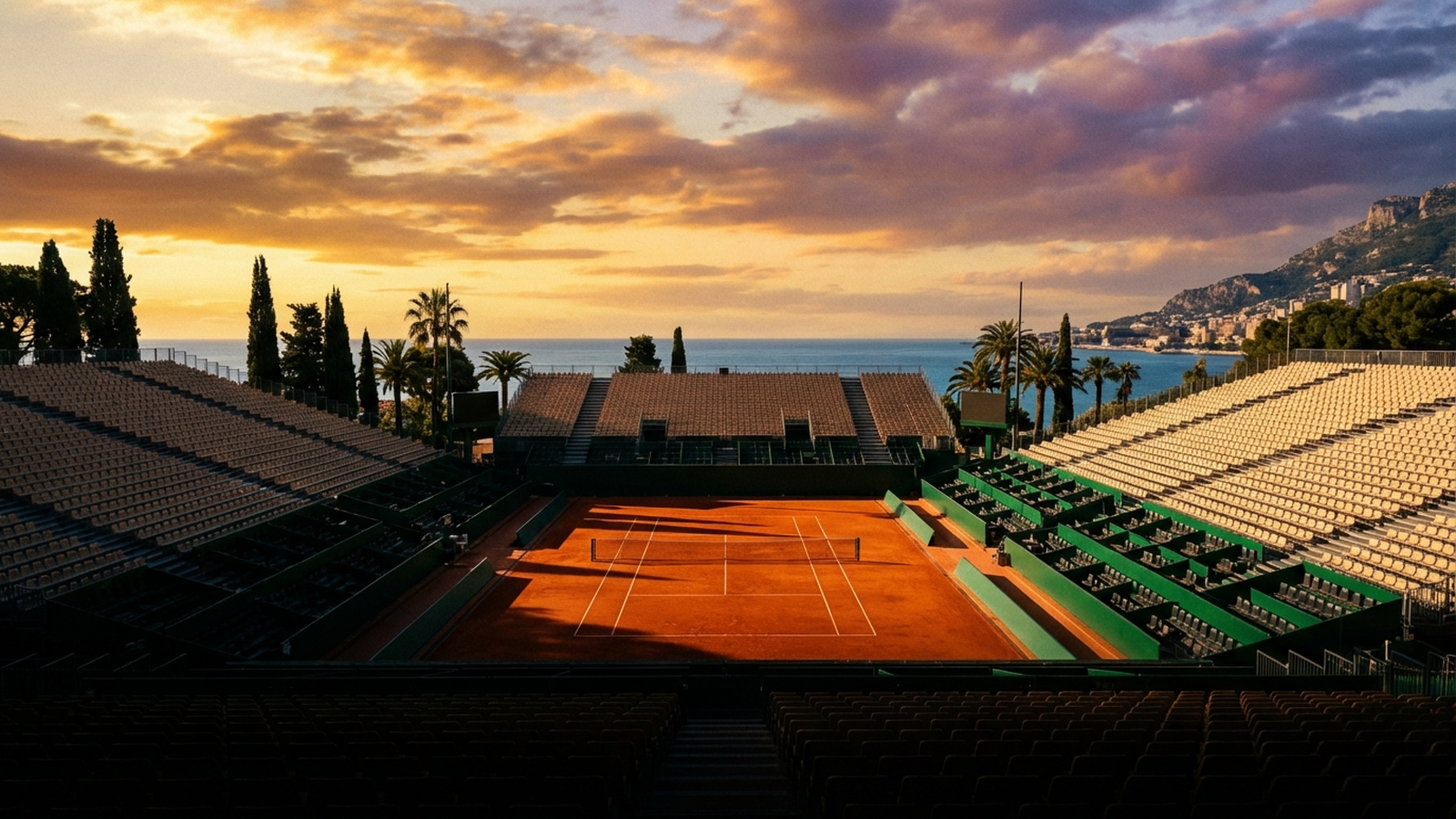
The Monte-Carlo Masters 2026 returns to the sun-drenched terraces of the Monte Carlo Country Club as one of the most anticipated events on the ATP calendar. As the traditional curtain-raiser for the European clay-court swing, this ATP Masters 1000 tournament serves as the proving ground where Roland Garros contenders are separated from pretenders. With a total prize purse of €6.3 million on offer and the prestige of one of tennis’s most storied venues, the 2026 edition promises another chapter in an event that has captivated audiences for over a century.
According to TennisMattch.com’s database of 1,862 matches, Monte-Carlo delivers a distinctive brand of clay-court tennis: players average just 3.13 aces per match — below the tour-wide average of 3.33 — while break point conversion rates sit at 45.34%, marginally above the tour average of 45.23%. The surface here rewards patience, tactical acuity, and physical endurance over raw power. Matches average 98.7 minutes, with finals stretching to a grueling 126.7 minutes on average. This is not a place where big servers can blast their way through draws; this is where clay-court craftsmen thrive.
After welcoming a record-setting 154,000-plus spectators in 2025, the Monte-Carlo Masters 2026 enters a new era. The tournament remains the only ATP Masters 1000 event where player participation is not mandatory — a distinction it has held since 2009 — yet its breathtaking Mediterranean setting, rich history, and competitive intensity continue to attract the sport’s biggest names year after year. Whether you’re planning to attend in person or follow from afar, this comprehensive guide covers everything you need to know: from deep statistical analysis and historical records to practical ticket and weather information.
Tournament History
Few tournaments in professional tennis can trace their lineage as far back as the Monte-Carlo Masters. Established in 1896 as the Monte Carlo International Lawn Tennis Tournament, the event was born in the Belle Époque era, quickly establishing itself as a jewel of European tennis. Renamed the Monte-Carlo Cup in 1897 and later the Monte-Carlo Championships, the tournament operated as a combined men’s and women’s event for much of the 20th century before the women’s draw ceased in 1982. The event’s historical significance is underscored by the records in TennisMattch.com’s database, which includes women’s champions like Helga Masthoff, who compiled an extraordinary 30-5 record and won 4 titles, and Gail Sherriff, who won 3 titles with a 28-9 record.
The tournament entered the professional era in 1969 when it became an “Open” event, welcoming both amateurs and professionals. Since 1990, it has been a cornerstone of the ATP Masters 1000 series (originally the ATP Masters Series), cementing its status as one of the nine most prestigious events below the Grand Slams. Positioned in mid-April, it has served as the traditional gateway to the European clay-court season, preceding Madrid, Rome, and ultimately the French Open.
The Pre-Open Era and Early Champions
In its earliest decades, the tournament attracted European aristocracy and sporting elite alike, blending competitive tennis with the glamour of the Côte d’Azur. The event’s prestige was bolstered by the construction of the iconic Monte Carlo Country Club in 1928, built with the patronage of Prince Louis II of Monaco and American philanthropist George Butler. The Art Deco clubhouse, perched on cliffs overlooking the Mediterranean, became one of the most photographed venues in all of sport.
The Open Era: Legends on the Red Clay
The Open era brought a parade of champions who would define generations of clay-court tennis. Ilie Nastase compiled a 28-10 record and claimed 3 titles, establishing himself as one of the early Open-era kings of Monte-Carlo. Guillermo Vilas, the great Argentine, matched Nastase’s 28-10 record while winning 2 titles. The 1980s saw Ivan Lendl and Mats Wilander each claim 2 titles, underscoring the tournament’s role as a stage for the era’s dominant baseliners.
The 1990s brought Thomas Muster, whose relentless physicality made him a natural fit for Monte-Carlo’s red clay. Muster won 3 titles and compiled a superb 32-10 record — a 76.2% win rate that marked him as one of the event’s great champions. Sergi Bruguera also won 2 titles during this period, including his involvement in the longest match in tournament history: a 252-minute epic final against Boris Becker on April 22, 1991, which Bruguera won 5-7 6-4 7-6(6) 7-6(4). That match remains a monument to the attrition and drama that Monte-Carlo can produce.
The 21st Century: Nadal’s Kingdom
The modern era of the Monte-Carlo Masters is inseparable from one name: Rafael Nadal. Beginning with his first title in 2005, Nadal won an almost incomprehensible 11 titles — eight of them consecutive from 2005 to 2012 — transforming the tournament into his personal fiefdom. His 73-6 career record at the event, a 92.4% win rate, is arguably the most dominant stretch any player has enjoyed at a single venue in the history of professional tennis. We explore Nadal’s Monte-Carlo legacy in exhaustive detail in the Tournament King section below.
Beyond Nadal, the 21st century has seen Juan Carlos Ferrero win 2 titles with a remarkable 31-8 record (79.5% win rate), Gustavo Kuerten claim 2 titles, and Novak Djokovic win 2 titles while compiling a 39-16 record across 55 matches. Most recently, Stefanos Tsitsipas emerged as a modern Monte-Carlo specialist, winning 3 titles — tying him with Muster, Nastase, and Sherriff for the third-most in the tournament’s database history behind Nadal’s 11 and Masthoff’s 4.
| Year | Champion | Runner-Up | Score |
|---|---|---|---|
| 2025 | Carlos Alcaraz (Spain) | Lorenzo Musetti | 1 – 2 |
| 2024 | Stefanos Tsitsipas (Greece) | Casper Ruud | 6-1 6-4 |
| 2023 | Andrey Rublev (RUS) | Holger Rune | 5-7 6-2 7-5 |
| 2022 | Stefanos Tsitsipas (Greece) | Alejandro Davidovich Fokina | 6-3 7-6(3) |
| 2021 | Stefanos Tsitsipas (Greece) | Andrey Rublev | 6-3 6-3 |
| 2019 | Fabio Fognini | Dusan Lajovic | 6-3 6-4 |
| 2018 | Rafael Nadal | Kei Nishikori | 6-3 6-2 |
| 2017 | Rafael Nadal | Albert Ramos | 6-1 6-3 |
| 2016 | Rafael Nadal | Gael Monfils | 7-5 5-7 6-0 |
| 2015 | Novak Djokovic (Serbia) | Tomas Berdych | 7-5 4-6 6-3 |
| 2014 | Stan Wawrinka (Switzerland) | Roger Federer | 4-6 7-6(5) 6-2 |
| 2013 | Novak Djokovic (Serbia) | Rafael Nadal | 6-2 7-6(1) |
| 2012 | Rafael Nadal | Novak Djokovic | 6-3 6-1 |
| 2011 | Rafael Nadal | David Ferrer | 6-4 7-5 |
| 2010 | Rafael Nadal | Fernando Verdasco | 6-0 6-1 |
| 2009 | Rafael Nadal | Novak Djokovic | 6-3 2-6 6-1 |
| 2008 | Rafael Nadal | Roger Federer | 7-5 7-5 |
| 2007 | Rafael Nadal | Roger Federer | 6-4 6-4 |
| 2006 | Rafael Nadal | Roger Federer | 6-2 6-7(2) 6-3 7-6(5) |
| 2005 | Rafael Nadal | Guillermo Coria | 6-3 6-1 0-6 7-5 |
| 2004 | Guillermo Coria | Rainer Schuettler | 6-2 6-1 6-3 |
| 2003 | Juan Carlos Ferrero | Guillermo Coria | 6-2 6-2 |
| 2002 | Juan Carlos Ferrero | Carlos Moya | 7-5 6-3 6-4 |
| 2001 | Gustavo Kuerten | Hicham Arazi | 6-3 6-2 6-4 |
| 2000 | Cedric Pioline | Dominik Hrbaty | 6-4 7-6(3) 7-6(6) |
| 1999 | Gustavo Kuerten | Marcelo Rios | 6-4 2-1 RET |
| 1998 | Carlos Moya | Cedric Pioline | 6-3 6-0 7-5 |
| 1997 | Marcelo Rios | Alex Corretja | 6-4 6-3 6-3 |
| 1996 | Thomas Muster | Albert Costa | 6-3 5-7 4-6 6-3 6-2 |
| 1995 | Thomas Muster | Boris Becker | 4-6 5-7 6-1 7-6(6) 6-0 |
| 1994 | Andrei Medvedev | Sergi Bruguera | 7-5 6-1 6-3 |
| 1993 | Sergi Bruguera | Cedric Pioline | 7-6(2) 6-0 |
| 1992 | Thomas Muster | Aaron Krickstein | 6-3 6-1 6-3 |
| 1991 | Sergi Bruguera | Boris Becker | 5-7 6-4 7-6(6) 7-6(4) |
| 1990 | Andrei Chesnokov | Thomas Muster | 7-5 6-3 6-3 |
| 1989 | Alberto Mancini | Boris Becker | 7-5 2-6 7-6 7-5 |
| 1988 | Ivan Lendl | Martin Jaite | 5-7 6-4 7-5 6-3 |
| 1987 | Mats Wilander | Jimmy Arias | 4-6 7-5 6-1 6-3 |
| 1986 | Joakim Nystrom | Yannick Noah | 6-3 6-2 |
| 1985 | Ivan Lendl | Mats Wilander | 6-1 6-3 4-6 6-4 |
| 1984 | Henrik Sundstrom | Mats Wilander | 6-3 7-5 6-2 |
| 1983 | Mats Wilander | Mel Purcell | 6-1 6-2 6-3 |
| 1982 | Guillermo Vilas | Ivan Lendl | 6-1 7-6 6-3 |
| 1980 | Bjorn Borg | Guillermo Vilas | 6-1 6-0 6-2 |
| 1979 | Bjorn Borg | Vitas Gerulaitis | 6-2 6-1 6-3 |
| 1978 | Raul Ramirez | Tomas Smid | 6-3 6-3 6-4 |
| Year | Champion | Runner-Up | Score |
|---|---|---|---|
| 1982 | Virginia Ruzici | Bonnie Gadusek | 6-2 7-6 |
| 1980 | Brigitte Simon Glinel | Isabelle Villiger | 4-6 7-6 6-1 |
| 1979 | Helga Masthoff | Sabina Simmonds | 6-3 6-1 |
| 1978 | Brigitte Simon Glinel | Gail Sherriff | 7-5 6-1 |
Venue & Playing Conditions
The Monte Carlo Country Club is, by almost any measure, the most visually stunning venue in professional tennis. Perched on a hillside overlooking the sparkling Mediterranean Sea, with the Principality of Monaco’s skyline as a backdrop, the club has hosted the tournament since 1928. Here’s the catch that delights trivia enthusiasts: despite its name and its association with Monaco, the Monte Carlo Country Club actually sits approximately 150 meters outside Monaco’s border, in the French commune of Roquebrune-Cap-Martin. The official address is 155 Avenue Princesse Grace, 06190 Roquebrune-Cap-Martin, France.
Court Rainier III: The Center Stage
The main show court, Court Rainier III, seats approximately 10,000 spectators and is named in honor of Monaco’s late Prince Rainier III. The court is terraced into the hillside, giving spectators in even the upper rows a dramatic view of both the match and the Mediterranean coastline beyond. Unlike many modern stadiums with retractable roofs and climate-controlled environments, Court Rainier III is fully open-air — players and fans are exposed to the Mediterranean sun, the coastal wind, and the occasional spring shower. This is part of the tournament’s charm and its tactical complexity.
The Surface: Traditional European Red Clay
The Monte-Carlo Masters is played on outdoor red clay, the traditional surface of European tennis. The courts play slower than hard courts, producing longer rallies and rewarding players with patience, heavy topspin, and superior movement. The statistics bear this out powerfully. According to TennisMattch.com’s database of 1,862 matches, players average just 3.13 aces per match at Monte-Carlo, compared to a tour-wide average of 3.33 aces. First-serve percentage sits at 59.98%, notably below the tour average of 62.60%. These numbers tell a clear story: the Monte-Carlo surface diminishes the advantage of a big serve and places a premium on rally-based skills.
The clay in Monte-Carlo is typically slower than other major clay events later in the season. The courts are freshly laid each April, and the cooler spring temperatures — average highs of around 17-18°C historically — mean the ball doesn’t bounce as high or move as fast as it will at Roland Garros in late May or June. This makes Monte-Carlo a unique tactical challenge even within the clay-court calendar.
The 1928 Art Deco Clubhouse
The club’s original Art Deco clubhouse, constructed in 1928 with the support of Prince Louis II and American philanthropist George Butler, remains one of the most iconic structures in tennis. The building has been meticulously maintained and still serves as the tournament’s social heart, hosting VIP hospitality and player facilities. Walking through its corridors is a journey through nearly a century of tennis history.
Getting There
The venue is easily accessible from Nice Côte d’Azur Airport (approximately 30 minutes by car) and from central Monaco (a short taxi or bus ride). Many visitors stay in Monte-Carlo itself or in nearby French Riviera towns such as Nice, Menton, or Èze. The area offers world-class dining, the famous Monte Carlo Casino, the Prince’s Palace, and Monaco’s Exotic Garden — making a trip to the tournament as much a vacation as a sporting pilgrimage.
Serve Dominance
The serve at the Monte-Carlo Masters is not a weapon — it’s a setup tool. According to TennisMattch.com’s database of 1,862 matches, the tournament’s ace average of 3.13 per match falls below the tour-wide average of 3.33. More telling is the first-serve percentage: players land just 59.98% of first serves at Monte-Carlo, compared to 62.60% across the tour. The red clay surface, combined with the slower conditions of early spring on the Riviera, strips away the advantages that big servers enjoy on faster surfaces.
First-Serve Effectiveness: A Marginal Edge
When players do land their first serve, they win 67.00% of those points — a solid but unspectacular figure that reflects the returner-friendly nature of clay. The surface gives returners an extra split-second to read the serve, position their feet, and rip a return deep into the court. Compare this to hard-court Masters events where first-serve points won regularly exceeds 70%, and the difference becomes clear: at Monte-Carlo, even a well-placed first serve doesn’t guarantee an easy hold.
Second-Serve Vulnerability
The second-serve statistics reveal the true brutality of clay-court tennis at this level. Players win just 49.68% of second-serve points at Monte-Carlo — essentially a coin flip. This means that every time a server misses their first delivery, the returner has a nearly equal chance of winning the point. For serve-dependent players, this dynamic is devastating. It forces aggressive first-serve strategies and places enormous pressure on second-serve placement and spin.
Double Faults: Lower Than Tour Average
Interestingly, the double fault rate at Monte-Carlo (2.47 per match) is meaningfully lower than the tour average of 2.97. This is counterintuitive at first glance — you might expect players under pressure to miss more — but it actually reflects smart adaptation. Players know their second serve will be attacked relentlessly, so they add more spin and margin rather than going for pace. The result is fewer double faults but a more vulnerable second serve overall.
Year-Over-Year Ace Trends
The annual data reveals an interesting evolution. In 2008 and 2010, the ace average hovered between 2.85 and 2.85 per match. By 2023, it had risen to 3.80, and in 2025 it reached 3.89 — the highest in recent memory. This gradual increase likely reflects the broader trend of more powerful racket technology and increased physical conditioning on tour, though the Monte-Carlo surface continues to blunt the most extreme serving weapons.
| Year | Matches | Avg Aces | Avg DFs | 1st Serve % | BP Conv % |
|---|---|---|---|---|---|
| 2025 | 110 | 3.9 | 3.2 | — | 42.0% |
| 2024 | 110 | 3.4 | 2.3 | 60.2% | 44.1% |
| 2023 | 108 | 3.8 | 2.8 | 59.1% | 44.2% |
| 2022 | 110 | 3.3 | 3.1 | 62.1% | 46.1% |
| 2021 | 110 | 2.4 | 2.5 | 60.5% | 44.2% |
| 2019 | 108 | 2.5 | 2.8 | 57.1% | 47.0% |
| 2018 | 108 | 3.6 | 2.6 | 59.6% | 44.2% |
| 2017 | 110 | 2.7 | 2.3 | 58.8% | 45.4% |
| 2016 | 110 | 3.6 | 2.3 | 60.1% | 46.2% |
| 2015 | 110 | 3.5 | 2.0 | 60.4% | 41.7% |
| 2014 | 108 | 3.3 | 2.0 | 61.4% | 44.5% |
| 2013 | 110 | 3.2 | 2.2 | 59.3% | 50.3% |
| 2012 | 110 | 2.8 | 2.0 | 61.6% | 47.2% |
| 2011 | 110 | 2.6 | 2.3 | 59.9% | 43.2% |
| 2010 | 110 | 2.8 | 2.2 | 61.4% | 44.9% |
| 2009 | 110 | 2.9 | 3.2 | 57.7% | 46.1% |
| 2008 | 110 | 2.9 | 2.2 | 60.6% | 49.3% |
Player-Specific Serve Profiles
The serve statistics of the tournament’s most successful players tell fascinating stories. Rafael Nadal, the 11-time champion, averaged just 1.76 aces per match — well below the tournament average — yet won 92.4% of his matches. His success was built entirely on return dominance and rally quality, not on his serve. Novak Djokovic averaged 2.62 aces, also below the tournament average, while posting a 70.9% win rate across 55 matches. Roger Federer, perhaps the most serve-reliant of the Big Three, averaged 3.50 aces — above the tournament average — but never won the title in 43 matches (30-13 record). That stat alone encapsulates Monte-Carlo’s essence: serve power is a secondary asset here.
At the other end, Juan Carlos Ferrero averaged 1.43 aces per match and a first-serve percentage of 69.13% — the highest among the top players in the database. Ferrero’s approach was about consistency and placement rather than power, and his 2 titles and 31-8 record validate that strategy on this surface.
| Player | Record | Titles | Avg Aces |
|---|---|---|---|
| Rafael Nadal | 73W-6L | 11 | 1.8 |
| Novak Djokovic (Serbia) | 39W-16L | 2 | 2.6 |
| Thomas Muster | 32W-10L | 3 | — |
| Juan Carlos Ferrero | 31W-8L | 2 | 1.4 |
| Helga Masthoff | 30W-5L | 4 | — |
| Roger Federer | 30W-13L | 0 | 3.5 |
| Gail Sherriff | 28W-9L | 3 | — |
| Ilie Nastase | 28W-10L | 3 | — |
| Guillermo Vilas | 28W-10L | 2 | — |
| Carlos Moya | 28W-12L | 1 | 2.0 |
| Mats Wilander | 26W-6L | 2 | — |
| David Ferrer | 26W-11L | 0 | 1.1 |
| Grigor Dimitrov (Bulgaria) | 26W-12L | 0 | 3.9 |
| Cedric Pioline | 25W-11L | 1 | — |
| Sergi Bruguera | 25W-8L | 2 | — |
Break Point Battles
Break point conversion is the beating heart of clay-court tennis, and Monte-Carlo’s numbers confirm its centrality. According to TennisMattch.com’s database of 1,862 matches, the average break point conversion rate at Monte-Carlo sits at 45.34%, marginally above the tour-wide average of 45.23%. That 0.11 percentage point difference might seem trivial, but it reflects a fundamental truth about red clay: service breaks are slightly easier to come by, and the ability to convert when the moment arrives separates champions from also-rans.
Why Clay Amplifies Break Opportunities
The mechanism is straightforward. On clay, the serve’s effectiveness is diminished (as detailed in the serve stats section), which means more return games feature break opportunities. With second-serve points won at just 49.68%, returners regularly find themselves at 0-30 or 15-30, creating natural break point scenarios. The clay surface also rewards sustained baseline pressure — heavy topspin, deep returns, and relentless court coverage — which makes it harder for servers to escape trouble once they fall behind in a game.
Annual Conversion Rate Trends
The annual data reveals interesting fluctuations. In 2008, the break point conversion rate was a striking 49.30% — nearly one in two break points converted. By 2025, that figure had dropped to 42.04%, the lowest in the available dataset. This decline could reflect several factors: improved serving techniques on clay, better physical conditioning allowing servers to fight out of trouble more effectively, or tactical evolution in how players approach break point situations.
The year-by-year trajectory is telling: 2009 (46.15%) → 2010 (44.85%) → 2023 (44.24%) → 2024 (44.10%) → 2025 (42.04%). The general downward trend suggests that the Monte-Carlo Masters, while still a returner’s paradise relative to hard-court events, is gradually becoming slightly more server-friendly — even on this most traditional of clay surfaces.
Break Point Conversion: The Tournament King’s Secret Weapon
Rafael Nadal’s break point conversion rate at Monte-Carlo was an extraordinary 55.03% — nearly 10 percentage points above the tournament average. This single statistic arguably explains his dominance better than any other. When Nadal had a chance to break, he converted it more than half the time. Combined with his legendary ability to save break points on his own serve through sheer physicality and tactical discipline, this created a nearly unbreakable competitive loop: he broke opponents at will while rarely being broken himself.
For context, Novak Djokovic, one of the greatest returners in tennis history, converted break points at just the tournament’s broader average during his Monte-Carlo appearances. The gap between Nadal’s 55.03% and the tournament average of 45.34% represents one of the starkest individual performance gaps at any single venue in professional tennis.
What to Watch for in 2026
With the break point conversion rate trending downward in recent years (42.04% in 2025), the Monte-Carlo Masters 2026 will be a key test of whether this shift is structural or cyclical. If the next generation of clay-court specialists can reverse this trend and convert at rates closer to the historical average, it will signal a return to the aggressive, returner-dominated tennis that has traditionally defined this event. Players with elite return games — those who can punish weak second serves and sustain baseline pressure through long rallies — will hold a decisive edge.
Match Duration
Clay-court tennis is a test of endurance, and the Monte-Carlo Masters delivers that test with relentless consistency. According to TennisMattch.com’s database of 1,846 matches with recorded durations, the average match at Monte-Carlo lasts 98.7 minutes — just under the hour-and-forty-minute mark. The median match clocks in at 93 minutes, suggesting a distribution skewed by occasional marathon encounters that push the average higher.
Duration by Round: The Escalating Grind
Match durations at Monte-Carlo follow a predictable but dramatic escalation as the tournament progresses:
First Round (R64): 96.8 minutes average (836 matches)
Second Round (R32): 97.4 minutes average (518 matches)
Third Round (R16): 99.6 minutes average (261 matches)
Quarterfinals: 104.5 minutes average (132 matches)
Semifinals: 105.6 minutes average (66 matches)
Finals: 126.7 minutes average (33 matches)
The jump from the semifinals to the final is particularly notable: an increase of 21.1 minutes, or roughly 20%. Finals at Monte-Carlo are not sprints; they are endurance events that demand peak physical and mental conditioning. A player who reaches the final after five grueling matches must still summon the energy for what is, on average, a match exceeding two hours.
Median match length: 93 minutes
Longest match: Sergi Bruguera d. Boris Becker 5-7 6-4 7-6(6) 7-6(4) (252 min, F 1991)
The Longest Match in Tournament History
The most epic encounter in Monte-Carlo history took place on April 22, 1991, when Sergi Bruguera defeated Boris Becker 5-7 6-4 7-6(6) 7-6(4) in the final. The match lasted an extraordinary 252 minutes — four hours and twelve minutes of high-stakes clay-court tennis. Becker, one of the most powerful players of his era, was dragged into a war of attrition on a surface that neutralized his biggest weapons. Both tiebreaks were decided by margins of two, highlighting the razor-thin margins that separated the two men. That 1991 final remains a touchstone for what Monte-Carlo can produce when two elite competitors refuse to yield.
The Shortest Match
At the other end of the spectrum, the shortest recorded match in the database lasted just 9 minutes — almost certainly a retirement or walkover recorded with minimal play. This stark contrast with the 252-minute maximum illustrates the enormous range of competitive scenarios the tournament has produced across its decades of history.
What These Numbers Mean for 2026
For players preparing for the Monte-Carlo Masters 2026, the duration data delivers a clear message: fitness is non-negotiable. A realistic title run requires winning seven matches over the course of approximately two weeks, with the cumulative match time potentially exceeding 11-12 hours. The final alone is likely to push past two hours. Players who arrive in Monte-Carlo without elite clay-court conditioning — the ability to sustain heavy-topspin rallies, explosive lateral movement, and tactical clarity deep into long matches — will be exposed, regardless of their talent.
Year-by-Year Trends
The Monte-Carlo Masters has evolved steadily over the past two decades, and the annual statistical trends captured in TennisMattch.com’s database reveal how the nature of competition on this iconic red clay has shifted — sometimes subtly, sometimes dramatically.
The Ace Revolution: Slow but Steady
Perhaps the most striking trend is the gradual rise in aces. In 2008, players averaged 2.85 aces per match. By 2010, the figure was nearly identical at 2.85. But the last five years show a clear acceleration: 3.80 aces per match in 2023, 3.40 in 2024, and 3.89 in 2025. That 2025 figure represents a 36% increase over 2008 levels. Modern players are hitting bigger serves even on clay, likely driven by advances in racket technology, string technology, and the increasing emphasis on physical strength and first-serve power across the ATP Tour.
Double Faults: A Volatile Story
Double fault rates have fluctuated more unpredictably. The 2009 edition saw an average of 3.15 double faults per match — the highest in the available data — before dropping to 2.18 in 2010. The 2024 edition was notably clean at just 2.31 double faults per match, but 2025 surged back to 3.19. These oscillations suggest that double fault rates are more player-composition-dependent (driven by who enters the draw in a given year) than reflective of broad tactical evolution.
First-Serve Percentage: Holding Steady
First-serve percentages have remained remarkably stable across the dataset, hovering between 57.70% (2009) and 61.37% (2010), with 2024 at 60.17% and 2023 at 59.08%. The tournament average of 59.98% sits well below the tour average of 62.60%, and this gap has shown no signs of closing. Monte-Carlo’s surface continues to impose its own serving reality, regardless of broader tour trends.
Break Point Conversion: A Declining Art?
As noted in the break point section, conversion rates have trended downward. The 2008 rate of 49.30% was exceptionally high. By 2025, it had fallen to 42.04%. The tournament-wide average of 45.34% masks this decline; the recent editions suggest that modern players are either becoming better at saving break points or worse at converting them. This trend merits close watching at the Monte-Carlo Masters 2026 — a continued decline would fundamentally alter the event’s tactical landscape, making it more server-oriented than its clay-court heritage would suggest.
Match Count Consistency
The tournament has consistently featured 108-110 matches per edition in recent years (110 in 2024 and 2025, 108 in 2023), reflecting the stable 56-player main draw format standard to ATP Masters 1000 events. This consistency makes year-over-year comparisons particularly reliable.
| Year | Matches | Avg Aces | Avg DFs | 1st Serve % | BP Conv % |
|---|---|---|---|---|---|
| 2025 | 110 | 3.9 | 3.2 | — | 42.0% |
| 2024 | 110 | 3.4 | 2.3 | 60.2% | 44.1% |
| 2023 | 108 | 3.8 | 2.8 | 59.1% | 44.2% |
| 2022 | 110 | 3.3 | 3.1 | 62.1% | 46.1% |
| 2021 | 110 | 2.4 | 2.5 | 60.5% | 44.2% |
| 2019 | 108 | 2.5 | 2.8 | 57.1% | 47.0% |
| 2018 | 108 | 3.6 | 2.6 | 59.6% | 44.2% |
| 2017 | 110 | 2.7 | 2.3 | 58.8% | 45.4% |
| 2016 | 110 | 3.6 | 2.3 | 60.1% | 46.2% |
| 2015 | 110 | 3.5 | 2.0 | 60.4% | 41.7% |
| 2014 | 108 | 3.3 | 2.0 | 61.4% | 44.5% |
| 2013 | 110 | 3.2 | 2.2 | 59.3% | 50.3% |
| 2012 | 110 | 2.8 | 2.0 | 61.6% | 47.2% |
| 2011 | 110 | 2.6 | 2.3 | 59.9% | 43.2% |
| 2010 | 110 | 2.8 | 2.2 | 61.4% | 44.9% |
| 2009 | 110 | 2.9 | 3.2 | 57.7% | 46.1% |
| 2008 | 110 | 2.9 | 2.2 | 60.6% | 49.3% |
King of the Monte-Carlo Masters
Rafael Nadal won 11 Monte-Carlo Masters titles — a record so extraordinary it may never be matched at any tournament in professional tennis. According to TennisMattch.com’s database, Nadal compiled a 73-6 record at the event, a 92.4% win rate that represents perhaps the most dominant player-tournament relationship in the history of the sport.
The Reign: 2005-2012 and Beyond
Nadal’s Monte-Carlo dynasty began in 2005 and continued with an unprecedented eight consecutive titles through 2012. He then added three more in 2016, 2017, and 2018, bringing his total to 11. To put this in perspective, no other player in the database has won more than 3 titles at the event (Helga Masthoff in the women’s era). Among the men in the Open era, the next closest is Stefanos Tsitsipas with 3 titles, followed by Thomas Muster and Ilie Nastase, also with 3 each. Nadal’s 11 titles nearly quadruple his closest male competitor.
Statistical Dominance: The Numbers
Nadal’s statistical profile at Monte-Carlo was a paradox that perfectly illustrated his unique playing style. His average of 1.76 aces per match was well below the tournament average of 3.13 — he ranked among the lowest ace-producers of any top player. Yet his first-serve percentage of 67.70% was the second-highest in the database among top players, behind only Juan Carlos Ferrero’s 69.13%. Nadal didn’t overpower opponents with his serve; he used it as a reliable platform to launch his devastating forehand and begin the grinding baseline rallies that made him virtually unbeatable on this surface.
The decisive statistic was his break point conversion rate: 55.03%. When Nadal saw a break opportunity, he seized it more than half the time. The tournament average is 45.34%, and even the greatest competitors of Nadal’s era couldn’t come close to matching his conversion efficiency on Monte-Carlo’s red clay. This relentless ability to break opposing serves — combined with his legendary ability to defend his own service games through extraordinary physicality and court coverage — created an almost impenetrable competitive formula.
The Six Losses: Rare but Real
Nadal’s 6 losses at Monte-Carlo remind us that even the most dominant dynasties have cracks. Those defeats came against some of the finest clay-court players of multiple generations. Yet even in the context of losses, Nadal’s record is astonishing: he lost just once every 13.2 matches at the event. For comparison, Novak Djokovic, the next most accomplished active-era player in the database, had a 39-16 record (70.9% win rate) — stellar by any standard but 21.5 percentage points below Nadal’s rate.
The Legacy for Monte-Carlo Masters 2026
With Nadal having retired from professional tennis, the Monte-Carlo Masters 2026 will be contested in a landscape fundamentally reshaped by his absence. For 17 years (2005-2018, with interruptions), the question at Monte-Carlo was rarely “who will win?” but rather “can anyone beat Nadal?” The answer was almost always no. Now, the tournament enters a new competitive era. Stefanos Tsitsipas, with his 3 titles, is the most decorated active contender in the database, and a new generation of clay-court specialists will compete for the chance to write their own chapter in this event’s remarkable history.
Greatest Upsets
For all its tradition and predictability — Rafael Nadal won 11 of the titles in the database, after all — the Monte-Carlo Masters has produced its share of stunning upsets and Cinderella stories. The red clay surface, combined with the grueling physical demands of a week-long Masters 1000 event, creates conditions where even the greatest players can be toppled on the right day by the right opponent.
Breaking the Nadal Dynasty
The most significant upsets in modern Monte-Carlo history were the matches that ended Nadal’s reign. Given his 73-6 record and 92.4% win rate, each of those 6 losses qualifies as a seismic event. The players who managed to defeat Nadal on his favorite clay did so by solving one of the most difficult puzzles in tennis: how to sustain aggressive, high-quality play for two or three sets against a player who retrieves everything, punishes every short ball, and never gives away cheap points. These victories required not just skill but extraordinary mental fortitude.
The 1991 Final: Becker’s Four-Hour Heartbreak
While not a traditional upset in the seeding sense, the 1991 final between Sergi Bruguera and Boris Becker deserves mention as one of the tournament’s most dramatic encounters. Becker, a three-time Grand Slam champion built for grass and hard courts, pushed deep into clay-court territory and took Bruguera to four sets and 252 minutes before falling 5-7 6-4 7-6(6) 7-6(4). It was a near-upset of the natural clay-court order — an aggressive serve-and-volley player coming within two tiebreak points of winning on the surface least suited to his game.
Roger Federer’s Frustration
Perhaps the most remarkable upset narrative at Monte-Carlo is a cumulative one rather than a single match. Roger Federer, widely regarded as one of the greatest players in tennis history, played 43 matches at Monte-Carlo and won 30 of them — but never claimed the title. His 30-13 record (69.8% win rate) is excellent by most standards, yet it represents the one major venue where Federer’s extraordinary talent was repeatedly thwarted. His 3.50 aces per match were the highest among the tournament’s top players, but that serving prowess was insufficient to overcome the clay-court specialists who thrived here. Federer’s Monte-Carlo record is a testament to the surface’s ability to level the playing field and reward a specific skill set that even the most versatile champions cannot always replicate.
The Beauty of Non-Mandatory Status
Since 2009, Monte-Carlo’s status as the only non-mandatory Masters 1000 event has added an extra layer of unpredictability. Top players occasionally skip the event, opening the draw for lower-ranked competitors to make deep runs they might not manage in a full-strength field. This unique status ensures that each year’s draw has a slightly different character — and with it, the potential for unexpected results.
Rivalries
The Monte-Carlo Masters has been the stage for some of the most compelling rivalries in modern tennis, amplified by the tactical demands of red clay and the high stakes of a Masters 1000 title.
Nadal vs. Djokovic: The Defining Monte-Carlo Rivalry
The rivalry between Rafael Nadal and Novak Djokovic reached its most lopsided chapter on the red clay of Monte-Carlo. While their head-to-head across all surfaces was one of the closest in tennis history, Monte-Carlo was firmly Nadal’s domain. Nadal’s 73-6 overall record and 11 titles dwarf Djokovic’s 39-16 record and 2 titles, and their individual meetings at the event consistently showcased the gap between Nadal’s clay-court supremacy and Djokovic’s exceptional but ultimately insufficient challenge on this particular surface. When Djokovic did manage to defeat Nadal at Monte-Carlo, it was treated as a seismic event — a crack in the fortress.
Nadal vs. Federer: The Surface Mismatch
Monte-Carlo also served as a theatre for the Nadal-Federer rivalry, though here the dynamic was even more one-sided than on clay generally. Federer’s 43-match, 0-title record at the event tells the story: despite his ability to reach the latter stages, the Swiss maestro could never solve the combination of the slow surface and Nadal’s crushing topspin. Their Monte-Carlo encounters were often the most anticipated matches of the tournament, yet the outcome rarely deviated from the expected script.
The Muster-Bruguera Era
Before the Big Three era, the 1990s saw a compelling rivalry between Thomas Muster and Sergi Bruguera — two clay-court specialists who combined for 2 titles between them (Muster 3, Bruguera 2). Both players embodied the grueling, attritional style that Monte-Carlo’s surface demands, and their matches were classic clay-court battles of endurance and tactical patience. Muster’s 32-10 record and Bruguera’s involvement in the tournament’s longest-ever match underscore their deep connection to this event.
Tsitsipas: The New Monte-Carlo King?
Stefanos Tsitsipas, with 3 titles, has established himself as the most successful active player at Monte-Carlo. His rivalry with the next generation of clay-court contenders — including Carlos Alcaraz, Jannik Sinner, and others — will define the Monte-Carlo Masters 2026 and beyond. Tsitsipas’s smooth one-handed backhand and aggressive baseline game are ideally suited to the red clay, and his record suggests he is building a Monte-Carlo legacy that, while far from Nadal’s, could become the most significant of the post-Nadal era.
Looking Ahead: The Next Great Monte-Carlo Rivalry
With Nadal retired and Djokovic in the twilight of his career, the Monte-Carlo Masters 2026 represents a potential inflection point for new rivalries. The event’s unique non-mandatory status means that the players who do choose to compete are typically those with genuine ambitions on clay, creating a self-selecting field of motivated contenders. The next great Monte-Carlo rivalry may be born on these courts in April 2026.
Prize Money & Points
The Monte-Carlo Masters 2026 offers a total prize purse of €6.3 million, reflecting the tournament’s stature as an ATP Masters 1000 event and one of the most prestigious stops on the global tennis calendar. This positions Monte-Carlo among the most lucrative clay-court events in the world, trailing only Roland Garros and typically sitting alongside Madrid and Rome in the Masters 1000 prize money hierarchy.
Prize Money in Context
The €6.3 million figure represents a significant investment in professional tennis and reflects the tournament’s commercial strength. Monte-Carlo’s sponsor roster includes some of the world’s most recognized luxury and corporate brands: Rolex, BNP Paribas, Emirates, Maserati, Generali, PokerStars, Sergio Tacchini, and Replay. This blend of Swiss watchmaking, French banking, airline prestige, and Italian automotive luxury mirrors the Riviera setting perfectly and enables the tournament to offer competitive compensation to players.
Prize Distribution Structure
While the specific winner’s share for 2026 has not been officially confirmed, ATP Masters 1000 events typically allocate approximately 15-16% of the total purse to the singles champion and similar proportions through the draw rounds. First-round losers still receive meaningful compensation, and qualifying-round participants also earn prize money — an important financial lifeline for lower-ranked players.
The Economics of Non-Mandatory Status
Monte-Carlo’s unique non-mandatory status since 2009 adds an interesting economic dimension. Unlike other Masters 1000 events where top players are required to compete (or face penalties), Monte-Carlo must attract its field through the appeal of its prize money, ranking points, location, and prestige. The fact that it consistently draws elite fields despite this lack of compulsion is a testament to the tournament’s allure — and the €6.3 million purse certainly helps. Players who skip Monte-Carlo forgo both ranking points and significant earnings, making the economic incentive a powerful draw even without mandatory commitment.
Historical Prize Money Growth
Like all major tennis events, Monte-Carlo’s prize money has grown substantially over the decades. The tournament’s transformation from a genteel European clay-court event to a €6.3 million spectacle mirrors the professionalization and commercialization of the sport. The attendance record of over 154,000 spectators in 2025 demonstrates the commercial momentum that underpins continued prize money growth.
Weather & Conditions
Weather is a critical variable at the Monte-Carlo Masters, and understanding the conditions is essential for both players preparing their tactical approaches and fans planning their trips. The tournament takes place in mid-April on the French Riviera, a period when spring is arriving but the Mediterranean warmth of summer has not yet fully taken hold.
Historical Climate Data
Based on five years of historical climate data for the tournament period, spectators and players can expect average daily highs of 17.6°C (63.7°F) and average lows of 9.9°C (49.8°F). Average daily precipitation is 2.2mm, indicating that while rain is possible, extended washouts are relatively rare. Average wind speeds of 15.8 km/h are moderate but not negligible — enough to affect ball trajectory, particularly on the exposed, hillside courts of the Monte Carlo Country Club.
2026 Forecast Outlook
The 14-day forecast window for the Monte-Carlo Masters 2026 suggests conditions slightly cooler than the historical average: average highs of 15.1°C (59.2°F) with lows of 9.6°C (49.3°F). The precipitation probability of 36.9% is higher than ideal, suggesting that rain delays could play a role in the 2026 edition. Average wind speeds of 15.0 km/h are in line with historical norms.
Tactical Implications
The cooler temperatures forecast for 2026 could have a meaningful impact on play. Colder conditions mean heavier, slower-bouncing balls, which further diminishes serving power and favors grinders who thrive in long, physical rallies. The red clay will play even slower than usual, potentially pushing match durations above the tournament average of 98.7 minutes. Players who rely on power and pace may find their weapons blunted; those with patience, superior footwork, and heavy topspin production will be better positioned to succeed.
What to Wear and Bring
For fans attending the Monte-Carlo Masters 2026, layering is essential. Morning sessions may start in the low 10s (°C), warming into the mid-to-high teens by afternoon. A light jacket or sweater is recommended, along with sunglasses and sunscreen for when the Mediterranean sun breaks through. Given the 36.9% precipitation probability, a compact rain jacket or umbrella is a wise addition to your bag. The venue’s open-air design means there is limited shelter during rain delays — come prepared.
Records & Fun Facts
The Monte-Carlo Masters is one of the most storied events in all of tennis, and its 130-year history is rich with remarkable facts, records, and quirky details that make it unlike any other tournament on the ATP Tour.
Rafael Nadal: The Undisputed King of Monte-Carlo
Rafael Nadal stands alone as the most dominant force in the history of the Monte-Carlo Masters, and it is only fitting that any discussion of the tournament’s most remarkable facts and records begins with his name. According to TennisMattch.com’s database, Nadal’s staggering 73-6 record at Monte-Carlo (92.4% win rate) with 11 titles is arguably the most dominant individual performance at a single venue in the history of professional tennis. His eight consecutive titles from 2005 to 2012 are a feat unlikely to be replicated in the modern era of deep, competitive fields. Nadal’s stranglehold on this event was so complete that for nearly a decade, other top players openly acknowledged that the best they could realistically hope for was a finals appearance opposite the Spaniard. His dominance on the terre battue of the Monte Carlo Country Club remains the tournament’s defining statistical legacy. No other player in the tournament’s database of 1,862 matches comes close to matching his sustained excellence — Novak Djokovic ranks second with 39 wins, and Thomas Muster third with 32 wins, both remarkable totals in their own right but dwarfed by Nadal’s extraordinary consistency over more than a decade of competition.
It’s Not Actually in Monaco
Despite being universally referred to as the “Monte-Carlo Masters” and being synonymous with the Principality of Monaco, the Monte Carlo Country Club sits approximately 150 meters outside Monaco’s border in the French commune of Roquebrune-Cap-Martin. The official address — 155 Avenue Princesse Grace, 06190 Roquebrune-Cap-Martin, France — confirms this. Players competing at the “Monaco” tournament are technically playing in France. This geographical quirk has been a source of amusement for tennis fans and a perennial trivia question for decades.
The Oldest Masters 1000 Event
Founded in 1896, the Monte-Carlo Masters is by far the oldest event in the ATP Masters 1000 series. It predates the founding of the ATP itself (1972) by 76 years, the Open era (1968) by 72 years, and most of the other Masters 1000 events by nearly a century. Only a handful of Grand Slam tournaments have longer continuous histories.
The 252-Minute Marathon
The longest match in tournament history — Sergi Bruguera defeating Boris Becker 5-7 6-4 7-6(6) 7-6(4) in the 1991 final at 252 minutes — remains one of the longest finals in ATP Masters history. That two of the four sets required tiebreaks underlines just how competitive the match was.
Roger Federer: The Greatest Player Never to Win It
Roger Federer won 20 Grand Slam titles and 103 ATP titles in his career, but Monte-Carlo was his most notable absence. His 30-13 record across 43 matches — with 0 titles — makes him the most accomplished player never to lift the trophy in the tournament’s modern era. His 3.50 aces per match, the highest among the top 10 players in the database, couldn’t overcome the surface’s bias toward clay-court specialists.
Record Attendance
The 2025 edition welcomed over 154,000 spectators, setting a new attendance record for the tournament. Court Rainier III’s 10,000-seat capacity was consistently filled, and the outer courts drew massive crowds throughout the week. This record demonstrates the event’s growing popularity even in an era of competing entertainment options.
The Art Deco Clubhouse
The Monte Carlo Country Club’s stunning 1928 Art Deco clubhouse was built with the support of Prince Louis II of Monaco and American philanthropist George Butler. Nearly a century later, it remains one of the most architecturally significant buildings in professional sports, serving as both a functional facility and a living monument to the tournament’s golden age.
The Only Non-Mandatory Masters 1000
Since 2009, Monte-Carlo has held the unique distinction of being the only ATP Masters 1000 event that does not require mandatory player participation. Despite this, it consistently attracts top-tier fields — a testament to the combination of its prestige, prize money (€6.3 million in 2026), ranking points, and incomparable setting. Players choose to be here, which in many ways makes their participation more meaningful.
Aces Are Rare, Breaks Are Everything
With an average of just 3.13 aces per match (below the tour average of 3.33) and a break point conversion rate of 45.34%, Monte-Carlo remains one of the most returner-friendly events on the ATP calendar. The tournament averages 21.2 winners per player per match, meaning points must be earned through sustained rally quality rather than single-shot power.
Past Champions
| Year | Champion | Runner-Up | Score |
|---|---|---|---|
| 2025 | Carlos Alcaraz (Spain) | Lorenzo Musetti | 1 – 2 |
| 2024 | Stefanos Tsitsipas (Greece) | Casper Ruud | 6-1 6-4 |
| 2023 | Andrey Rublev (RUS) | Holger Rune | 5-7 6-2 7-5 |
| 2022 | Stefanos Tsitsipas (Greece) | Alejandro Davidovich Fokina | 6-3 7-6(3) |
| 2021 | Stefanos Tsitsipas (Greece) | Andrey Rublev | 6-3 6-3 |
| 2019 | Fabio Fognini | Dusan Lajovic | 6-3 6-4 |
| 2018 | Rafael Nadal | Kei Nishikori | 6-3 6-2 |
| 2017 | Rafael Nadal | Albert Ramos | 6-1 6-3 |
| 2016 | Rafael Nadal | Gael Monfils | 7-5 5-7 6-0 |
| 2015 | Novak Djokovic (Serbia) | Tomas Berdych | 7-5 4-6 6-3 |
| 2014 | Stan Wawrinka (Switzerland) | Roger Federer | 4-6 7-6(5) 6-2 |
| 2013 | Novak Djokovic (Serbia) | Rafael Nadal | 6-2 7-6(1) |
| 2012 | Rafael Nadal | Novak Djokovic | 6-3 6-1 |
| 2011 | Rafael Nadal | David Ferrer | 6-4 7-5 |
| 2010 | Rafael Nadal | Fernando Verdasco | 6-0 6-1 |
| 2009 | Rafael Nadal | Novak Djokovic | 6-3 2-6 6-1 |
| 2008 | Rafael Nadal | Roger Federer | 7-5 7-5 |
| 2007 | Rafael Nadal | Roger Federer | 6-4 6-4 |
| 2006 | Rafael Nadal | Roger Federer | 6-2 6-7(2) 6-3 7-6(5) |
| 2005 | Rafael Nadal | Guillermo Coria | 6-3 6-1 0-6 7-5 |
| 2004 | Guillermo Coria | Rainer Schuettler | 6-2 6-1 6-3 |
| 2003 | Juan Carlos Ferrero | Guillermo Coria | 6-2 6-2 |
| 2002 | Juan Carlos Ferrero | Carlos Moya | 7-5 6-3 6-4 |
| 2001 | Gustavo Kuerten | Hicham Arazi | 6-3 6-2 6-4 |
| 2000 | Cedric Pioline | Dominik Hrbaty | 6-4 7-6(3) 7-6(6) |
| 1999 | Gustavo Kuerten | Marcelo Rios | 6-4 2-1 RET |
| 1998 | Carlos Moya | Cedric Pioline | 6-3 6-0 7-5 |
| 1997 | Marcelo Rios | Alex Corretja | 6-4 6-3 6-3 |
| 1996 | Thomas Muster | Albert Costa | 6-3 5-7 4-6 6-3 6-2 |
| 1995 | Thomas Muster | Boris Becker | 4-6 5-7 6-1 7-6(6) 6-0 |
| 1994 | Andrei Medvedev | Sergi Bruguera | 7-5 6-1 6-3 |
| 1993 | Sergi Bruguera | Cedric Pioline | 7-6(2) 6-0 |
| 1992 | Thomas Muster | Aaron Krickstein | 6-3 6-1 6-3 |
| 1991 | Sergi Bruguera | Boris Becker | 5-7 6-4 7-6(6) 7-6(4) |
| 1990 | Andrei Chesnokov | Thomas Muster | 7-5 6-3 6-3 |
| 1989 | Alberto Mancini | Boris Becker | 7-5 2-6 7-6 7-5 |
| 1988 | Ivan Lendl | Martin Jaite | 5-7 6-4 7-5 6-3 |
| 1987 | Mats Wilander | Jimmy Arias | 4-6 7-5 6-1 6-3 |
| 1986 | Joakim Nystrom | Yannick Noah | 6-3 6-2 |
| 1985 | Ivan Lendl | Mats Wilander | 6-1 6-3 4-6 6-4 |
| 1984 | Henrik Sundstrom | Mats Wilander | 6-3 7-5 6-2 |
| 1983 | Mats Wilander | Mel Purcell | 6-1 6-2 6-3 |
| 1982 | Guillermo Vilas | Ivan Lendl | 6-1 7-6 6-3 |
| 1980 | Bjorn Borg | Guillermo Vilas | 6-1 6-0 6-2 |
| 1979 | Bjorn Borg | Vitas Gerulaitis | 6-2 6-1 6-3 |
| 1978 | Raul Ramirez | Tomas Smid | 6-3 6-3 6-4 |
| Year | Champion | Runner-Up | Score |
|---|---|---|---|
| 1982 | Virginia Ruzici | Bonnie Gadusek | 6-2 7-6 |
| 1980 | Brigitte Simon Glinel | Isabelle Villiger | 4-6 7-6 6-1 |
| 1979 | Helga Masthoff | Sabina Simmonds | 6-3 6-1 |
| 1978 | Brigitte Simon Glinel | Gail Sherriff | 7-5 6-1 |
Year-by-Year Statistics
| Year | Matches | Avg Aces | Avg DFs | 1st Serve % | BP Conv % |
|---|---|---|---|---|---|
| 2025 | 110 | 3.9 | 3.2 | — | 42.0% |
| 2024 | 110 | 3.4 | 2.3 | 60.2% | 44.1% |
| 2023 | 108 | 3.8 | 2.8 | 59.1% | 44.2% |
| 2022 | 110 | 3.3 | 3.1 | 62.1% | 46.1% |
| 2021 | 110 | 2.4 | 2.5 | 60.5% | 44.2% |
| 2019 | 108 | 2.5 | 2.8 | 57.1% | 47.0% |
| 2018 | 108 | 3.6 | 2.6 | 59.6% | 44.2% |
| 2017 | 110 | 2.7 | 2.3 | 58.8% | 45.4% |
| 2016 | 110 | 3.6 | 2.3 | 60.1% | 46.2% |
| 2015 | 110 | 3.5 | 2.0 | 60.4% | 41.7% |
| 2014 | 108 | 3.3 | 2.0 | 61.4% | 44.5% |
| 2013 | 110 | 3.2 | 2.2 | 59.3% | 50.3% |
| 2012 | 110 | 2.8 | 2.0 | 61.6% | 47.2% |
| 2011 | 110 | 2.6 | 2.3 | 59.9% | 43.2% |
| 2010 | 110 | 2.8 | 2.2 | 61.4% | 44.9% |
| 2009 | 110 | 2.9 | 3.2 | 57.7% | 46.1% |
| 2008 | 110 | 2.9 | 2.2 | 60.6% | 49.3% |
All-Time Player Records
| Player | Record | Titles | Avg Aces |
|---|---|---|---|
| Rafael Nadal | 73W-6L | 11 | 1.8 |
| Novak Djokovic (Serbia) | 39W-16L | 2 | 2.6 |
| Thomas Muster | 32W-10L | 3 | — |
| Juan Carlos Ferrero | 31W-8L | 2 | 1.4 |
| Helga Masthoff | 30W-5L | 4 | — |
| Roger Federer | 30W-13L | 0 | 3.5 |
| Gail Sherriff | 28W-9L | 3 | — |
| Ilie Nastase | 28W-10L | 3 | — |
| Guillermo Vilas | 28W-10L | 2 | — |
| Carlos Moya | 28W-12L | 1 | 2.0 |
| Mats Wilander | 26W-6L | 2 | — |
| David Ferrer | 26W-11L | 0 | 1.1 |
| Grigor Dimitrov (Bulgaria) | 26W-12L | 0 | 3.9 |
| Cedric Pioline | 25W-11L | 1 | — |
| Sergi Bruguera | 25W-8L | 2 | — |