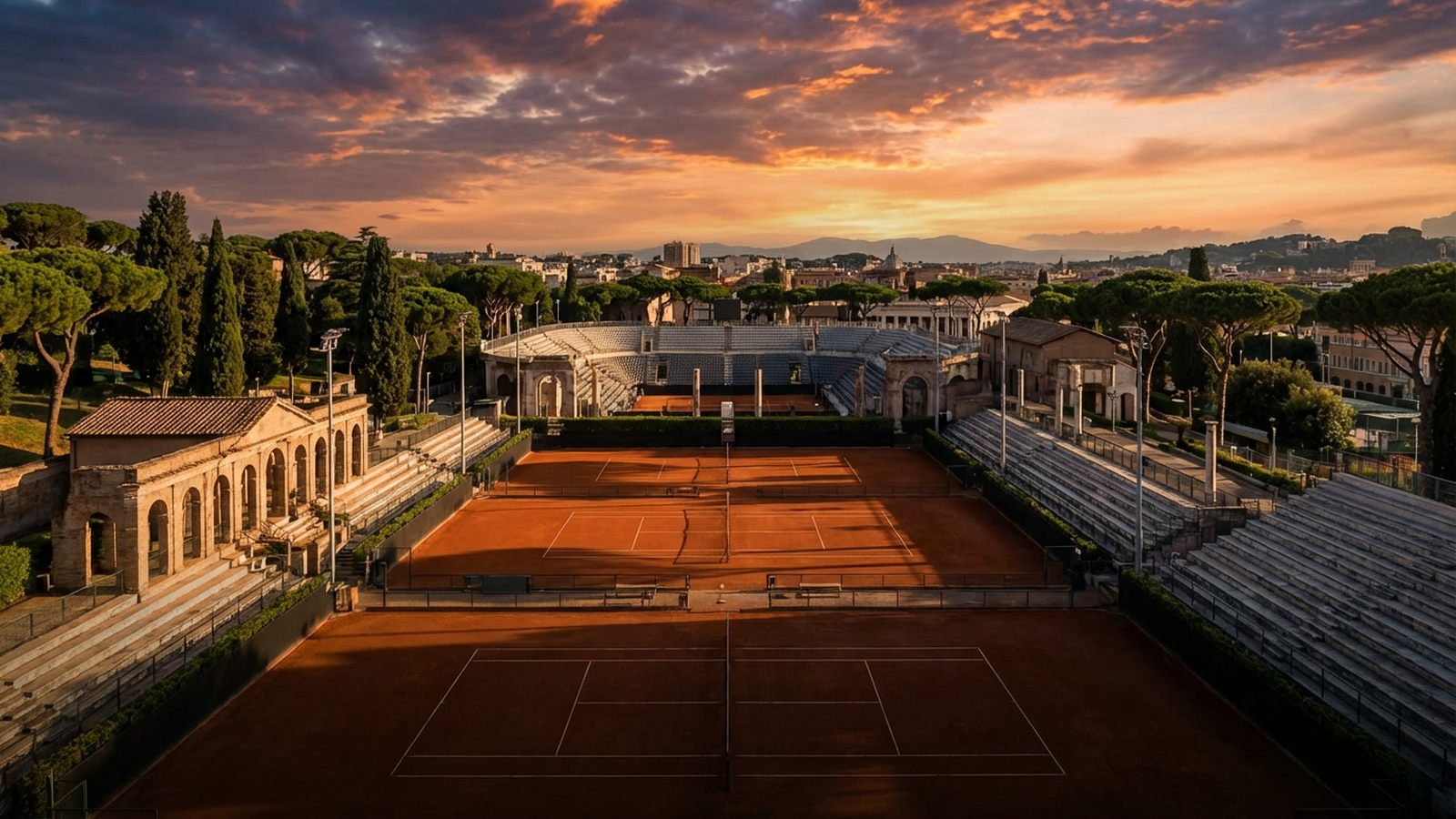
The Internazionali BNL d’Italia — the Italian Open — is the crown jewel of European clay-court tennis and the final proving ground before Roland Garros. Staged at the majestic Foro Italico in Rome, the tournament has been a fixture on the global calendar since 1930 and today stands as a combined ATP Masters 1000 and WTA 1000 event worth $17.0 million in total prize money. According to TennisMattch.com’s database of 3,794 matches, the red clay of Rome produces a distinctive brand of tennis: long rallies, relentless baseline battles, and a style of play where patience and physicality trump raw power. The tournament’s average match lasts 103.3 minutes, finals clock in at nearly 129.5 minutes, and the record for the longest match — a staggering 314 minutes — belongs to the 2005 final between Rafael Nadal and Guillermo Coria.
The 2026 edition promises to be another spectacular chapter. The expanded two-week, 96-player format introduced in recent years has supercharged both the draw and the atmosphere — the tournament shattered its all-time attendance record in 2024 with 358,396 spectators across the fortnight and set a single-day mark of 36,671 fans on a single Saturday. With Novak Djokovic (6 titles), Carlos Alcaraz (6 title), Alexander Zverev (2 titles), and Iga Swiatek (3 titles) all expected in contention, the Internazionali BNL d’Italia 2026 is shaping up to be the most anticipated clay-court event this side of Paris.
This guide covers everything you need to know ahead of the tournament — from century-spanning history and in-depth statistical analysis to ticket information, weather forecasts, and the stories that have made Rome one of the sport’s most beloved destinations. Every statistic referenced below comes directly from TennisMattch.com’s verified database unless otherwise noted.
Tournament History
Founded in 1930 by Count Alberto Bonacossa, the Internazionali d’Italia debuted at the Tennis Club di Milano in Milan. The tournament moved to its permanent and now iconic home, the Foro Italico in Rome, in 1935. The venue was originally constructed in the 1920s and 1930s as part of Rome’s bid for the 1940 Olympic Games, and its classical marble architecture gave the event an immediate grandeur that few tennis tournaments could match. Following a hiatus during World War II, the competition resumed and steadily grew in stature throughout the post-war decades. When the Open Era began in 1969, Rome was ready — and quickly established itself as one of the premier stops on the professional circuit.
Throughout the 1970s and 1980s, the Italian Open became a battleground for the sport’s greatest clay-court artists. Ilie Nastase, who compiled a 33–10 record and won 2 titles in Rome according to TennisMattch.com’s database, was a dominant force during the early Open Era. Guillermo Vilas (33–13, 1 title) brought Argentine flair to the red clay, while Italy’s own Adriano Panatta (30–16, 1 title) became a national hero with his exploits at the Foro Italico. On the women’s side, Gabriela Sabatini was virtually unbeatable in Rome, amassing an astonishing 32–5 record and 4 titles, while Conchita Martinez matched that haul with 44–10 and 10 titles of her own.
The modern era has been defined by two names above all others. Rafael Nadal captured a record 10 titles in Rome between 2005 and 2021, posting a 70–9 win-loss record — an 88.6% winning percentage that cements the Italian Open as one of his most dominant hunting grounds. Novak Djokovic has been Nadal’s most persistent rival here, winning 10 titles with a 68–12 record (85.0%). Together, the two have accounted for 16 of the men’s titles tracked in TennisMattch.com’s records.
On the WTA side, the 2010s and 2020s have seen generational shifts. Serena Williams won 3 titles in Rome with a 38–12 record, while Maria Sharapova also claimed 3 titles. More recently, Iga Swiatek has established herself as the modern queen of Roman clay with 3 titles and counting. The 2024 edition marked a historic moment when Italy’s own Jasmine Paolini captured her 1 title on home soil, sending the Foro Italico into raptures.
Today, the tournament operates as a two-week ‘mini-Slam’ format with 96-player singles draws in both the ATP and WTA events. The grounds have been expanded from 12 to 20 hectares to accommodate the growth, making the Internazionali BNL d’Italia one of the largest and most ambitious events outside the Grand Slams. Its evolution from a regional European contest into a cornerstone of the global tennis calendar is one of the sport’s great success stories.
| Year | Champion | Runner-Up | Score |
|---|---|---|---|
| 2025 | Carlos Alcaraz (Spain) | Jannik Sinner | 0 – 2 |
| 2024 | Alexander Zverev (Germany) | Nicolas Jarry | 6-4 7-5 |
| 2023 | Daniil Medvedev (RUS) | Holger Rune | 7-5 7-5 |
| 2022 | Novak Djokovic (Serbia) | Stefanos Tsitsipas | 6-0 7-6(5) |
| 2021 | Rafael Nadal | Novak Djokovic | 7-5 1-6 6-3 |
| 2020 | Novak Djokovic (Serbia) | Diego Schwartzman | 7-5 6-3 |
| 2019 | Rafael Nadal | Novak Djokovic | 6-0 4-6 6-1 |
| 2018 | Rafael Nadal | Alexander Zverev | 6-1 1-6 6-3 |
| 2017 | Alexander Zverev (Germany) | Novak Djokovic | 6-4 6-3 |
| 2016 | Andy Murray | Novak Djokovic | 6-3 6-3 |
| 2015 | Novak Djokovic (Serbia) | Roger Federer | 6-4 6-3 |
| 2014 | Novak Djokovic (Serbia) | Rafael Nadal | 4-6 6-3 6-3 |
| 2013 | Rafael Nadal | Roger Federer | 6-1 6-3 |
| 2012 | Rafael Nadal | Novak Djokovic | 7-5 6-3 |
| 2011 | Novak Djokovic (Serbia) | Rafael Nadal | 6-4 6-4 |
| 2010 | Rafael Nadal | David Ferrer | 7-5 6-2 |
| 2009 | Rafael Nadal | Novak Djokovic | 7-6(2) 6-2 |
| 2008 | Novak Djokovic (Serbia) | Stan Wawrinka | 4-6 6-3 6-3 |
| 2007 | Rafael Nadal | Fernando Gonzalez | 6-2 6-2 |
| 2006 | Rafael Nadal | Roger Federer | 6-7(0) 7-6(5) 6-4 2-6 7-6(5) |
| 2005 | Rafael Nadal | Guillermo Coria | 6-4 3-6 6-3 4-6 7-6(6) |
| 2004 | Carlos Moya | David Nalbandian | 6-3 6-3 6-1 |
| 2003 | Felix Mantilla | Roger Federer | 7-5 6-2 7-6(8) |
| 2002 | Andre Agassi | Tommy Haas | 6-3 6-3 6-0 |
| 2001 | Juan Carlos Ferrero | Gustavo Kuerten | 3-6 6-1 2-6 6-4 6-2 |
| 2000 | Magnus Norman | Gustavo Kuerten | 6-3 4-6 6-4 6-4 |
| 1999 | Gustavo Kuerten | Patrick Rafter | 6-4 7-5 7-6(6) |
| 1998 | Marcelo Rios | Albert Costa | W/O |
| Year | Champion | Runner-Up | Score |
|---|---|---|---|
| 2025 | Jasmine Paolini (Italy) | Coco Gauff | 0 – 2 |
| 2024 | Iga Swiatek (Poland) | Aryna Sabalenka | 6-2 6-3 |
| 2023 | Elena Rybakina (Kazakhstan) | Anhelina Kalinina | 6-4 1-0 RET |
| 2022 | Iga Swiatek (Poland) | Ons Jabeur | 6-2 6-2 |
| 2021 | Iga Swiatek (Poland) | Karolina Pliskova | 6-0 6-0 |
| 2015 | Maria Sharapova | Carla Suarez Navarro | 4-6 7-5 6-1 |
| 2014 | Serena Williams | Sara Errani | 6-3 6-0 |
| 2013 | Serena Williams | Victoria Azarenka | 6-1 6-3 |
| 2012 | Maria Sharapova | Na Li | 4-6 6-4 7-6(5) |
| 2011 | Maria Sharapova | Samantha Stosur | 6-2 6-4 |
| 2010 | Maria Jose Martinez Sanchez | Jelena Jankovic | 7-6(5) 7-5 |
| 2009 | Dinara Safina | Svetlana Kuznetsova | 6-3 6-2 |
| 2008 | Jelena Jankovic | Alize Cornet | 6-2 6-2 |
| 2007 | Jelena Jankovic | Svetlana Kuznetsova | 7-5 6-1 |
| 2006 | Martina Hingis | Dinara Safina | 6-2 7-5 |
| 2005 | Amelie Mauresmo | Patty Schnyder | 2-6 6-3 6-4 |
| 2004 | Amelie Mauresmo | Jennifer Capriati | 3-6 6-3 7-6(6) |
| 2003 | Kim Clijsters | Amelie Mauresmo | 3-6 7-6(3) 6-0 |
| 2002 | Serena Williams | Justine Henin | 7-6(6) 6-4 |
| 2001 | Jelena Dokic | Amelie Mauresmo | 7-6(3) 6-1 |
| 2000 | Monica Seles | Amelie Mauresmo | 6-2 7-6(4) |
| 1999 | Venus Williams | Mary Pierce | 6-4 6-2 |
Venue & Playing Conditions
The Parco del Foro Italico, located at Viale dei Gladiatori, 31 in the northwest of Rome, is one of the most visually stunning sports complexes in the world. Framed by the Monte Mario hills to the north and the Tiber River to the south, the venue blends classical Roman aesthetics — think white marble, heroic statues, and grand colonnades — with modern sports infrastructure. The main show court, Campo Centrale, seats approximately 10,500 spectators and has hosted some of the most memorable matches in clay-court history, including the 314-minute 2005 final.
The complex was originally built in the 1920s and 1930s by the Fascist-era government as part of a broader sporting precinct designed to showcase Italian athletic prowess. It later served as a venue for the 1960 Rome Olympics, and the layers of history are visible everywhere — from the mosaic pavements lining the walkways to the enormous obelisk at the entrance. The iconic Stadio Nicola Pietrangeli, the tournament’s secondary showcourt, is surrounded by 18 colossal white marble statues depicting various athletic sports, creating an atmosphere unlike anything else in professional tennis.
Surface and Playing Conditions
Rome plays on red clay (terra rossa), an outdoor surface classified as medium-slow in speed. The European red clay at the Foro Italico rewards patience, heavy topspin, and defensive resilience. According to TennisMattch.com’s database, players at the Italian Open average just 3.20 aces per match — slightly below the tour-wide average of 3.33 — confirming that the surface suppresses big serving. First-serve percentage sits at 62.87%, nearly identical to the tour average of 62.60%, but the real story is what happens after the serve lands: first-serve points won average only 65.93%, while second-serve points won drop to 48.98%. The clay slows the ball, gives returners time, and turns every service game into a potential battle.
The Foro Italico sits at relatively low altitude with no extreme elevation effects. However, the venue’s open design means wind can be a factor — historical climate data shows average wind speeds of 17.1 km/h during tournament weeks over the past five years. The clay surface also interacts with ambient temperature and humidity; hotter, drier conditions tend to speed up the court slightly, while cooler, damper days produce a heavier, slower ball that favors grinders and counter-punchers.
Recent Expansion
The move to a 96-player draw and two-week format necessitated significant infrastructure upgrades. The tournament grounds expanded from 12 to 20 hectares, and in a creative architectural decision, the adjacent Stadio dei Marmi — a historical track-and-field arena — was converted by building a temporary 3,000-seat stadium directly inside it. This gave the tournament a dramatic additional showcourt without sacrificing the venue’s heritage character. The expansion has been wildly successful: the 2024 edition drew a record 358,396 total spectators.
Getting There
The Foro Italico is located just north of Vatican City and adjacent to the Stadio Olimpico. Visitors can walk across the scenic Ponte della Musica footbridge to reach the vibrant Flaminio district, while the historic city center and the culinary hotspots of Trastevere are easily accessible by Rome’s metro and bus networks. For those combining tennis with sightseeing, St. Peter’s Basilica and the Vatican Museums are mere minutes away.
Serve Dominance
Clay courts are where serve dominance goes to die — and the Italian Open’s numbers prove it with forensic precision. According to TennisMattch.com’s database of 3,794 matches, players at the Foro Italico average just 3.20 aces per match, marginally below the tour-wide average of 3.33. That 4% reduction may seem modest, but it compounds over hundreds of service games per tournament to produce a measurably different playing experience.
First Serve: Landing It vs. Winning It
The average first-serve percentage in Rome is 62.87%, essentially on par with the tour-wide mark of 62.60%. Players aren’t finding the serve harder to land in Rome — they’re finding it harder to win once they do. First-serve points won average 65.93% at the Italian Open, a figure that trails what big servers typically produce on faster surfaces. The red clay strips pace off the ball, giving returners an extra split-second to read direction and set up an aggressive response.
Second-serve points won tell an even starker story: 48.98%. That’s nearly a coin flip. On faster surfaces, a reliable second serve is a safety net; on Roman clay, it’s an invitation for the returner to step in and dictate the rally. This dynamic is why the tournament’s greatest champions — Nadal (averaging 1.50 aces per match) and Djokovic (3.47 aces) — didn’t rely on free points from the serve. They won with relentless returning, crushing break-point conversion, and the stamina to sustain that pressure across marathon matches.
Double Faults: The Hidden Tax
Players at the Italian Open average 2.67 double faults per match, which is actually lower than the tour-wide average of 2.97. This suggests that players consciously dial back risk on their second serves in Rome, prioritizing placement over power. It’s a rational trade-off: on clay, a slightly slower but well-placed second serve is far less punishing than a double fault that hands a free point — and potentially a service break — to an opponent who is likely already controlling the rally from the baseline.
Ace Trends Over Time
The annual data reveals interesting evolution. In 2009, the tournament averaged just 2.56 aces per match. By 2010, that had risen to 3.21. In the most recent editions — 2023 (2.94), 2024 (3.06), and 2025 (3.25) — a clear upward trend is visible. Modern racket technology, improved physical conditioning, and the general trend toward more aggressive second serves even on clay appear to be slowly lifting the ace count. Still, the numbers remain well below what you’d see on grass or hard courts, preserving the Italian Open’s identity as a tournament where rallies — not serves — decide matches.
Star Players and Serve Profiles
The contrast between the tournament’s greatest champions and its most frustrated contenders is illuminating. Rafael Nadal averaged a modest 1.50 aces per match in Rome — among the lowest of any top-10 player in the database — yet won 10 titles. His first-serve percentage of 69.83% was the highest among the top recorded players, meaning he prioritized getting his first serve in play over blasting aces. Contrast that with Roger Federer, who averaged 4.86 aces per match and a first-serve percentage of 61.38% — yet never won a single title in Rome despite 34 wins and 51 total matches. Serena Williams, with 5.13 aces per match, also relied more on serve firepower, but her 3 titles suggest the WTA game may reward aggressive serving on clay more than the ATP game does. The lesson from Rome is clear: on terra rossa, serving is about consistency and placement, not raw power.
| Year | Matches | Avg Aces | Avg DFs | 1st Serve % | BP Conv % |
|---|---|---|---|---|---|
| 2025 | 356 | 3.3 | 3.3 | — | 45.1% |
| 2024 | 380 | 3.1 | 3.1 | 61.3% | 43.6% |
| 2023 | 378 | 2.9 | 2.9 | 62.8% | 45.7% |
| 2022 | 218 | 2.9 | 2.9 | 61.2% | 44.9% |
| 2021 | 216 | 3.4 | 3.1 | 60.4% | 44.5% |
| 2020 | 110 | 3.9 | 2.7 | 60.0% | 40.8% |
| 2019 | 110 | 4.2 | 2.4 | 62.3% | 45.5% |
| 2018 | 110 | 4.2 | 2.1 | 62.1% | 45.1% |
| 2017 | 110 | 5.4 | 2.1 | 62.4% | 43.1% |
| 2016 | 110 | 3.9 | 2.1 | 63.6% | 44.7% |
| 2015 | 214 | 3.8 | 2.8 | 64.3% | 44.9% |
| 2014 | 218 | 3.2 | 1.9 | 65.3% | 48.4% |
| 2013 | 208 | 2.9 | 2.5 | 63.5% | 47.3% |
| 2012 | 208 | 2.4 | 2.5 | 63.7% | 46.7% |
| 2011 | 206 | 2.6 | 2.1 | 64.6% | 46.3% |
| 2010 | 218 | 3.2 | 2.4 | 64.6% | 44.6% |
| 2009 | 218 | 2.6 | 2.9 | 62.2% | 46.5% |
| 2008 | 206 | 2.9 | 2.6 | 63.7% | 46.7% |
Break Point Battles
If serves are suppressed on Roman clay, break points are amplified — and the data confirms it. According to TennisMattch.com’s database, the average break-point conversion rate at the Internazionali BNL d’Italia is 45.37%, compared to a tour-wide average of 45.23%. That difference is small but meaningful when extrapolated across thousands of matches: the slower surface gives returners more time to construct rallies, which translates into more break-point opportunities and a slight conversion edge.
Why Clay Elevates Break-Point Drama
The mechanics are straightforward. On clay, the ball bounces higher and slower, neutralizing the server’s advantage. This gives the returner more time to get into position, more opportunity to attack a weak second serve, and more runway to construct the kind of extended rally that wears down a server under pressure. With second-serve points won sitting at just 48.98% in Rome, every second serve under break-point pressure becomes a psychological minefield. The server knows they can’t afford a double fault (average: 2.67 per match), but they also can’t simply push the ball in and hope for the best against a returner who is primed to attack.
The Nadal Blueprint
Rafael Nadal’s break-point conversion rate in Rome is a masterclass in returning excellence: 49.20%. That’s nearly four percentage points above the tournament average and far above the tour-wide norm. Nadal converted nearly half of every break-point opportunity he faced in Rome — across 79 matches spanning nearly two decades. This stat alone explains much of his dominance: when Nadal had a chance to break, he took it almost one out of every two times. Combined with his own near-impregnable service games (aided by a 69.83% first-serve percentage that minimized pressure on his second delivery), this conversion rate meant that opponents had vanishingly small margins for error. One lapse in a service game, and Nadal would pounce.
Year-by-Year Conversion Trends
Break-point conversion rates have fluctuated across recent editions. The 2023 tournament saw a robust 45.72% average conversion rate, while 2024 dipped to 43.64% — the lowest in our recent sample. In 2025, the number bounced back to 45.11%, closer to the historical norm. These swings likely reflect draw composition: in years when big servers make deep runs, the tournament-wide conversion rate drops; when grinders and counter-punchers dominate, it rises.
What to Watch in 2026
For the Internazionali BNL d’Italia 2026, the break-point battle will be decisive. Returners who can consistently convert above the 45.37% tournament average will have an enormous structural advantage. Players like Iga Swiatek and Carlos Alcaraz, known for their aggressive returning games, tend to thrive in exactly this kind of environment. Conversely, serve-dependent players who can’t sustain break-point defense across five-set-length rallies on clay may find Rome an unforgiving venue.
Match Duration
Tennis in Rome is not for the faint-hearted — or the short of attention span. According to TennisMattch.com’s database of 2,351 matches with recorded durations, the average Italian Open match lasts 103.3 minutes, with a median of 98 minutes. That’s nearly an hour and three-quarters of clay-court combat per match, and the number climbs dramatically as the rounds progress.
Duration by Round
The data reveals a clear escalation from the opening rounds to the final. First-round matches (R64) average 100.5 minutes. By the Round of 16, that rises to 104.4 minutes. Quarterfinals average 106.8 minutes, and semifinals push to 107.4 minutes. But the real marathon awaits in the final: the average championship match in Rome lasts 129.5 minutes — more than two hours and nine minutes of high-stakes clay-court tennis.
Interestingly, the R128 round (first round of the expanded draw) actually averages 114.3 minutes — longer than some later rounds. This may reflect the fact that early-round matches in a 96-player draw often pit qualifiers and lower-ranked players against each other, producing more competitive, grinding affairs. The R32 round (102.4 minutes) then sees a dip as top seeds begin dispatching overmatched opponents more efficiently.
Median match length: 98 minutes
Longest match: Rafael Nadal d. Guillermo Coria 6-4 3-6 6-3 4-6 7-6(6) (314 min, F 2005)
The Longest Match in Tournament History
The record belongs to the 2005 final between Rafael Nadal and Guillermo Coria: a staggering 314 minutes — five hours and fourteen minutes — of relentless clay-court warfare. The final score of 6-4, 3-6, 6-3, 4-6, 7-6(6) tells the story of two players who refused to yield, trading sets back and forth before a seventh tiebreak at 6-6 in the fifth set decided the championship. This match was Nadal’s first Italian Open title at just 18 years old, and it set the tone for a decade-plus of dominance. Remarkably, the shortest recorded match in the database clocks in at just 1 minute, almost certainly a retirement or walkover.
Why Rome Matches Run Long
Several factors conspire to extend match times in Rome. The clay surface produces longer rallies — with players averaging 20.22 winners per match, the point construction is methodical rather than explosive. The relatively low ace count (3.20 per match) means fewer free points, forcing both players to earn virtually every point through rally play. And the high break-point conversion rate (45.37%) ensures that service games are frequently contested, adding games — and minutes — to every set. For spectators, this means extraordinary value: a grounds pass at the Italian Open buys access to some of the longest, most absorbing matches on the tennis calendar.
Year-by-Year Trends
Eighteen years of data from TennisMattch.com reveal how the Italian Open has evolved — and, in some ways, how it has stayed remarkably consistent. The tournament’s expanded format has dramatically increased the annual match count, while subtle shifts in playing style and technology have left their mark on the underlying statistics.
Match Volume: The Expansion Effect
The most visible trend is the sheer growth in matches played. In 2008, the tournament produced 206 matches. By 2010, that was 218. The expansion to larger draws pushed the count to 378 matches in 2023, 380 in 2024, and 356 in 2025. The two-week, 96-player format has nearly doubled the amount of competitive tennis played at the Foro Italico compared to a decade and a half ago. This growth has been accompanied by record attendance — 358,396 in 2024 — confirming that demand has kept pace with supply.
Aces: Slow but Steady Rise
The average ace count has trended upward over time. In 2009, players averaged just 2.56 aces per match. By 2010, the figure had jumped to 3.21. Through 2023 (2.94), 2024 (3.06), and 2025 (3.25), the trajectory is clearly upward. Modern racket engineering, taller and more powerful players entering the tour, and tactical evolution toward more aggressive serving — even on clay — are all plausible drivers. Yet the tournament average of 3.20 remains below the tour-wide mark of 3.33, confirming that Rome’s red clay continues to suppress the serve relative to the broader tour.
Double Faults: The Risk-Management Story
Double faults have moved in the opposite direction from what you might expect. In 2008, the average was 2.63 per match. In 2024, it rose to 3.12, and in 2025 it climbed further to 3.27. This increase parallels the rise in aces and suggests that modern players are accepting more second-serve risk. Rather than simply pushing in a safe second serve, today’s competitors are going for more pace and spin on their second deliveries — sometimes successfully (hence more aces), sometimes not (hence more double faults). It’s a calculated trade-off that reflects the broader tour’s evolution toward aggression on every ball.
Break-Point Conversion: Holding Steady
Despite the shifts in serving patterns, break-point conversion has remained remarkably stable. The 2008 average was 46.65%. In 2009, it was 46.50%. In 2010, 44.55%. Fast-forward to 2023 (45.72%), 2024 (43.64%), and 2025 (45.11%). The overall tournament average across all years is 45.37%. This stability suggests that the fundamental dynamics of clay-court returning haven’t changed much: the surface gives returners an enduring structural advantage, and no amount of improved serving technology has been able to shift the equilibrium significantly.
First-Serve Percentage: Marginal Tightening
First-serve percentage has shown slight fluctuations without a clear directional trend. In 2008, the average was 63.69%. In 2010, 64.59%. In 2023, 62.83%. In 2024, 61.33%. The overall tournament average is 62.87%, nearly identical to the tour-wide figure of 62.60%. The consistency of this metric suggests that first-serve accuracy is a player-level skill that doesn’t vary much by surface — it’s what happens after the serve that makes clay so different.
| Year | Matches | Avg Aces | Avg DFs | 1st Serve % | BP Conv % |
|---|---|---|---|---|---|
| 2025 | 356 | 3.3 | 3.3 | — | 45.1% |
| 2024 | 380 | 3.1 | 3.1 | 61.3% | 43.6% |
| 2023 | 378 | 2.9 | 2.9 | 62.8% | 45.7% |
| 2022 | 218 | 2.9 | 2.9 | 61.2% | 44.9% |
| 2021 | 216 | 3.4 | 3.1 | 60.4% | 44.5% |
| 2020 | 110 | 3.9 | 2.7 | 60.0% | 40.8% |
| 2019 | 110 | 4.2 | 2.4 | 62.3% | 45.5% |
| 2018 | 110 | 4.2 | 2.1 | 62.1% | 45.1% |
| 2017 | 110 | 5.4 | 2.1 | 62.4% | 43.1% |
| 2016 | 110 | 3.9 | 2.1 | 63.6% | 44.7% |
| 2015 | 214 | 3.8 | 2.8 | 64.3% | 44.9% |
| 2014 | 218 | 3.2 | 1.9 | 65.3% | 48.4% |
| 2013 | 208 | 2.9 | 2.5 | 63.5% | 47.3% |
| 2012 | 208 | 2.4 | 2.5 | 63.7% | 46.7% |
| 2011 | 206 | 2.6 | 2.1 | 64.6% | 46.3% |
| 2010 | 218 | 3.2 | 2.4 | 64.6% | 44.6% |
| 2009 | 218 | 2.6 | 2.9 | 62.2% | 46.5% |
| 2008 | 206 | 2.9 | 2.6 | 63.7% | 46.7% |
King of the Internazionali BNL d'Italia
Rafael Nadal won 10 titles at the Internazionali BNL d’Italia — more than any other player in the tournament’s history, men’s or women’s. His Roman empire spanned from 2005 to 2021, encompassing title victories in 2005, 2006, 2007, 2009, 2010, 2012, 2013, 2018, 2019, and 2021. According to TennisMattch.com’s database, Nadal compiled a 70–9 record in Rome — an 88.6% winning percentage — across 79 total matches.
The Statistical Fingerprint of Dominance
Nadal’s approach to Rome was the antithesis of modern power tennis — and devastatingly effective. He averaged just 1.50 aces per match, the lowest among all players with significant records in the database. But his 69.83% first-serve percentage was the highest of any top player tracked — nearly seven percentage points above the tournament average of 62.87%. This tells a precise tactical story: Nadal didn’t try to hit through his opponents on serve. He got his first serve in play at an elite rate, used its heavy topspin and depth to neutralize the return, and then dominated the rally with his forehand and court coverage.
On the return side, Nadal’s 49.20% break-point conversion rate was nearly four points above the tournament average of 45.37%. This means that across 79 matches in Rome, Nadal converted almost half of every break-point opportunity he created. For opponents, the math was brutal: hold every service game perfectly, or face the near-certainty that Nadal would break and then consolidate with his own impenetrable service games.
The Arc of the Dynasty
Nadal’s first Roman title in 2005 — the epic 314-minute final against Guillermo Coria — announced a teenager who played clay-court tennis with a ferocity the sport hadn’t seen. He won three consecutive titles from 2005 to 2007, establishing himself as the Foro Italico’s undisputed king before a brief interruption. He reclaimed the throne in 2009 and 2010, then again in 2012 and 2013, before a remarkable late-career resurgence produced titles in 2018, 2019, and 2021. The 2021 victory, Nadal’s 10th, came at age 34 — a testament to his extraordinary physical conditioning and his undiminished mastery of the Roman clay.
Nadal vs. Djokovic: Rome’s Defining Rivalry
The only player who came close to challenging Nadal’s Roman supremacy was Novak Djokovic, who won 6 titles with a 68–12 record (85.0% win rate). Djokovic’s serve was more potent in Rome — 3.47 aces per match compared to Nadal’s 1.50 — and his first-serve percentage of 66.51% was also strong, if lower than Nadal’s. But the difference in title count (10 vs. 6) and win-loss efficiency (88.6% vs. 85.0%) underscores that Rome remained Nadal’s tournament above all. Their finals and semifinals in Rome — played before raucous, passionate Italian crowds under the Monte Mario sunset — constitute some of the most iconic matches in the tournament’s nearly century-long history.
Legacy
With Nadal retired from professional tennis, his record of 10 titles stands as a monument that may never be surpassed. Novak Djokovic (6 titles) is the nearest active challenger, but at this stage of his career, matching Nadal’s mark would require an extraordinary run. On the women’s side, Iga Swiatek (3 titles) has the game and the age to build a significant legacy in Rome, but she would need seven more titles to match Nadal’s count — a generational undertaking. For now, Rafael Nadal remains, unambiguously, the King of Rome.
| Player | Record | Titles | Avg Aces |
|---|---|---|---|
| Rafael Nadal | 70W-9L | 10 | 1.5 |
| Novak Djokovic (Serbia) | 68W-12L | 6 | 3.5 |
| Conchita Martinez | 44W-10L | 4 | — |
| Serena Williams | 38W-12L | 3 | 5.1 |
| Roger Federer | 34W-17L | 0 | 4.9 |
| Ilie Nastase | 33W-10L | 2 | — |
| Guillermo Vilas | 33W-13L | 1 | — |
| Gabriela Sabatini | 32W-5L | 4 | — |
| Arantxa Sanchez Vicario | 30W-12L | 0 | — |
| Adriano Panatta | 30W-16L | 1 | — |
| Jelena Jankovic | 30W-10L | 2 | 2.3 |
| Eddie Dibbs | 29W-10L | 0 | — |
| Jan Kodes | 29W-10L | 0 | — |
| Amelie Mauresmo | 29W-7L | 2 | 3.0 |
| Venus Williams | 28W-10L | 1 | 3.7 |
Greatest Upsets
The red clay of Rome is a great equalizer. The slow surface, the long rallies, and the physical demands of a two-week tournament create conditions where lower-ranked players can hang with the elite — and occasionally knock them out. While TennisMattch.com’s database focuses on aggregate statistics rather than individual upset records, the structural characteristics of the Italian Open explain why Rome has produced some of clay-court tennis’s most memorable shocks.
Why Upsets Happen Here
The data provides the context. With aces averaging just 3.20 per match and second-serve points won at a near-coin-flip 48.98%, top seeds can’t simply blast their way through matches. Every point must be earned through rally play, and that gives underdogs a fighting chance. The 45.37% break-point conversion rate means that even a slight dip in a top player’s service-game concentration can be punished. And with matches averaging 103.3 minutes, the physical toll is immense — fatigue can level the playing field as the tournament progresses.
The Federer Paradox
Perhaps the most striking “upset” narrative in the Italian Open’s history is Roger Federer’s complete failure to win the title. Federer entered Rome year after year as one of the greatest players of all time, compiling 34 wins and 51 total matches and averaging 4.86 aces per match — far above the tournament norm. Yet he walked away with 0 titles. Federer’s game — built on serve-and-volley instincts, one-shot power, and flat groundstrokes — was precisely the wrong toolkit for Roman clay. The surface neutralized his serve advantage and gave his opponents time to run down his winners. His 17 losses in Rome tell the story of a player who was beaten not by any single opponent, but by the court itself.
The Early-Round Gauntlet
The expanded 96-player draw has made the early rounds more dangerous than ever. R128 matches average 114.3 minutes — longer than quarterfinals (106.8) — suggesting that the opening round is genuinely competitive. Top seeds entering their first match may face a qualifier who has already played multiple matches on the Roman clay and found their rhythm. The combination of match fitness, surface familiarity, and the neutralizing effect of clay creates a petri dish for early-round upsets.
Arantxa Sanchez Vicario: The Nearly Woman
On the WTA side, Arantxa Sanchez Vicario embodies the heartbreak of falling just short. The Spanish clay-court specialist compiled a strong 30–12 record in Rome across 42 matches — but never won the title (0 titles). Like Federer on the men’s side, her story serves as a reminder that sustained success in Rome requires not just talent and clay-court pedigree, but a specific combination of physical endurance, mental fortitude, and tactical precision that even great champions sometimes lack.
Rivalries
The Foro Italico has been the stage for some of tennis’s most intense and consequential rivalries. The combination of passionate Italian crowds, a demanding clay surface, and the tournament’s position as the final major warm-up before Roland Garros has elevated ordinary matches into career-defining encounters.
Nadal vs. Djokovic: The Rivalry That Defined an Era
No rivalry has shaped the Italian Open more profoundly than Rafael Nadal vs. Novak Djokovic. Between them, they won 6 titles (Nadal 10, Djokovic 6) and compiled a combined 138–21 record in Rome. Their statistical profiles were mirror images: Nadal relied on an elite first-serve percentage (69.83%) and devastating break-point conversion (49.20%), while Djokovic brought a more balanced arsenal with 3.47 aces per match and a 66.51% first-serve percentage. Their meetings in Rome — often in the semifinals or final — were tennis at its absolute zenith: two players who understood clay better than anyone, fighting for supremacy on the sport’s most atmospheric stage.
What made the rivalry so compelling in Rome was its evolution. In the early years (2005–2010), Nadal was virtually untouchable on clay, and their Rome encounters often tilted decisively in the Spaniard’s favor. But Djokovic’s game matured, and from 2011 onward he became a genuine threat, eventually claiming multiple titles of his own. The shift reflected broader changes in the sport: Djokovic’s extraordinary returning ability and defensive prowess gave him the tools to compete with Nadal’s physical intensity, even on Rafa’s best surface.
Sabatini vs. Martinez: The WTA’s Roman Duel
In the women’s game, the late 1980s and 1990s produced a compelling Rome rivalry between Gabriela Sabatini and Conchita Martinez. Sabatini’s 32–5 record and 4 titles reflect near-perfection, while Martinez’s 44–10 record and 4 titles demonstrate remarkable sustained excellence across a longer Roman career. Both were quintessential clay-court artists — Sabatini with her elegant one-handed backhand and graceful movement, Martinez with her tactical versatility and relentless consistency. Their overlapping periods of dominance ensured that the WTA draw in Rome was never predictable.
The Modern Triangle: Alcaraz, Djokovic, and Sinner
The Internazionali BNL d’Italia 2026 will likely showcase the next generation of Rome rivalries. Carlos Alcaraz (6 title) has already proven he can win on Roman clay, while Novak Djokovic (6 titles) remains a formidable presence. Italian fans will be desperate to see Jannik Sinner — the world’s top-ranked player as of recent seasons — finally conquer his home tournament. On the WTA side, Iga Swiatek (3 titles) is the clear favorite but faces an increasingly competitive field. The convergence of established champions and hungry challengers makes the 2026 edition a potential turning point in several developing rivalries.
Panatta and the Italian Dream
No discussion of Italian Open rivalries is complete without acknowledging the unique role of Italian players. Adriano Panatta’s 30–16 record and 1 title made him a national icon in the 1970s. More recently, Jasmine Paolini’s breakthrough 1 title on the WTA side has reignited the dream of Italian success at the Foro Italico. The passionate home crowd creates an undeniable advantage — and an enormous pressure — for Italian players, turning their matches into emotionally charged encounters that transcend ordinary competition.
Prize Money & Points
The Internazionali BNL d’Italia 2026 offers a total prize purse of $17.0 million, with the singles champions each taking home $1,050,000. This places the Italian Open firmly among the most lucrative events outside the four Grand Slams and reflects its dual status as both an ATP Masters 1000 and a WTA 1000 event.
Context and Comparison
The $17.0 million purse represents the continued investment in the tournament’s growth. As a combined Masters 1000/WTA 1000 event with 96-player draws, the Italian Open distributes prize money across a significantly larger field than most tournaments. This means meaningful paydays even for first-round losers, making Rome an important stop on the calendar for players outside the top rankings who depend on tournament earnings to fund their travel and training.
The $1,050,000 winner’s check places Rome slightly below the top-tier Masters events like Indian Wells and Miami but comfortably above most other 1000-level tournaments. For players arriving in Rome, the financial stakes are enormous: a deep run can fund months of touring expenses, while a title provides both life-changing prize money and the 1,000 ranking points that come with a Masters crown.
Sponsorship Ecosystem
The prize pool is supported by a robust sponsorship portfolio headlined by BNL (Banca Nazionale del Lavoro), the Italian banking giant that serves as title partner and gives the tournament its official name. Other major sponsors include BMW, EA7 (Emporio Armani’s athleisure line), Reale Mutua, Emirates, and TicketOne. The blend of financial services, luxury automotive, fashion, and travel brands reflects the tournament’s positioning as a premium lifestyle event as much as a sporting competition.
Revenue and Economic Impact
With 358,396 spectators in 2024, the Italian Open generates enormous economic impact for Rome’s tourism and hospitality sectors. Ticket revenue, merchandise sales, food and beverage, and the ripple effects of hundreds of thousands of visitors spending money in hotels, restaurants, and cultural attractions make the tournament one of Rome’s most significant annual events. The $17.0 million prize pool, while substantial, is just a fraction of the total economic value the tournament generates for the Eternal City.
Weather & Conditions
Rome in mid-May is one of the most pleasant places on earth — most of the time. But weather variability can be a real factor at the Internazionali BNL d’Italia 2026, and smart spectators (and players) plan accordingly.
Historical Climate
Based on five-year historical climate averages for Rome during the tournament window, conditions are typically warm and mostly dry. Average daily high temperatures reach 22.9°C (73.2°F), with lows dropping to a comfortable 12.7°C (54.9°F). Average daily precipitation is just 1.8 mm, confirming that extended rain delays are relatively uncommon but not impossible. Wind is a more persistent factor, averaging 17.1 km/h historically — enough to affect ball flight and make high-bouncing topspin shots even more challenging to control on clay.
2026 Forecast
The 14-day forecast for the 2026 edition suggests conditions may be cooler than historical norms. Average highs are projected at 17.5°C (63.4°F) — significantly below the five-year average of 22.9°C — with lows around 7.8°C (46.0°F). The average precipitation probability is 30.6%, suggesting that rain interruptions are a real possibility across the two-week event. Wind is projected at 13.3 km/h, slightly below the historical average but still enough to be a factor on exposed courts.
What This Means for Tennis
Cooler, damper conditions tend to slow the already-slow Roman clay. The ball picks up more moisture from the surface, making it heavier and reducing its pace through the court. This would further benefit defensive players and counter-punchers — players who thrive on extended rallies and whose opponents struggle to generate pace on a heavy ball. For big hitters and aggressive baseliners, the 2026 conditions could be frustrating: shots that normally carry power through the court may sit up and invite a counterpunch.
Spectator Tips
If the forecast holds, fans attending the Internazionali BNL d’Italia 2026 should bring layers. Evenings in the 7–8°C range can feel chilly after hours of sitting courtside, especially during the late-finishing night sessions. A waterproof jacket is essential given the 30.6% rain probability. Sunscreen remains important on clear days — even at 17.5°C, the Roman spring sun is strong — but the usual concerns about heat exhaustion and dehydration that accompany warmer editions are less pressing this year. Comfortable walking shoes are a must: the expanded 20-hectare grounds require significant walking between courts.
Records & Fun Facts
Nearly a century of tennis at the Foro Italico has produced an extraordinary collection of records, milestones, and quirky footnotes. Here are the most compelling facts from the Internazionali BNL d’Italia, drawn from TennisMattch.com’s database and the tournament’s rich history.
Records and Milestones
Nadal’s Roman Empire: Rafael Nadal’s 10 titles at the Italian Open are the most by any player in tournament history, men’s or women’s. His 70–9 record (88.6% win rate) may be the most dominant run at a single Masters 1000 event in tennis history.
314 minutes of madness: The longest match in Italian Open history was the 2005 final between Rafael Nadal and Guillermo Coria, lasting 5 hours and 14 minutes with a final score of 6-4, 3-6, 6-3, 4-6, 7-6(6). Nadal was just 18 years old — and it was his first of 10 titles in Rome.
Djokovic’s 80-match marathon: Novak Djokovic has played 80 total matches at the Italian Open — more than any other player in TennisMattch.com’s database — winning 68 of them for a staggering 85.0% success rate and 6 titles.
Sabatini’s near-perfect record: Gabriela Sabatini lost just 5 matches in her entire Italian Open career, going 32–5 (86.5%) for 4 titles. Her dominance in Rome was perhaps the most efficient in the women’s game.
Federer’s Roman blind spot: Roger Federer played 51 matches in Rome, won 34 of them, and averaged 4.86 aces per match — yet never won the title (0 titles). The Italian Open remains the most glaring gap on his otherwise incomparable resume.
Venue Trivia
Marble guardians: The Stadio Nicola Pietrangeli, the tournament’s secondary showcourt, is surrounded by 18 colossal white marble statues depicting various athletic sports. These statues, designed to evoke the aesthetics of ancient Rome, make it one of the most photographed tennis venues in the world.
Olympic origins: The Foro Italico sports complex was originally constructed in the 1920s and 1930s to help Rome bid for the 1940 Olympic Games. The bid ultimately failed (the Games were awarded to Tokyo, then cancelled due to WWII), but the complex went on to host the 1960 Summer Olympics and, of course, nearly a century of world-class tennis.
A stadium within a stadium: During the tournament’s recent expansion, organizers incorporated the adjacent Stadio dei Marmi by building a temporary 3,000-seat stadium directly inside the historical track-and-field arena. It’s one of the most creative venue solutions in sports.
Statistical Oddities
The ace paradox: The player with the most aces per match among Rome’s top performers is Serena Williams at 5.13, followed by Federer at 4.86. Yet Nadal, who averaged just 1.50 aces per match, won more than three times as many titles as either of them. In Rome, fewer aces equals more championships.
3,794 matches and counting: TennisMattch.com’s database includes 3,794 total matches from the Internazionali BNL d’Italia, spanning decades of Open Era and pre-Open Era competition. It is one of the deepest statistical archives for any tennis tournament in the world.
Winners average: Players average 20.22 winners per match in Rome — a number that reflects the clay court’s tendency to produce rallies where winners must be manufactured through construction rather than raw power. Every winner earned in Rome tells a story of patience and positioning.
Record crowds: The 2024 edition drew 358,396 total spectators, shattering the all-time attendance record. A single-day record of 36,671 fans was also set — more people than attend many Grand Slam sessions. The Italian Open is, by this measure, one of the best-attended tennis events in the world.
Past Champions
| Year | Champion | Runner-Up | Score |
|---|---|---|---|
| 2025 | Carlos Alcaraz (Spain) | Jannik Sinner | 0 – 2 |
| 2024 | Alexander Zverev (Germany) | Nicolas Jarry | 6-4 7-5 |
| 2023 | Daniil Medvedev (RUS) | Holger Rune | 7-5 7-5 |
| 2022 | Novak Djokovic (Serbia) | Stefanos Tsitsipas | 6-0 7-6(5) |
| 2021 | Rafael Nadal | Novak Djokovic | 7-5 1-6 6-3 |
| 2020 | Novak Djokovic (Serbia) | Diego Schwartzman | 7-5 6-3 |
| 2019 | Rafael Nadal | Novak Djokovic | 6-0 4-6 6-1 |
| 2018 | Rafael Nadal | Alexander Zverev | 6-1 1-6 6-3 |
| 2017 | Alexander Zverev (Germany) | Novak Djokovic | 6-4 6-3 |
| 2016 | Andy Murray | Novak Djokovic | 6-3 6-3 |
| 2015 | Novak Djokovic (Serbia) | Roger Federer | 6-4 6-3 |
| 2014 | Novak Djokovic (Serbia) | Rafael Nadal | 4-6 6-3 6-3 |
| 2013 | Rafael Nadal | Roger Federer | 6-1 6-3 |
| 2012 | Rafael Nadal | Novak Djokovic | 7-5 6-3 |
| 2011 | Novak Djokovic (Serbia) | Rafael Nadal | 6-4 6-4 |
| 2010 | Rafael Nadal | David Ferrer | 7-5 6-2 |
| 2009 | Rafael Nadal | Novak Djokovic | 7-6(2) 6-2 |
| 2008 | Novak Djokovic (Serbia) | Stan Wawrinka | 4-6 6-3 6-3 |
| 2007 | Rafael Nadal | Fernando Gonzalez | 6-2 6-2 |
| 2006 | Rafael Nadal | Roger Federer | 6-7(0) 7-6(5) 6-4 2-6 7-6(5) |
| 2005 | Rafael Nadal | Guillermo Coria | 6-4 3-6 6-3 4-6 7-6(6) |
| 2004 | Carlos Moya | David Nalbandian | 6-3 6-3 6-1 |
| 2003 | Felix Mantilla | Roger Federer | 7-5 6-2 7-6(8) |
| 2002 | Andre Agassi | Tommy Haas | 6-3 6-3 6-0 |
| 2001 | Juan Carlos Ferrero | Gustavo Kuerten | 3-6 6-1 2-6 6-4 6-2 |
| 2000 | Magnus Norman | Gustavo Kuerten | 6-3 4-6 6-4 6-4 |
| 1999 | Gustavo Kuerten | Patrick Rafter | 6-4 7-5 7-6(6) |
| 1998 | Marcelo Rios | Albert Costa | W/O |
| Year | Champion | Runner-Up | Score |
|---|---|---|---|
| 2025 | Jasmine Paolini (Italy) | Coco Gauff | 0 – 2 |
| 2024 | Iga Swiatek (Poland) | Aryna Sabalenka | 6-2 6-3 |
| 2023 | Elena Rybakina (Kazakhstan) | Anhelina Kalinina | 6-4 1-0 RET |
| 2022 | Iga Swiatek (Poland) | Ons Jabeur | 6-2 6-2 |
| 2021 | Iga Swiatek (Poland) | Karolina Pliskova | 6-0 6-0 |
| 2015 | Maria Sharapova | Carla Suarez Navarro | 4-6 7-5 6-1 |
| 2014 | Serena Williams | Sara Errani | 6-3 6-0 |
| 2013 | Serena Williams | Victoria Azarenka | 6-1 6-3 |
| 2012 | Maria Sharapova | Na Li | 4-6 6-4 7-6(5) |
| 2011 | Maria Sharapova | Samantha Stosur | 6-2 6-4 |
| 2010 | Maria Jose Martinez Sanchez | Jelena Jankovic | 7-6(5) 7-5 |
| 2009 | Dinara Safina | Svetlana Kuznetsova | 6-3 6-2 |
| 2008 | Jelena Jankovic | Alize Cornet | 6-2 6-2 |
| 2007 | Jelena Jankovic | Svetlana Kuznetsova | 7-5 6-1 |
| 2006 | Martina Hingis | Dinara Safina | 6-2 7-5 |
| 2005 | Amelie Mauresmo | Patty Schnyder | 2-6 6-3 6-4 |
| 2004 | Amelie Mauresmo | Jennifer Capriati | 3-6 6-3 7-6(6) |
| 2003 | Kim Clijsters | Amelie Mauresmo | 3-6 7-6(3) 6-0 |
| 2002 | Serena Williams | Justine Henin | 7-6(6) 6-4 |
| 2001 | Jelena Dokic | Amelie Mauresmo | 7-6(3) 6-1 |
| 2000 | Monica Seles | Amelie Mauresmo | 6-2 7-6(4) |
| 1999 | Venus Williams | Mary Pierce | 6-4 6-2 |
Year-by-Year Statistics
| Year | Matches | Avg Aces | Avg DFs | 1st Serve % | BP Conv % |
|---|---|---|---|---|---|
| 2025 | 356 | 3.3 | 3.3 | — | 45.1% |
| 2024 | 380 | 3.1 | 3.1 | 61.3% | 43.6% |
| 2023 | 378 | 2.9 | 2.9 | 62.8% | 45.7% |
| 2022 | 218 | 2.9 | 2.9 | 61.2% | 44.9% |
| 2021 | 216 | 3.4 | 3.1 | 60.4% | 44.5% |
| 2020 | 110 | 3.9 | 2.7 | 60.0% | 40.8% |
| 2019 | 110 | 4.2 | 2.4 | 62.3% | 45.5% |
| 2018 | 110 | 4.2 | 2.1 | 62.1% | 45.1% |
| 2017 | 110 | 5.4 | 2.1 | 62.4% | 43.1% |
| 2016 | 110 | 3.9 | 2.1 | 63.6% | 44.7% |
| 2015 | 214 | 3.8 | 2.8 | 64.3% | 44.9% |
| 2014 | 218 | 3.2 | 1.9 | 65.3% | 48.4% |
| 2013 | 208 | 2.9 | 2.5 | 63.5% | 47.3% |
| 2012 | 208 | 2.4 | 2.5 | 63.7% | 46.7% |
| 2011 | 206 | 2.6 | 2.1 | 64.6% | 46.3% |
| 2010 | 218 | 3.2 | 2.4 | 64.6% | 44.6% |
| 2009 | 218 | 2.6 | 2.9 | 62.2% | 46.5% |
| 2008 | 206 | 2.9 | 2.6 | 63.7% | 46.7% |
All-Time Player Records
| Player | Record | Titles | Avg Aces |
|---|---|---|---|
| Rafael Nadal | 70W-9L | 10 | 1.5 |
| Novak Djokovic (Serbia) | 68W-12L | 6 | 3.5 |
| Conchita Martinez | 44W-10L | 4 | — |
| Serena Williams | 38W-12L | 3 | 5.1 |
| Roger Federer | 34W-17L | 0 | 4.9 |
| Ilie Nastase | 33W-10L | 2 | — |
| Guillermo Vilas | 33W-13L | 1 | — |
| Gabriela Sabatini | 32W-5L | 4 | — |
| Arantxa Sanchez Vicario | 30W-12L | 0 | — |
| Adriano Panatta | 30W-16L | 1 | — |
| Jelena Jankovic | 30W-10L | 2 | 2.3 |
| Eddie Dibbs | 29W-10L | 0 | — |
| Jan Kodes | 29W-10L | 0 | — |
| Amelie Mauresmo | 29W-7L | 2 | 3.0 |
| Venus Williams | 28W-10L | 1 | 3.7 |