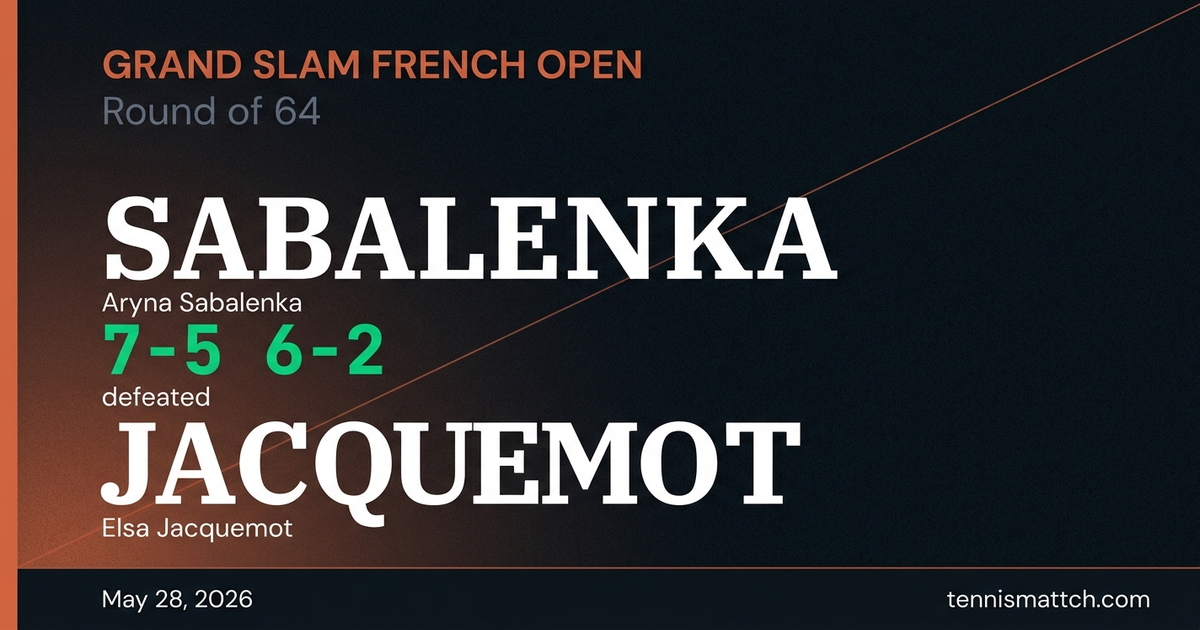


Aryna Sabalenka defeated Elsa Jacquemot 7-5, 6-2 in the French Open second round on Tuesday, overcoming a tight opening set with a dominant second-set display. The reigning finalist fired 45 winners—three times Jacquemot’s total of 15—and converted five of ten break point opportunities to advance to the round of 32 at Roland Garros.
Jacquemot pushed Sabalenka through a competitive first set, staying within striking distance until the final games. The Frenchwoman’s cleaner ball-striking limited her unforced errors to just 11, compared to Sabalenka’s 31, but she lacked the firepower to sustain pressure. Sabalenka’s ability to win 54% of second serve points proved decisive, exploiting Jacquemot’s woeful 29% return rate on those exchanges. Once the second seed seized the opening set, she raced through the second, breaking twice to close out the match in routine fashion.
The match showcased the gulf in offensive weaponry. Sabalenka’s 45 winners—well above her clay court average of 26 per match—underscored her aggressive intent despite the 31 unforced errors. Jacquemot’s three aces and three double faults reflected the tight margins she operated within, unable to generate enough free points or sustained pressure against one of the tour’s most imposing clay court players.
Key Takeaways
- Sabalenka’s 45 winners dwarfed Jacquemot’s 15, demonstrating a three-to-one advantage in offensive shot-making that the Frenchwoman could not overcome despite cleaner ball-striking.
- The second serve return became Jacquemot’s undoing—she won just 29% of points on Sabalenka’s second serve, the lowest efficiency mark in any category and a staggering 25-point gap from Sabalenka’s 54% return rate.
- Sabalenka’s five break point conversions from ten opportunities proved sufficient, maintaining her typical clay court conversion rate (39.2% average) while Jacquemot could only manage two breaks from seven chances.
- The winner-to-error differential tells the story: Sabalenka’s +14 margin (45 winners to 31 errors) outweighed Jacquemot’s cautious +4 ledger (15 winners to 11 errors), proving aggression pays on clay when paired with power.
Player Analysis
Aryna Sabalenka
The Belarusian delivered precisely the kind of performance expected from a Roland Garros finalist—aggressive, relentless, and gradually overwhelming. Her 45 winners, nearly double her clay court average of 26, reflected a willingness to take risks against an opponent she knew she could overpower. The 31 unforced errors suggest some rust on the surface, but her 66% first serve points won and 54% second serve return rate demonstrate she controlled the important exchanges. Breaking five times from ten opportunities kept Jacquemot constantly under pressure, never allowing the Frenchwoman to settle into a rhythm.
Sabalenka’s willingness to absorb errors in pursuit of winners paid dividends in the second set, where she accelerated through six games to close out the match efficiently. Her zero double faults—a rarity given her aggressive service motion—indicated improved discipline compared to her 2.5 per match clay court average. With six wins in her last ten matches and momentum from Miami, she appears to be finding form at the right time for another deep Roland Garros run.
Elsa Jacquemot
The Frenchwoman played a clean but ultimately toothless match, limiting herself to just 11 unforced errors while generating only 15 winners. Her 64% first serve percentage and 58% points won on first serve represented solid fundamentals, but she could not sustain pressure without more offensive firepower. The 29% second serve return rate proved catastrophic—she won fewer than one in three points when Sabalenka missed her first delivery, a statistic that guaranteed defeat against a player of Sabalenka’s caliber.
Jacquemot’s three aces matched her three double faults, encapsulating the narrow margins she operated within. Her break point conversion (2 of 7) fell well short of her clay court average of 54.9%, suggesting Sabalenka’s quality elevated in the crucial moments. The gulf in winner production—45 to 15—exposed the harsh reality: Jacquemot’s 4-8 career clay record and limited power game leave her ill-equipped to challenge the tour’s elite on red dirt.
Match Statistics
| Aryna Sabalenka | Stat | Elsa Jacquemot |
|---|---|---|
| 2 | Aces | 3 |
| 0 | Double Faults | 3 |
| 56% | 1st Serve % | 64% |
| 66% | 1st Serve Points Won | 58% |
| 54% | 2nd Serve Points Won | 29% |
| 5/10 | Break Points Won | 2/7 |
| 45 | Winners | 15 |
| 31 | Unforced Errors | 11 |
| 73 | Total Points Won | 56 |
Frequently Asked Questions
What was the final score of Sabalenka vs Jacquemot at the French Open 2026?
Aryna Sabalenka defeated Elsa Jacquemot 7-5, 6-2 in the second round of the 2026 French Open.
How many winners did Aryna Sabalenka hit against Elsa Jacquemot?
Sabalenka struck 45 winners, three times Jacquemot’s total of 15 winners and well above her clay court average of 26 winners per match.
Who won the French Open 2026 second round match between Sabalenka and Jacquemot?
Aryna Sabalenka won in straight sets, advancing to the round of 32 at Roland Garros.
What was Jacquemot’s second serve return percentage against Sabalenka?
Elsa Jacquemot won just 29% of points on Sabalenka’s second serve, a critical weakness that contributed to her defeat.
What’s Next
Sabalenka advances to the round of 32, where she will look to continue her pursuit of a 24th career title. As the 2025 finalist, she remains one of the favorites to claim the championship, particularly if her winner production stays at this elevated level.
Follow all results: French Open 2026.