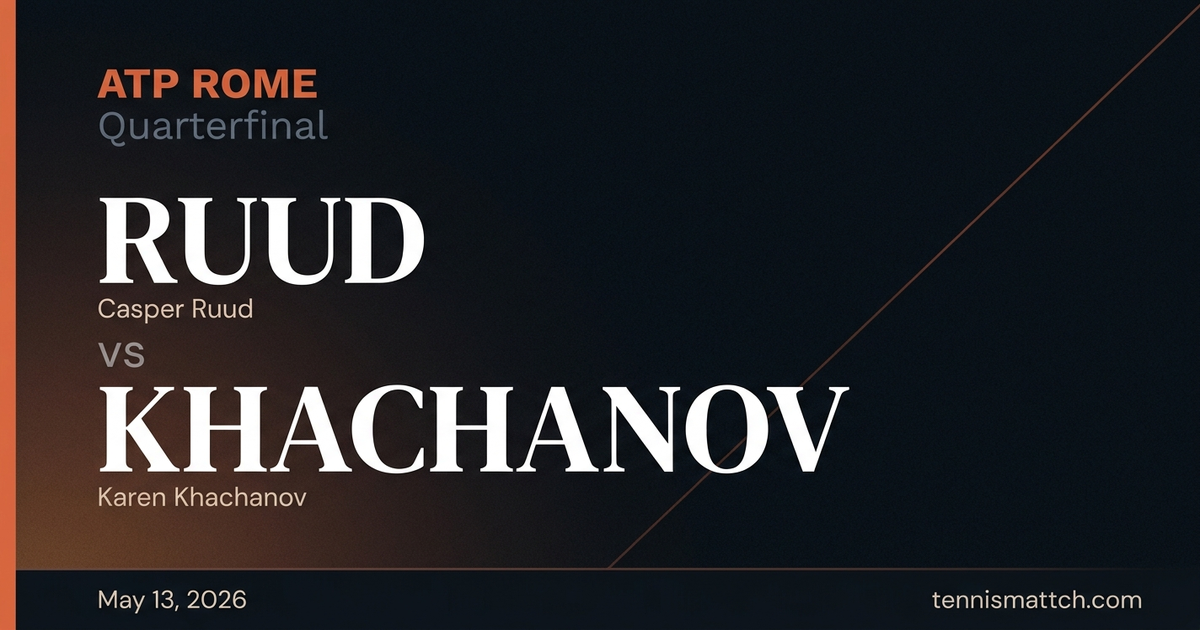



Casper Ruud and Karen Khachanov meet in the Rome quarterfinals on May 13, 2026, with Ruud holding a 2-1 career edge though notably they’ve never faced each other on clay. The Norwegian’s superior clay pedigree—163-57 career record on the surface—contrasts with Khachanov’s surging form, the Russian averaging 5.1 more winners per match and converting break points at 45.5% compared to Ruud’s 40.3%.
The model’s simulation gives Ruud a 55.3% edge, driven largely by his clay-specific Elo rating of 1670 versus Khachanov’s 1646. Yet the projection of 25.9 total games and a 50% probability of straight sets suggests tactical dynamics could override raw surface expertise. Both arrive unbeaten in Rome this fortnight, but their paths diverge in style: Ruud’s baseline consistency versus Khachanov’s aggressive shot-making.
The H2H record offers limited clay insight—their most recent encounter came five weeks ago at the UTS Championship, where Ruud prevailed in a non-traditional format. Their last ATP tour meeting on hard court in Toronto nine months ago saw Khachanov win in straight sets, while their only Grand Slam clash came in the 2022 US Open semifinals with Ruud advancing. This quarterfinal represents uncharted territory for the rivalry on clay.
Key Takeaways
- Ruud’s clay court mastery (163-57 career record, .741 win rate) gives him a 14.7-point winning percentage edge over Khachanov (.594), yet they’ve never played on this surface—making statistical history less predictive than recent form.
- Khachanov’s offensive metrics suggest tactical pressure: he produces 25.3 winners per match versus Ruud’s 20.2, and converts break points 5.2 percentage points more efficiently—critical on a surface where break opportunities are scarce.
- The model projects 25.9 total games with 50% straight-set probability, indicating a tight encounter where small tactical margins could decide the outcome—particularly in pressure moments like tiebreaks or deciding-set scenarios.
- Both players are 2-0 in Rome 2026, but Ruud’s tournament pedigree (2025 quarterfinalist, 2023 semifinalist) contrasts with Khachanov’s historically earlier exits, suggesting the Norwegian thrives as matches deepen while the Russian may face unfamiliar late-round pressure.
Player Analysis
Casper Ruud
The Norwegian arrives as one of clay’s most reliable performers, his 163-57 career record representing elite-level consistency on the surface. His recent Rome run—dispatching Lorenzo Musetti 6-3 6-1 and Jiri Lehecka 6-3 6-4—showcases the topspin-heavy baseline game that has carried him to multiple Roland Garros finals. Yet his 20.2 winners per match and 40.3% break point conversion suggest a more defensive posture than Khachanov’s attacking style, potentially forcing him to absorb pressure rather than dictate play.
Ruud’s vulnerability emerges against opponents who take time away from him—his recent 5-5 record includes hard court struggles where faster conditions exposed his reactive tendencies. Khachanov’s flat power could replicate those difficulties even on clay, particularly if the Russian establishes control of the baseline early. Ruud’s path to victory likely requires extending rallies, exploiting Khachanov’s 2.4 double faults per match, and converting the break opportunities his consistency generates in long sets.
Karen Khachanov
The Russian’s recent form suggests he’s peaking precisely when it matters—his 25.3 winners per match and 45.5% break point conversion indicate an aggressive mindset that’s translated to results in Rome. His comeback victory over Botic van de Zandschulp (5-7 6-4 6-4) revealed mental resilience, while his dominant 6-1 7-6 win over Joao Faria showed the capacity to close matches efficiently when given openings. That firepower could trouble Ruud if Khachanov maintains his recent precision.
The concern for Khachanov lies in sustainability—his 79-54 clay record (.594) reflects a player who can dominate stretches but lacks Ruud’s consistency over long matches. His 4.8 aces per match provide free points, yet they also signal reliance on serve strength that clay’s slower surface neutralizes compared to hard courts. If Ruud forces extended baseline exchanges and Khachanov’s winner count drops, the Norwegian’s superior clay court endurance could become decisive in a potential third set. The model’s 27% probability of a 2-1 Ruud victory captures this scenario.
Head-to-Head Record
| Date | Tournament | Surface | Winner | Score |
|---|---|---|---|---|
| 2026-04-03 | UTS Championship | Hard | Casper Ruud | 3-1 |
| 2025-08-02 | Toronto | Hard | Karen Khachanov | 2-0 |
| 2022-09-09 | US Open | Hard | Casper Ruud | 1-3 |
Match Prediction
| Casper Ruud | Karen Khachanov | |
|---|---|---|
| Elo Rating | 1725 | 1690 |
| Clay Elo | 1670 | 1646 |
| Last 10 Win% | 60% | 60% |
Frequently Asked Questions
Who will win Ruud vs Khachanov at Rome 2026?
The prediction model gives Casper Ruud a 55.3% win probability versus Karen Khachanov’s 44.7%, driven by Ruud’s superior clay court Elo rating (1670 vs 1646) and career surface record (163-57 vs 79-54). However, Khachanov’s recent form—averaging 5.1 more winners per match and converting break points 5.2 percentage points more efficiently—suggests he could dictate play if he maintains his aggressive baseline game. The model projects 25.9 total games with 50% straight-set probability, indicating tactical execution in pressure moments will likely decide the outcome rather than surface pedigree alone.
What is the head-to-head record between Ruud and Khachanov?
Casper Ruud leads the overall head-to-head 2-1, but the record requires context: all three previous meetings occurred on hard courts or non-traditional formats, meaning this Rome quarterfinal will be their first ATP tour encounter on clay. Ruud won their most recent meeting at the UTS Championship in April 2026 (five weeks ago) and defeated Khachanov in the 2022 US Open semifinals. Khachanov’s lone victory came in Toronto nine months ago in August 2025. The absence of clay court precedent makes recent form and surface-specific statistics more predictive than historical H2H results.
Ruud vs Khachanov Rome 2026 prediction
Simulation data suggests Casper Ruud holds a narrow edge with 55.3% win probability, but the projected 25.9 total games indicate a competitive match where Karen Khachanov’s firepower could force a deciding set. Key factors include Ruud’s 14.7-point clay court winning percentage advantage (.741 vs .594 career records) versus Khachanov’s superior break point conversion (45.5% vs 40.3%) and winner production (+5.1 per match). The most likely outcomes are a 2-0 Ruud win (29% probability) if his consistency wears down the Russian, or a 2-1 result either way (50% combined probability) if Khachanov’s aggression splits sets. Ruud’s Rome pedigree—quarterfinal in 2025, semifinal in 2023—suggests he handles late-round pressure more effectively than Khachanov, who historically exits earlier at this event.
When is Ruud vs Khachanov at Rome 2026?
The quarterfinal match is scheduled for May 13, 2026, at the Internazionali BNL d’Italia in Rome. Both players enter with 2-0 records in the tournament, having won their Round of 64 and Round of 16 matches. The winner advances to the semifinals and remains in contention for one of clay’s most prestigious titles ahead of Roland Garros.
What’s Next
The quarterfinal is scheduled for May 13, 2026, on the clay courts of Rome, with the winner advancing to face either the top seed or an emerging contender in the semifinals. For Ruud, a victory would mark his deepest Rome run since the 2023 semifinals and reinforce his status among clay’s elite heading into Roland Garros. For Khachanov, reaching the semifinals would represent his best-ever result at the Foro Italico and validate his recent form surge as more than a temporary hot streak.
Full rivalry page: Casper Ruud vs Karen Khachanov head-to-head.