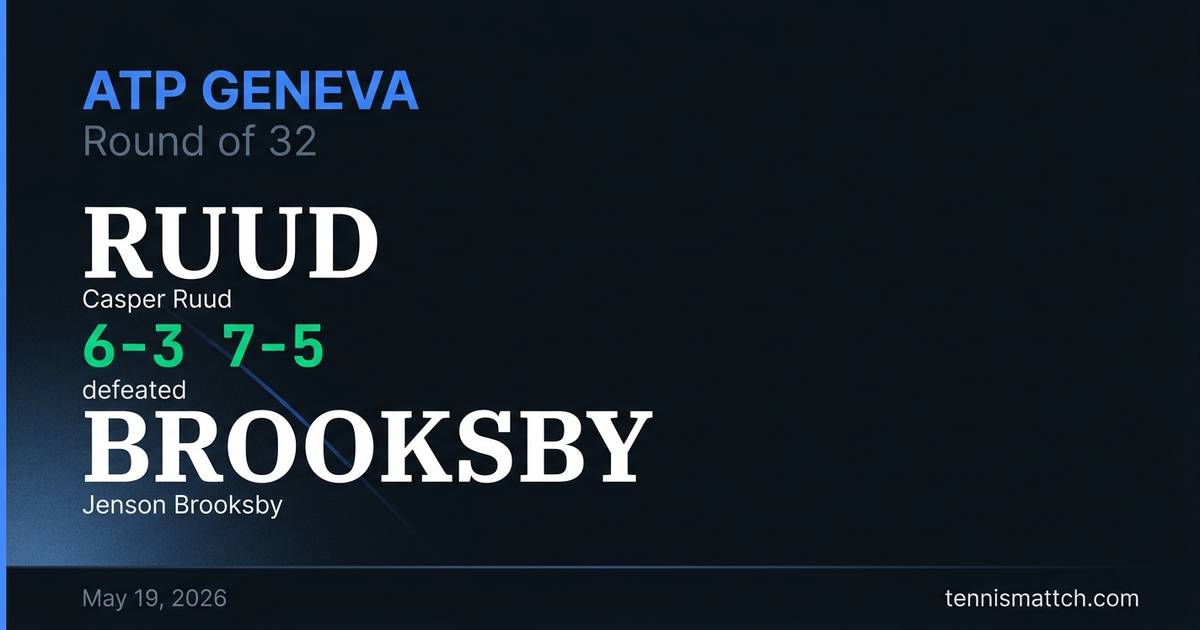



Casper Ruud advanced to the Round of 16 at the Geneva ATP tournament with a 6-3, 7-5 victory over Jenson Brooksby on Tuesday. The Norwegian, a two-time Geneva champion on clay, converted 5 of 10 break point opportunities while limiting Brooksby to just 3 breaks from 5 chances in a match that underscored the American’s recent struggles.
Ruud’s cleaner performance proved decisive despite Brooksby hitting more winners (28 to 21). The Norwegian committed just 12 unforced errors compared to Brooksby’s 22, a disciplined showing that compensated for his opponent’s greater shot-making aggression. Ruud dominated on serve, winning 66% of first-serve points and 62% on his second delivery, while Brooksby managed only 53% and 50% respectively—margins that left the American perpetually defending.
The second set saw Brooksby push harder, forcing Ruud to save multiple break points before the Norwegian finally broke through at 6-5 to close out the match. Ruud hit 3 aces without a double fault, while Brooksby managed just 1 ace in a serving performance that lacked penetration. The result extends Brooksby’s dismal 2026 form to 1-10 across all surfaces, while Ruud builds momentum on hard courts after his Rome clay court final appearance last week.
Key Takeaways
- Ruud’s serve effectiveness was the story: he won 66% of first-serve points and 62% of second-serve points, compared to Brooksby’s woeful 53% and 50% respectively—a gap that left the American scrambling all afternoon.
- Despite hitting 7 fewer winners (21 to 28), Ruud’s disciplined 12 unforced errors—nearly half Brooksby’s 22—proved that precision trumped aggression. The Norwegian’s +9 winner-to-error differential overwhelmed Brooksby’s +6.
- Break point conversion told the tale of two players: Ruud converted 50% of his opportunities (5 of 10) while Brooksby managed 60% (3 of 5), but Ruud created twice as many chances, reflecting superior returning and tactical pressure throughout the match.
- The 73-58 total points won margin illustrates Ruud’s dominance. He controlled nearly 56% of all points played, a comfortable cushion that never allowed Brooksby to threaten a comeback despite the competitive second set scoreline.
Player Analysis
Casper Ruud
Ruud’s performance was a masterclass in percentage tennis. His 3 aces might seem modest, but they represented a calculated approach—he landed 78% of first serves while committing zero double faults, a clean serving day that kept Brooksby under constant pressure. The Norwegian’s 66% first-serve points won vastly exceeded his recent hard court average, suggesting heightened focus after last week’s Rome final loss. His 62% success rate on second serves was particularly impressive, neutralizing Brooksby’s return game and preventing the American from establishing any rhythm.
What separated Ruud was his discipline. With just 12 unforced errors, he played well below his hard court average of 30.3 per match—a stunning 60% reduction that reflects laser-sharp decision-making. His break point conversion (5 of 10) wasn’t spectacular, but creating 10 opportunities in a straight-sets match demonstrated relentless returning pressure. This was Ruud playing smart, controlled tennis, leveraging his Geneva pedigree (two titles on clay) to navigate the hard court shift with tactical maturity.
Jenson Brooksby
Brooksby’s 28 winners painted a deceptive picture of a competitive performance, but his 22 unforced errors revealed the truth: too much risk, not enough reward. The American’s serve struggled to find any bite, winning just 53% of first-serve points—well below his hard court average and nowhere near the 60% threshold typically needed to hold comfortably at this level. His lone ace told the story of a serve lacking penetration, forcing him into grinding rallies where Ruud’s superior consistency eventually prevailed.
The numbers confirm a player mired in poor form. Entering 1-9 over his last 10 matches, Brooksby’s 50% second-serve points won left him perpetually vulnerable. He converted 3 of 5 break points—a solid 60%—but generated only 5 chances all match, evidence that Ruud’s serving quality kept him on the defensive. Brooksby’s aggressive shot selection produced moments of brilliance (those 28 winners), but without the platform of a reliable serve or the discipline to minimize errors, he had no foundation to build from. This loss extends a troubling 1-10 record in 2026, and the hard court surface—where he holds a respectable .562 career win rate—offered no salvation.
Match Statistics
| Casper Ruud | Stat | Jenson Brooksby |
|---|---|---|
| 3 | Aces | 1 |
| 78% | 1st Serve % | 77% |
| 66% | 1st Serve Points Won | 53% |
| 62% | 2nd Serve Points Won | 50% |
| 5/10 | Break Points Won | 3/5 |
| 21 | Winners | 28 |
| 12 | Unforced Errors | 22 |
| 73 | Total Points Won | 58 |
Frequently Asked Questions
What was the final score of Casper Ruud vs Jenson Brooksby at Geneva 2026?
Casper Ruud defeated Jenson Brooksby 6-3, 7-5 in the Round of 32 at the Geneva ATP tournament on May 19, 2026.
How many break points did Casper Ruud convert against Jenson Brooksby?
Ruud converted 5 of 10 break point opportunities (50%), while Brooksby converted 3 of 5 (60%). Ruud’s ability to create twice as many break chances proved decisive.
Who won the Geneva ATP Round of 32 match between Ruud and Brooksby?
Casper Ruud won 6-3, 7-5, advancing to the Round of 16 with a dominant serving performance and just 12 unforced errors.
How many unforced errors did Jenson Brooksby commit against Casper Ruud?
Brooksby committed 22 unforced errors compared to Ruud’s 12, a disparity that proved costly despite Brooksby hitting more winners (28 to 21).
What’s Next
Ruud advances to the Round of 16 in Geneva, where he will seek to extend his winning record at a tournament he has conquered twice before. His opponent has not yet been determined.
Head-to-head history: Casper Ruud vs Jenson Brooksby.