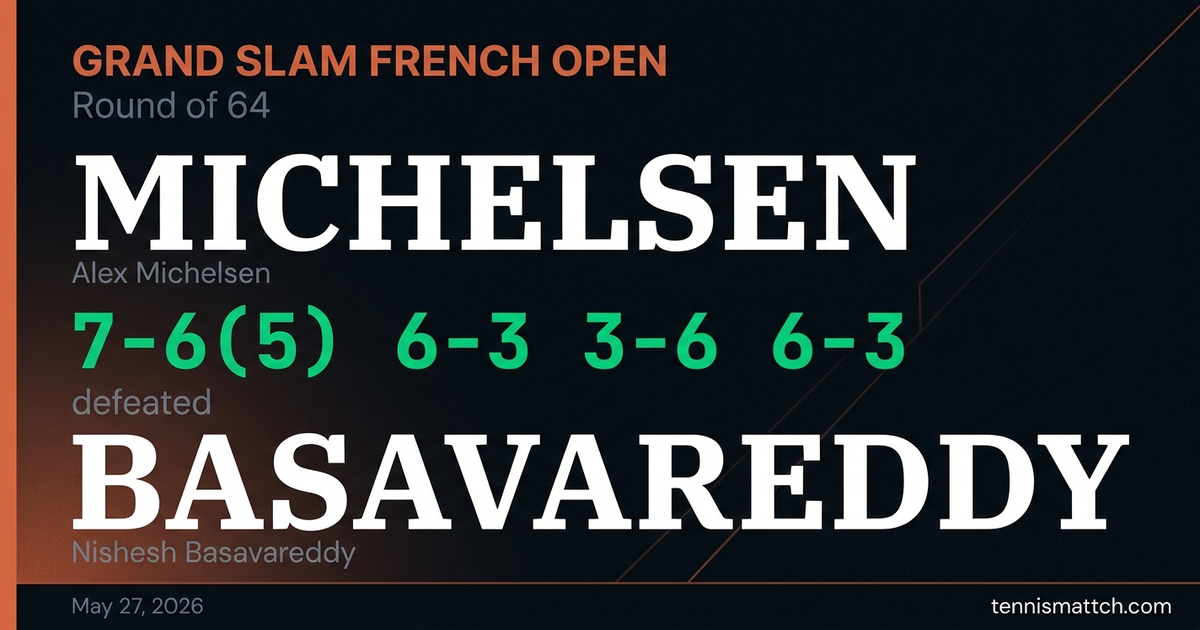


Alex Michelsen outlasted Nishesh Basavareddy 7-6(5), 6-3, 3-6, 6-3 in the French Open Round of 64, navigating a nervy opening-set tiebreak before asserting control with 50 winners. The American converted just 4 of 15 break point chances but held firm in the fourth set to advance at Roland Garros.
The first set tested Michelsen’s clay court mettle. Both players held serve through twelve games, with Basavareddy matching Michelsen’s aggression—73% of first-serve points won for the underdog against 72% for Michelsen. The tiebreak tilted 7-5 in Michelsen’s favor, a crucial foothold. From there, Michelsen seized momentum with a clinical 6-3 second set, hammering 10 aces and dominating baseline exchanges. Basavareddy responded with his best set, breaking twice to claim the third 6-3 and exposing Michelsen’s profligacy: just 4 of 15 break points converted across the match.
The fourth set saw Michelsen regain composure. He won 58% of second-serve points—five percentage points better than Basavareddy—and steadied his serve after seven double faults earlier. A late break sealed the 6-3 set and the match, with Michelsen’s 50 winners ultimately overwhelming Basavareddy’s 40. The American advanced having won 129 total points to 125, a razor-thin margin that belied the four-set scoreline.
Key Takeaways
- Michelsen’s 10 aces dwarfed his recent clay average of 1.4 per match, signaling an aggressive serve strategy on the slower Roland Garros surface that paid dividends in the straightforward second and fourth sets.
- Break point conversion remained Michelsen’s Achilles heel: he converted just 4 of 15 chances (27%), well below his 34% clay court average, yet still enough to edge Basavareddy’s 3 of 8 (38%).
- The four-point margin in total points won (129 to 125) underscores how tight this match was—Basavareddy’s 73% first-serve points won actually bettered Michelsen’s 72%, but Michelsen’s 58% to 53% edge on second serves proved decisive.
- Michelsen’s 50 winners came at a cost: 45 unforced errors, a high-risk, high-reward approach that left him vulnerable in the third set but ultimately overwhelmed Basavareddy’s cleaner but less aggressive 40 winners and 36 errors.
Player Analysis
Alex Michelsen
Michelsen’s performance was a study in controlled chaos. His 50 winners—more than triple his 16.3 clay-court average—revealed an attacking mindset suited for the first-round matchup, though the 45 unforced errors kept the outcome in doubt longer than the scoreline suggests. The 7-6(5) opening set exposed his ongoing break point woes: 11 failed conversions through the first two sets alone. Yet Michelsen’s serve carried him through tight moments, with 10 aces offering free points his 56% first-serve percentage otherwise couldn’t reliably deliver. His 58% second-serve points won—five percentage points better than Basavareddy—became the match’s defining split, allowing him to escape trouble after those seven costly double faults.
The third-set lapse, where Basavareddy broke twice to claim a 6-3 set, hinted at the fragility that has plagued Michelsen’s clay season (5-10 overall record on the surface). But credit Michelsen’s composure in the fourth: he steadied his groundstrokes, fired three more aces, and broke once to seal the 6-3 set. For a player who lost in the first round here last year, this was a gritty, if imperfect, step forward at Roland Garros.
Nishesh Basavareddy
Basavareddy emerged as the cleaner player statistically—36 unforced errors to Michelsen’s 45, and a superior 73% first-serve points won. His 7 aces matched his opponent’s power for stretches, and his 38% break point conversion (3 of 8) actually outpaced Michelsen’s 27%. The third set, where he broke twice and won 6-3, showcased his ability to counterattack when Michelsen’s game wavered. Yet Basavareddy couldn’t sustain that level, particularly on second serves: his 53% second-serve points won left him vulnerable whenever Michelsen forced him off his first delivery.
The 7-5 tiebreak loss in the opener proved costly. Basavareddy had matched Michelsen serve-for-serve through twelve games, but couldn’t capitalize on the handful of mini-break chances in the breaker. From there, Michelsen’s 50 winners—10 more than Basavareddy’s 40—became a volume problem. For an emerging player competing in a Grand Slam Round of 64, Basavareddy showed enough baseline solidity and serving prowess to suggest he’ll return to this stage, even if this particular four-setter slipped away.
Match Statistics
| Alex Michelsen | Stat | Nishesh Basavareddy |
|---|---|---|
| 10 | Aces | 7 |
| 7 | Double Faults | 7 |
| 56% | 1st Serve % | 55% |
| 72% | 1st Serve Points Won | 73% |
| 58% | 2nd Serve Points Won | 53% |
| 4/15 | Break Points Won | 3/8 |
| 50 | Winners | 40 |
| 45 | Unforced Errors | 36 |
| 129 | Total Points Won | 125 |
Frequently Asked Questions
What was the final score of Alex Michelsen vs Nishesh Basavareddy at the French Open 2026?
Alex Michelsen defeated Nishesh Basavareddy 7-6(5), 6-3, 3-6, 6-3 in the French Open Round of 64 on May 27, 2026.
How many winners did Alex Michelsen hit against Nishesh Basavareddy?
Michelsen struck 50 winners in the match, compared to Basavareddy’s 40, with the American’s aggressive baseline play proving decisive over four sets.
Who won the French Open 2026 Round of 64 match between Michelsen and Basavareddy?
Alex Michelsen won, advancing past Nishesh Basavareddy in four sets at Roland Garros.
What was Alex Michelsen’s break point conversion rate against Basavareddy?
Michelsen converted just 4 of 15 break point opportunities (27%), a rate below his clay-court average but enough to secure the four-set victory.
What’s Next
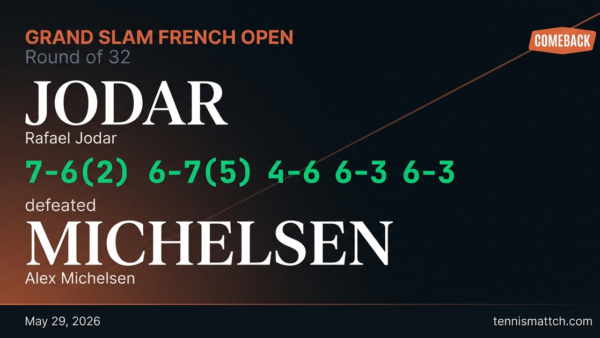
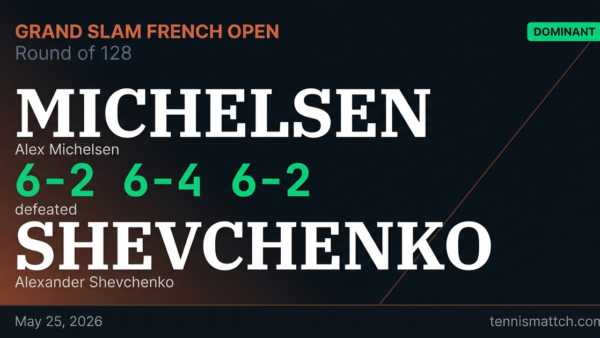
Michelsen advances to the Round of 32 at Roland Garros, where he’ll face a higher-seeded opponent as he seeks his first career title and aims to build on his recent clay-court momentum after defeating Alexander Shevchenko in the previous round.
Follow all results: French Open 2026.
Head-to-head history: Alex Michelsen vs Nishesh Basavareddy.