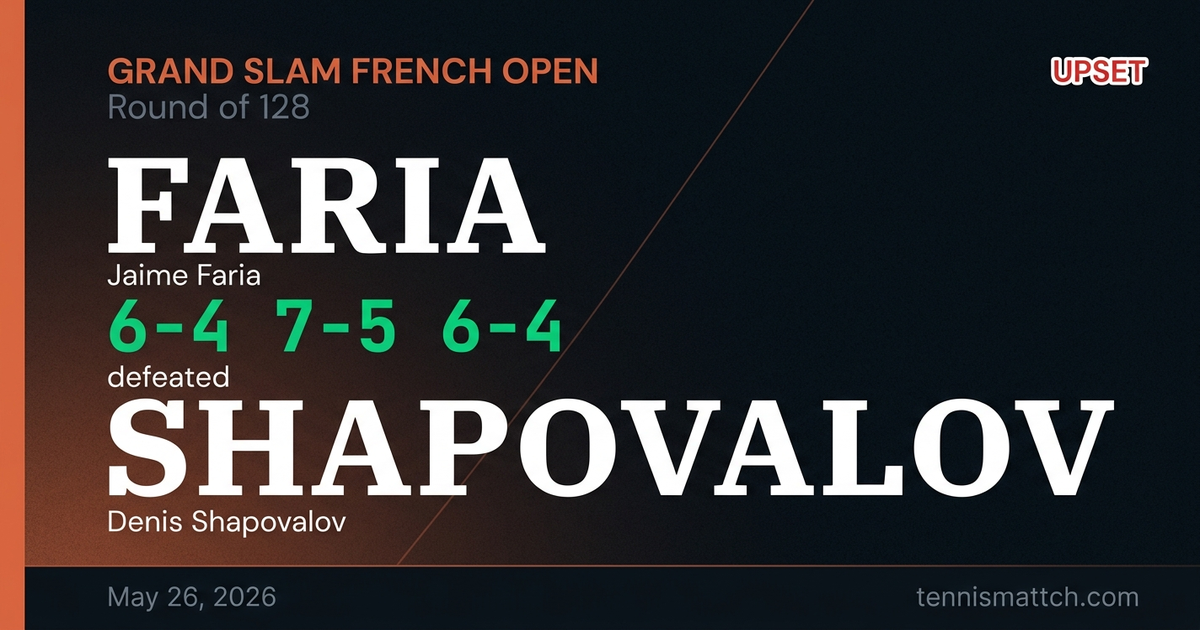


Jaime Faria produced a stunning first-round upset at the 2026 French Open, defeating Denis Shapovalov 6-4, 7-5, 6-4 on Court Philippe-Chatrier. The Portuguese player, making his Roland Garros debut with minimal clay court experience, controlled crucial moments while Shapovalov’s 48 unforced errors proved fatal in the straight-sets defeat.
The match hinged on break point execution. Faria converted 4 of 8 opportunities while Shapovalov managed just 1 of 6, unable to capitalize despite hitting 10 aces. The Canadian’s erratic play—double faulting 8 times and committing more than twice as many unforced errors as his opponent—handed Faria control. Each set followed a similar pattern: Shapovalov produced flashes of brilliance with 33 winners, but his inability to sustain consistency allowed Faria to win 15 more total points (108-93) and close out the match in straight sets.
Faria’s victory marks a breakthrough on clay, where he had won just zero of his two previous matches on the surface. His composed serving—68% first serves and only 4 double faults—kept Shapovalov from mounting sustained pressure, while his 61% second serve points won rate shut down the Canadian’s return game.
Key Takeaways
- Faria’s break point conversion (50%, 4/8) versus Shapovalov’s woeful 17% (1/6) decided the match—the Portuguese won three more service breaks despite entering with a clay court conversion rate nearly half of Shapovalov’s 41.1% average.
- Shapovalov’s 48 unforced errors dwarfed Faria’s 22, resulting in a -15 winner-to-error differential for the Canadian compared to Faria’s +6. Despite hitting 33 winners to Faria’s 28, Shapovalov’s consistency collapse on clay proved decisive.
- Faria’s first serve percentage (68%) gave him a massive 15-point advantage over Shapovalov’s 53%, neutralizing the Canadian’s ability to attack returns and limiting break point chances. This was especially critical given Faria’s minimal clay court experience (0-2 record entering the tournament).
- The Portuguese player’s 61% second serve points won rate compared to Shapovalov’s 46% highlights where the match was truly controlled—Faria won 15 more second serve points, directly translating to his 15-point total margin (108-93).
Player Analysis
Jaime Faria
Faria’s Roland Garros debut will stand as the defining clay court performance of his career to date. Entering with only two clay matches in his recent record—both losses—the Portuguese player showed no sign of nerves or surface discomfort. His 68% first serve percentage, well above his 60% clay average, anchored his performance, while his composed 61% second serve winning rate prevented Shapovalov from gaining traction on return games. Most impressively, Faria converted half his break point chances (4/8), capitalizing on Shapovalov’s service struggles at critical moments in all three sets. His 22 unforced errors were a model of discipline on a surface where patience is paramount.
The tactical blueprint was clear: make first serves, minimize errors, and pounce when Shapovalov cracked. Faria executed it flawlessly. While his 28 winners paled beside Shapovalov’s 33, he didn’t need to be flashy—just consistent. His ability to win 108 total points while hitting fewer aces (2) than his opponent demonstrates a mature understanding of clay court tennis: construction over destruction.
Denis Shapovalov
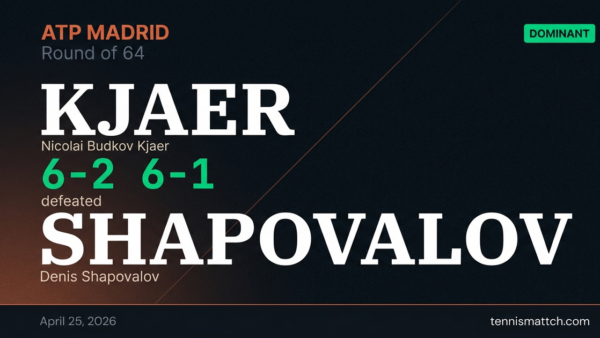
Shapovalov’s 48 unforced errors tell the story of a player battling himself as much as his opponent. Despite hammering 10 aces and striking 33 winners, the Canadian’s first-round exit extends a worrying clay slide that includes a lopsided loss to T. Gibson at Madrid last month. His 53% first serve percentage—7 points below his clay average—handed Faria too many looks at second serves, where Shapovalov won just 46% of points. The break point conversion debacle (1/6, 17%) was particularly damaging given his reputation for opportunistic returning; he generated enough chances but couldn’t finish them.
Most concerning was Shapovalov’s inability to impose his game despite clear weapons. He out-aced Faria 10-2 and produced five more winners, yet lost by 15 total points because his 8 double faults and error-strewn baseline play negated every advantage. For a player with 72 career clay matches and a 35-37 record on the surface, this was an uncharacteristic collapse. The aggressive, high-risk style that makes Shapovalov thrilling on hard courts proved unsustainable over three sets on the slow Paris clay against a patient opponent who refused to beat himself.
Match Statistics
| Jaime Faria | Stat | Denis Shapovalov |
|---|---|---|
| 2 | Aces | 10 |
| 4 | Double Faults | 8 |
| 68% | 1st Serve % | 53% |
| 72% | 1st Serve Points Won | 72% |
| 61% | 2nd Serve Points Won | 46% |
| 4/8 | Break Points Won | 1/6 |
| 28 | Winners | 33 |
| 22 | Unforced Errors | 48 |
| 108 | Total Points Won | 93 |
Frequently Asked Questions
What was the final score of Jaime Faria vs Denis Shapovalov at the French Open 2026?
Jaime Faria defeated Denis Shapovalov 6-4, 7-5, 6-4 in the first round of the 2026 French Open on May 26, 2026.
How many unforced errors did Denis Shapovalov commit against Jaime Faria?
Shapovalov committed 48 unforced errors compared to Faria’s 22, a differential of 26 errors that proved decisive in the straight-sets defeat.
What was Jaime Faria’s break point conversion rate against Shapovalov?
Faria converted 4 of 8 break points (50%) while Shapovalov managed just 1 of 6 opportunities (17%), a key disparity in the Portuguese player’s upset victory.
Who won the French Open 2026 first round match between Faria and Shapovalov?
Jaime Faria won in straight sets, marking his Roland Garros debut with a 6-4, 7-5, 6-4 victory over Denis Shapovalov.
What’s Next
Faria advances to the second round of the French Open, where he will face a yet-to-be-determined opponent. For Shapovalov, the first-round exit marks another disappointing Grand Slam result and raises questions about his clay court game heading into the grass season.