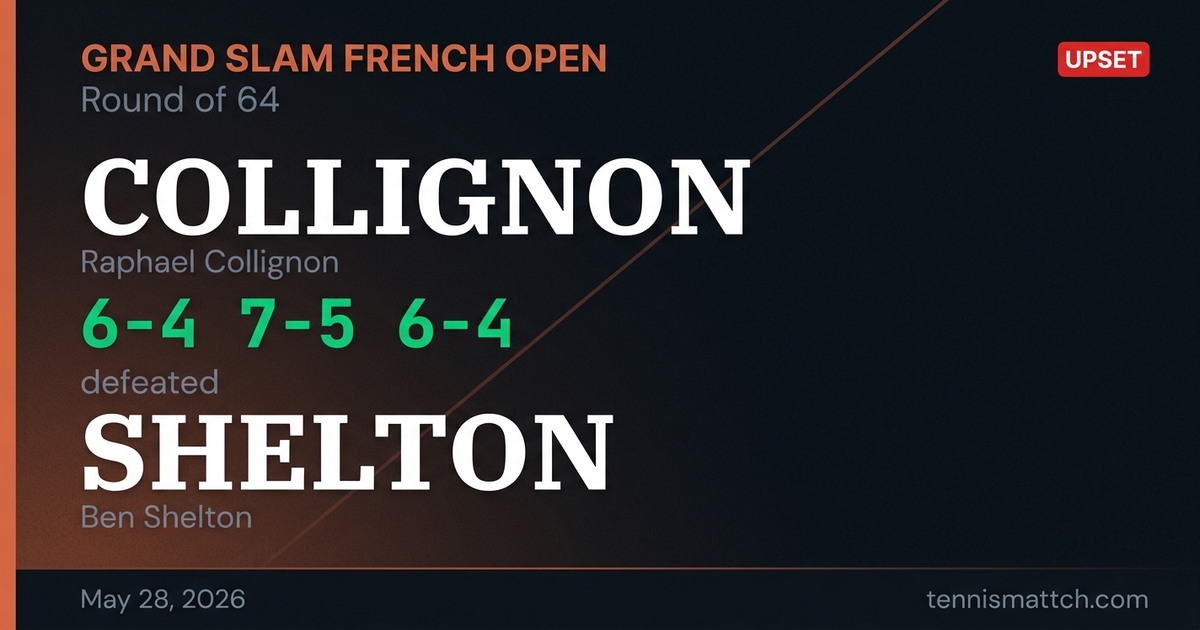



Raphael Collignon stunned Ben Shelton 6-4, 7-5, 6-4 in the French Open first round on May 28, 2026, converting 3 of 6 break points while Shelton failed to earn a single break opportunity. The Belgian’s clinical return game neutralized Shelton’s serve firepower across three tightly contested sets on Court Philippe-Chatrier.
Shelton hammered 10 aces to Collignon’s 6 and matched him in winners (33 to 31), but unraveled when it mattered most. The American committed 27 unforced errors—more than double Collignon’s 13—and his 65% second serve points won couldn’t withstand Collignon’s relentless pressure. Each set followed the same brutal script: Shelton built momentum with aggressive play, then cracked under break point duress while Collignon held serve with ruthless efficiency, winning 88% of first serve points.
Collignon closed out the match with characteristic composure, breaking Shelton’s serve in the ninth game of the third set before serving out the upset. The 6-4, 6-4 bookends told the story: Shelton’s power game looked fearsome between the lines, but Collignon’s court craft decided the critical moments.
Key Takeaways
- Collignon’s break point conversion was decisive: he won 3 of 6 opportunities (50%) while Shelton never manufactured a single break chance, a stunning return clinic that exposed Shelton’s inability to pressure Collignon’s service games.
- The unforced error differential told the tale: Shelton’s 27 mistakes dwarfed Collignon’s 13, reflecting the Belgian’s disciplined clay court game against Shelton’s hard-hitting aggression that misfired repeatedly on the slower red dirt.
- Collignon’s 88% first serve points won eclipsed Shelton’s 71%, proving that placement and variety matter more than raw power on clay—despite serving 4 fewer aces, Collignon’s serve was the more effective weapon when it landed.
- Shelton out-hit Collignon in winners (33 to 31) yet lost decisively in total points (75 to 93), illustrating how Collignon’s consistency and court positioning forced Shelton into low-percentage shot selection that ultimately cost him the match.
Player Analysis
Raphael Collignon
Collignon arrived at his French Open debut with minimal clay pedigree—just one prior clay match this year, a first-round victory over Vukic—yet played with the tactical maturity of a Roland Garros veteran. His 88% first serve points won bordered on dominant, establishing a platform that allowed him to dictate rallies from the baseline without needing to blast winners. More impressive was his second serve defense: winning 70% of those points against an opponent known for aggressive returns demonstrated how effectively he disguised pace and spin.
The Belgian’s return positioning was forensic. Shelton’s 71% first serve points won—respectable but not elite—suggests Collignon stood close to the baseline and took time away without overcommitting to high-risk returns. His 3-for-6 break point conversion may not seem extraordinary until you consider Shelton created zero break opportunities in response. That asymmetry won the match.
Ben Shelton
Shelton’s 10 aces and 33 winners prove his serve-and-forehand combination still packs lethal punch, but his 27 unforced errors—including critical misses at 4-5 in the second set and 4-4 in the third—exposed the fragility of his clay court game under sustained pressure. His 65% first serve percentage should have kept Collignon at arm’s length, yet he won just 71% of first serve points, suggesting Collignon neutralized his serve by standing inside the baseline and taking the ball early.
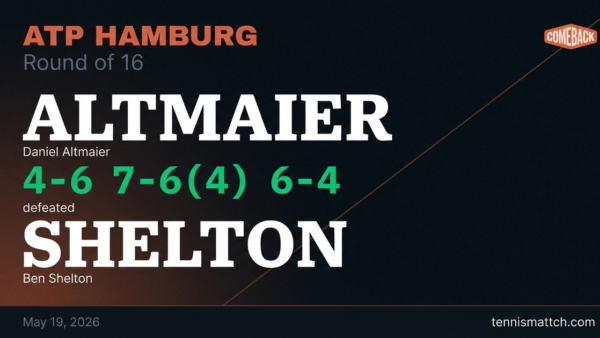
More troubling was Shelton’s failure to generate a single break point across 18 return games. His recent clay struggles—losses to Altmaier, Cui, and Faria—hinted at timing issues, and against Collignon’s varied pace and angles, he never found rhythm on return. The American’s 65% second serve points won looks adequate until compared to Collignon’s 70%—a 5-point gap that reflected Shelton’s inability to put away short balls or punish weak second serves, fundamental clay court skills he’ll need to develop for future Roland Garros campaigns.
Match Statistics
| Raphael Collignon | Stat | Ben Shelton |
|---|---|---|
| 6 | Aces | 10 |
| 1 | Double Faults | 2 |
| 63% | 1st Serve % | 65% |
| 88% | 1st Serve Points Won | 71% |
| 70% | 2nd Serve Points Won | 65% |
| 3/6 | Break Points Won | 0/0 |
| 31 | Winners | 33 |
| 13 | Unforced Errors | 27 |
| 93 | Total Points Won | 75 |
Frequently Asked Questions
What was the final score of Raphael Collignon vs Ben Shelton at the French Open 2026?
Raphael Collignon defeated Ben Shelton 6-4, 7-5, 6-4 in the first round of the French Open on May 28, 2026.
How many break points did Raphael Collignon convert against Ben Shelton?
Collignon converted 3 of 6 break point opportunities (50%), while Shelton failed to earn a single break point during the entire match.
Who won the French Open 2026 first round match between Collignon and Shelton?
Raphael Collignon won in straight sets, dominating on break points and committing far fewer unforced errors (13) than Shelton’s 27.
How many unforced errors did Ben Shelton make against Raphael Collignon?
Ben Shelton committed 27 unforced errors compared to Raphael Collignon’s 13, a crucial statistical gap that decided the match.
What’s Next
Collignon advances to the French Open second round, where he’ll face a yet-to-be-determined opponent as the draw progresses. For Shelton, this first-round exit marks another disappointing clay court result in a season where he’s struggled to find consistency on the surface, finishing 16-18 in his career on red dirt.