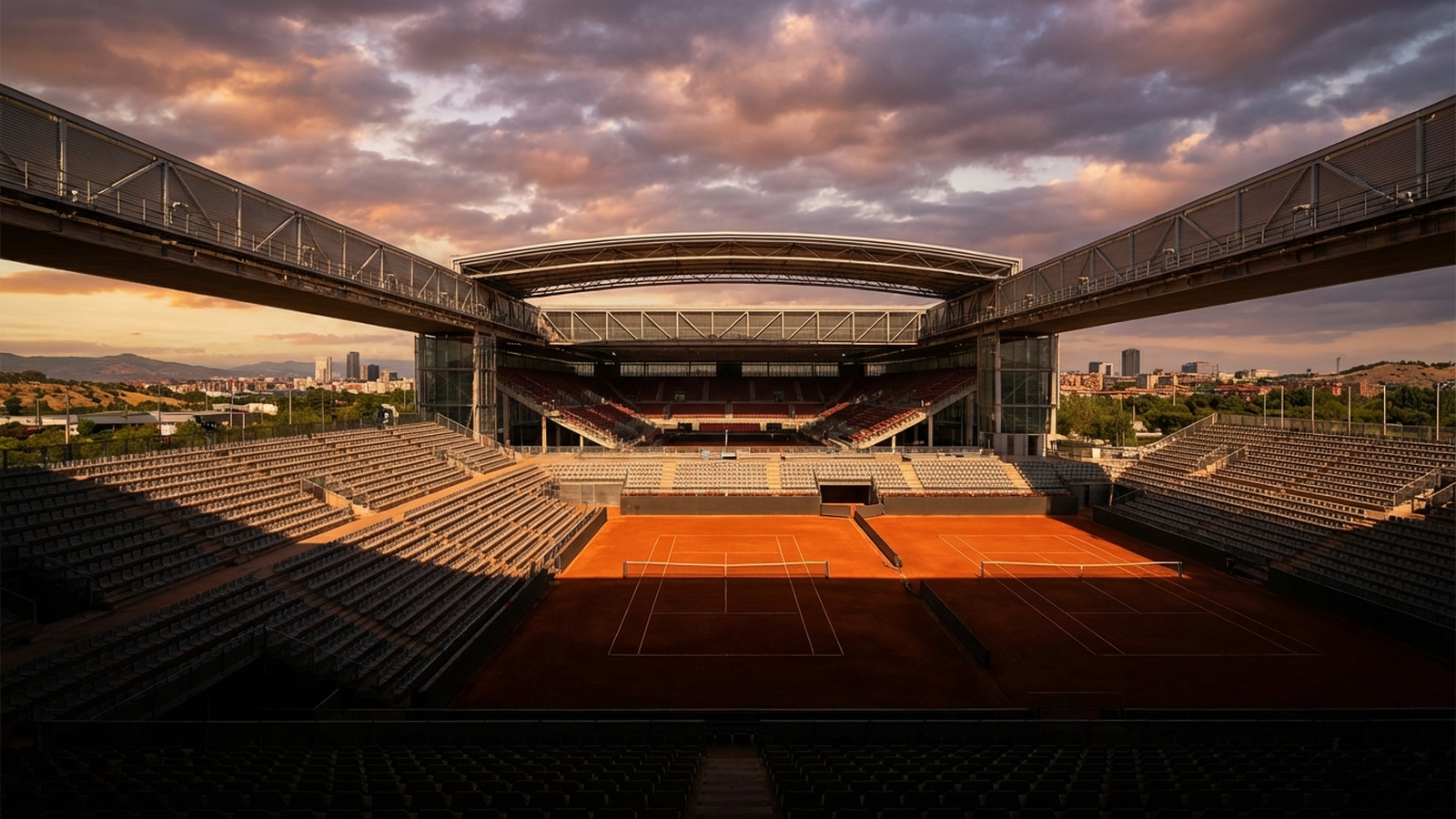
The Madrid Open 2026 returns to La Caja Mágica with $17.4 million on the line, a retractable-roof arena perched 660 meters above sea level, and one of the deepest fields on the spring clay-court calendar. According to TennisMattch.com’s database of 3,748 matches, the tournament produces an average of 4.10 aces per player per match — 23% higher than the tour-wide average of 3.33 — a direct consequence of Madrid’s thin air pushing the ball through the strike zone faster than any other major clay event. First-serve points won sit at 68.06%, and break-point conversion falls to 43.24%, both numbers that diverge meaningfully from tour norms and shape a brand of clay-court tennis that rewards aggression over attrition.
Since its transformation from an indoor hard-court event in 2002 to an outdoor clay showcase in 2009, the Mutua Madrid Open has become the gateway to Roland Garros and one of the most unpredictable Masters-level stops on the calendar. Rafael Nadal leads all players with 5 titles and a 61–15 career record here, yet even the King of Clay managed only a 80.3% win rate — lower than at several other premier clay events — highlighting how Madrid’s unique altitude conditions level the playing field. With the 2026 edition approaching, this guide breaks down everything you need to know: historical context, statistical deep dives, venue logistics, weather forecasts, prize money, and the storylines that will define the fortnight ahead.
Whether you’re booking flights to Manzanares Park or streaming from home, this is your definitive resource for the Madrid Open 2026.
Tournament History
The Madrid Open’s history is a tale of reinvention. Founded in 2002 as a men’s-only indoor hard-court event held late in the season at the Madrid Arena, it initially replaced the Eurocard Open in Stuttgart to fill the eighth slot in the ATP Masters Series calendar. Those early editions served as a crucial late-season proving ground: fast indoor courts, European autumn chill, and players jostling for year-end championship positioning. The tournament’s statistical fingerprint from this era still shows in the data — the 2008 edition, the final year on indoor hard courts, produced a whopping 6.84 aces per player per match according to TennisMattch.com’s database, compared to the current tournament-wide average of 4.10.
Everything changed in 2009. Billionaire Ion Țiriac, one of tennis’s most colorful and influential figures, acquired the event, relocated it to the purpose-built La Caja Mágica, shifted the surface to outdoor clay, and moved the calendar slot to late April/early May — squarely in the heart of the European clay swing. The transformation was dramatic. That inaugural outdoor clay edition saw 216 matches played, with ace counts dropping to 3.44 per match and break-point conversion rising to 44.12% as the surface rewarded patience alongside power. Crucially, the tournament also expanded to include a WTA 1000 event, doubling its footprint and its prestige overnight.
Perhaps no single episode captures Madrid’s appetite for disruption better than the blue clay experiment of 2012. Designed to improve television contrast and brand distinctiveness, the Har-Tru blue courts proved far too slippery for the sport’s elite. Top players lodged vocal complaints about footing and unpredictable bounces, and by 2013 the tournament had returned to traditional red clay. It remains one of the most talked-about experiments in modern tennis history — and a cautionary tale about innovation for innovation’s sake.
In 2021, IMG, the global sports and entertainment conglomerate, purchased the tournament from Țiriac’s group, ushering in a new era of corporate investment and expanded scheduling. Recent editions have featured two-week formats, regularly drawing crowds that exceed 270,000 spectators. The event’s sponsor roster — headlined by Mutua Madrileña and joined by Openbank, PIF, Lacoste, and Mercedes-Benz — reflects its standing as one of the most commercially valuable stops outside the Grand Slams.
Looking at the broader arc, TennisMattch.com’s database captures 3,748 matches across the tournament’s history. First-serve percentages have remained remarkably stable over the years — 64.74% in 2010, 64.01% in 2023, 65.59% in 2024 — suggesting that while the surface and conditions changed radically, the fundamental challenge of serving in Madrid’s altitude has produced a consistent statistical baseline. What has changed is the sheer volume of matches: from 94 in 2008 (men only, indoor) to 364 in 2025 (combined ATP and WTA draw), a nearly fourfold increase that underscores the tournament’s growth into a flagship combined event.
| Year | Champion | Runner-Up | Score |
|---|---|---|---|
| 2025 | Casper Ruud (Norway) | Jack Draper | 2 – 1 |
| 2024 | Andrey Rublev (RUS) | Felix Auger-Aliassime | 4-6 7-5 7-5 |
| 2023 | Carlos Alcaraz (Spain) | Jan-Lennard Struff | 6-4 3-6 6-3 |
| 2022 | Carlos Alcaraz (Spain) | Alexander Zverev | 6-3 6-1 |
| 2021 | Alexander Zverev (Germany) | Matteo Berrettini | 6-7(8) 6-4 6-3 |
| 2019 | Novak Djokovic (Serbia) | Stefanos Tsitsipas | 6-3 6-4 |
| 2018 | Alexander Zverev (Germany) | Dominic Thiem | 6-4 6-4 |
| 2017 | Rafael Nadal | Dominic Thiem | 7-6(8) 6-4 |
| 2016 | Novak Djokovic (Serbia) | Andy Murray | 6-2 3-6 6-3 |
| 2015 | Andy Murray | Rafael Nadal | 6-3 6-2 |
| 2014 | Rafael Nadal | Kei Nishikori | 2-6 6-4 3-0 RET |
| 2013 | Rafael Nadal | Stan Wawrinka | 6-2 6-4 |
| 2012 | Roger Federer | Tomas Berdych | 3-6 7-5 7-5 |
| 2011 | Novak Djokovic (Serbia) | Rafael Nadal | 7-5 6-4 |
| 2010 | Rafael Nadal | Roger Federer | 6-4 7-6(5) |
| 2009 | Roger Federer | Rafael Nadal | 6-4 6-4 |
| 2008 | Andy Murray | Gilles Simon | 6-4 7-6(6) |
| 2007 | David Nalbandian | Roger Federer | 1-6 6-3 6-3 |
| 2006 | Roger Federer | Fernando Gonzalez | 7-5 6-1 6-0 |
| 2005 | Rafael Nadal | Ivan Ljubicic | 3-6 2-6 6-3 6-4 7-6(3) |
| 2004 | Marat Safin | David Nalbandian | 6-2 6-4 6-3 |
| 2003 | Juan Carlos Ferrero | Nicolas Massu | 6-3 6-4 6-3 |
| 2002 | Andre Agassi | Jiri Novak | W/O |
| 1994 | Thomas Muster | Sergi Bruguera | 6-2 3-6 6-4 7-5 |
| 1993 | Stefan Edberg | Sergi Bruguera | 6-3 6-3 6-2 |
| 1992 | Sergi Bruguera | Carlos Costa | 7-6(6) 6-2 6-2 |
| 1991 | Jordi Arrese | Marcelo Filippini | 6-2 6-4 |
| 1990 | Andres Gomez | Marc Rosset | 6-3 7-6 |
| 1989 | Martin Jaite | Jordi Arrese | 6-3 6-2 |
| 1988 | Kent Carlsson | Fernando Luna | 6-2 6-1 |
| Year | Champion | Runner-Up | Score |
|---|---|---|---|
| 2025 | Aryna Sabalenka (BLR) | Coco Gauff | 2 – 0 |
| 2024 | Iga Swiatek (Poland) | Aryna Sabalenka | 7-5 4-6 7-6(7) |
| 2023 | Aryna Sabalenka (BLR) | Iga Swiatek | 6-3 3-6 6-3 |
| 2022 | Ons Jabeur | Jessica Pegula | 7-5 0-6 6-2 |
| 2021 | Aryna Sabalenka (BLR) | Ashleigh Barty | 6-0 3-6 6-4 |
| 2015 | Petra Kvitova | Svetlana Kuznetsova | 6-1 6-2 |
| 2014 | Maria Sharapova | Simona Halep | 1-6 6-2 6-3 |
| 2013 | Serena Williams | Maria Sharapova | 6-1 6-4 |
| 2012 | Serena Williams | Victoria Azarenka | 6-1 6-3 |
| 2011 | Petra Kvitova | Victoria Azarenka | 7-6(3) 6-4 |
| 2010 | Aravane Rezai | Venus Williams | 6-2 7-5 |
| 2009 | Dinara Safina | Caroline Wozniacki | 6-2 6-4 |
| 2003 | Chanda Rubin | Maria Sanchez Lorenzo | 6-4 5-7 6-4 |
| 2002 | Monica Seles | Chanda Rubin | 6-4 6-2 |
| 2001 | Arantxa Sanchez Vicario | Angeles Montolio | 7-5 6-0 |
| 2000 | Gala Leon Garcia | Fabiola Zuluaga | 4-6 6-2 6-2 |
| 1999 | Lindsay Davenport | Paola Suarez | 6-1 6-3 |
| 1998 | Patty Schnyder | Dominique Monami | 3-6 6-4 6-0 |
| 1997 | Jana Novotna | Monica Seles | 7-5 6-1 |
| 1996 | Jana Novotna | Magdalena Maleeva | 4-6 6-4 6-3 |
Venue & Playing Conditions
La Caja Mágica — “The Magic Box” — is one of the most architecturally striking venues in world tennis. Designed by French architect Dominique Perrault and opened in 2009, the complex sits in the Manzanares Park area of southern Madrid at the address Camino de Perales, 23, 28041 Madrid. Its three main show courts are topped with enormous retractable roofs powered by hydraulic jacks, capable of opening, closing, or resting half-open in approximately 15 minutes. This mechanical versatility means rain delays are virtually eliminated on the primary courts, a significant logistical advantage during Madrid’s occasionally unpredictable spring weather.
The centerpiece, Estadio Manolo Santana, seats 12,442 spectators and hosts all marquee sessions from the quarterfinals onward. Named after the legendary Spanish player who won the 1966 Wimbledon title, the stadium’s steep seating bowl concentrates crowd noise in a way that creates one of the most electric atmospheres on tour. Two additional roofed stadiums and numerous outer courts handle the voluminous early-round schedule.
The Altitude Factor
Madrid’s elevation — approximately 660 meters (2,165 feet) above sea level — is the single most consequential factor shaping play at this tournament. The thinner air reduces drag on the tennis ball, causing it to fly faster through the court and bounce higher off the clay surface. The result is a hybrid playing experience: the slow, grinding rallies typical of sea-level clay events like Rome or Roland Garros are replaced by more explosive exchanges where big hitters can dictate play with pace and spin alike.
The numbers bear this out clearly. According to TennisMattch.com’s database of 3,748 matches, the Madrid Open produces 4.10 aces per player per match versus a tour-wide average of 3.33 — a 23.1% premium. Meanwhile, break-point conversion sits at 43.24%, noticeably below the tour average of 45.23%. Servers thrive in Madrid’s thin air; returners must work harder to neutralize that advantage. This altitude effect also explains why players who combine serve-and-volley instincts with clay-court movement have historically outperformed at this venue.
Getting There
The venue is accessible via the San Fermín-Orcasur Metro station on Line 3, making it a straightforward commute from central Madrid. From the Puerta del Sol, the journey takes roughly 25–30 minutes. Shuttle buses typically run from several key pickup points during the tournament fortnight. For those staying near the venue, the surrounding Manzanares Park area offers green space along the Manzanares River, though most fans base themselves in central Madrid’s hotel district and commute to matches. Premium accommodation options in the city include The Principal Madrid and Hotel Único.
Serve Dominance
Madrid’s altitude transforms the serve from a useful weapon into the dominant one. According to TennisMattch.com’s database of 3,748 matches, players win 68.06% of first-serve points at the Madrid Open — a figure that reflects how the thinner air adds velocity and reduces the returner’s reaction window. Players land their first serves at an average rate of 64.31%, slightly above the tour-wide average of 62.60%, suggesting that the altitude may also subtly aid service accuracy by reducing the ball’s lateral movement through the air.
Ace Production: A Clear Altitude Premium
The ace count tells the altitude story most vividly. At 4.10 aces per player per match, Madrid sits 23.1% above the tour-wide average of 3.33. This is not a marginal difference — it is one of the largest venue-specific ace premiums in professional tennis. The effect is even more pronounced when you isolate the indoor hard-court era: in 2008, the tournament’s final year on that surface, the average ballooned to 6.84 aces per match. The transition to outdoor clay in 2009 brought the number down to 3.44, but it has since crept steadily upward as player service technology has evolved — reaching 4.20 in 2023 and 4.08 in 2025.
Double faults, conversely, tell a more nuanced story. The tournament average of 2.54 double faults per match is actually lower than the tour-wide figure of 2.97. The thin air’s effect on ball trajectory apparently helps servers keep their second serves in play, even as they push for more aggressive placements. In 2025, however, double faults spiked to 3.44 — the highest in the database — a trend worth monitoring heading into 2026.
Individual Serve Profiles
The serve statistics of top players at Madrid reveal fascinating contrasts. Roger Federer, who won 3 titles here, averaged a commanding 8.10 aces per match — nearly double the tournament average and almost four times Rafael Nadal’s 2.12 per match. Federer’s first-serve percentage of 63.58% was actually slightly below the tournament norm, meaning he simply converted a higher proportion of his service games through pure ace power rather than placement consistency.
Alexander Zverev, a 2-time champion, provides the modern template for serving at altitude: 5.55 aces per match with a first-serve percentage of 69.07% — the second-highest among top-20 career players at the tournament. Only Nadal’s 70.00% first-serve percentage exceeds Zverev’s, and Nadal’s serve profile is fundamentally different — built on relentless placement and spin rather than flat power.
Andy Murray, who won 2 titles at Madrid, averaged 5.52 aces per match but posted the lowest first-serve percentage among elite Madrid performers at just 60.05%. Murray’s Madrid success came not from service dominance but from his extraordinary returning ability — a rarer path to titles at this altitude-blessed venue.
| Player | Record | Titles | Avg Aces |
|---|---|---|---|
| Rafael Nadal | 61W-15L | 5 | 2.1 |
| Manuel Orantes | 47W-13L | 2 | — |
| Roger Federer | 37W-9L | 3 | 8.1 |
| Novak Djokovic (Serbia) | 33W-10L | 3 | 4.6 |
| Ilie Nastase | 32W-4L | 4 | — |
| Andy Murray | 29W-11L | 2 | 5.5 |
| Jose Higueras | 28W-11L | 1 | — |
| Alexander Zverev (Germany) | 25W-6L | 2 | 5.5 |
| Jaime Fillol | 24W-10L | 0 | — |
| Petra Kvitova | 24W-8L | 2 | 3.6 |
| David Ferrer | 24W-16L | 0 | 2.7 |
| Tomas Berdych | 23W-14L | 0 | 5.6 |
| Feliciano Lopez | 23W-17L | 0 | 9.9 |
| Aryna Sabalenka (BLR) | 23W-2L | 3 | 4.2 |
| Guillermo Vilas | 20W-5L | 1 | — |
Break Point Battles
If Madrid’s altitude empowers the server, it punishes the returner. According to TennisMattch.com’s database of 3,748 matches, break-point conversion at the Madrid Open averages 43.24% — a full 1.99 percentage points below the tour-wide average of 45.23%. That gap may sound small in isolation, but across the hundreds of break-point opportunities in a typical tournament, it translates into meaningfully more service holds and tighter sets.
What the Gap Means Tactically
A lower break-point conversion rate means matches are more frequently decided by a player’s ability to seize rare opportunities rather than grind out a steady stream of breaks. At sea-level clay events, long rallies and deep returns create abundant break chances; in Madrid, the faster ball flight compresses rally length and makes the return of serve a more reactive, less proactive shot. Players who excel at reading serve patterns and pouncing on second-serve returns hold an outsized advantage.
The year-to-year data reveals interesting fluctuations. In 2008 — the last indoor hard-court year — break-point conversion plummeted to just 39.04%, reflecting the extreme difficulty of breaking serve on a fast indoor surface. The move to outdoor clay in 2009 immediately raised the figure to 44.12%, much closer to the tour norm. In 2024, conversion hit 44.35%, while in 2025 it dipped slightly to 43.45%. Over the full clay-court era (2009–2025), the average has hovered consistently in the 43–44% band, suggesting this is a structural feature of Madrid’s playing conditions rather than a statistical anomaly.
Break-Point Artistry: Who Converts Best?
Among all-time Madrid leaders, Rafael Nadal converted break points at a rate of 45.17% — nearly 2 percentage points above the tournament average and essentially at the tour-wide norm of 45.23%. This is a testament to Nadal’s extraordinary returning and rally-building even at altitude, where conditions should theoretically favor his opponents’ serves. Nadal’s ability to convert at a tour-average rate in a below-average-conversion venue is one of the underappreciated statistical pillars of his 5-title reign.
For the 2026 edition, the break-point dynamic will be critical. Players entering the tournament from sea-level clay events in Barcelona, Monte Carlo, or Estoril will need to recalibrate their return games quickly. Those who arrive early and acclimatize to the altitude — or who carry over momentum from previous Madrid success — historically gain an edge in the opening rounds where adjustment periods can prove costly.
Match Duration
The Madrid Open produces matches that are slightly shorter than you might expect from a clay-court Masters event. According to TennisMattch.com’s database of 1,647 matches with recorded durations, the average match length is 103 minutes, with a median of 98 minutes. The altitude effect is the primary driver: faster ball flight shortens rallies, which shortens games, which shortens sets. Fewer deuces, fewer extended baseline exchanges, and a lower break-point conversion rate all conspire to keep the clock ticking at a brisk pace by clay-court standards.
Round-by-Round Breakdown
Match duration at Madrid follows an intuitive but revealing pattern. Finals average 123.25 minutes, the longest of any round — but not by as much as you’d expect given the stakes and the caliber of players involved. The surprise in the data is the first round (R128), which averages 113.46 minutes — longer than semifinals (105.45 minutes), quarterfinals (104.25 minutes), and even round-of-16 matches (102.85 minutes). This likely reflects the number of three-set battles in the opening round, where qualifier-main draw mismatches are less common than assumed, and where players still adjusting to Madrid’s altitude often struggle to put opponents away efficiently.
The middle rounds tell a story of efficiency: R64 matches average 100.52 minutes, R32 matches 102.14 minutes, and R16 matches 102.85 minutes. The gradual increase as the draw narrows is modest — roughly 2 minutes per round from R64 to QF — suggesting that the quality gap between players tightens only incrementally, and that the altitude conditions create a relatively uniform match tempo regardless of round.
The Longest Match in Madrid Open History
The longest match ever recorded at the Madrid Open is a monument to tenacity. On May 10, 2009, Rafael Nadal defeated Novak Djokovic 3-6 7-6(5) 7-6(9) in a semifinal that lasted 243 minutes — four hours and three minutes. Every element of the scoreline screams drama: Nadal lost the first set, saved his tournament in a second-set tiebreak, and then prevailed in a third-set tiebreak that reached 9-7. This match alone lasted more than twice the tournament average and remains a benchmark for the kind of epic that Madrid’s unique conditions can occasionally produce. That it occurred in the tournament’s very first year on outdoor clay only added to its mythic status.
At the other extreme, the shortest recorded match clocks in at just 5 minutes — almost certainly a retirement or walkover that was logged with minimal playing time.
Median match length: 98 minutes
Longest match: Rafael Nadal d. Novak Djokovic 3-6 7-6(5) 7-6(9) (243 min, SF 2009)
Year-by-Year Trends
Seventeen years of match data from TennisMattch.com’s database reveal a tournament whose statistical identity has remained remarkably stable since the 2009 transition to outdoor clay — with a few notable exceptions that hint at evolving player strategies and conditions.
Ace Trends: A Gradual Climb
Ace production at Madrid has trended upward over the past decade. From 3.41 per match in 2009 and 3.41 in 2010, the figure rose to 4.20 in 2023 before settling at 3.24 in 2024 and rebounding to 4.08 in 2025. The long-term trajectory suggests that modern players — with more powerful rackets, refined service motions, and better understanding of altitude ball physics — are increasingly able to weaponize their serves on Madrid’s clay. The 2008 outlier (6.84 aces on indoor hard courts) remains an artifact of the tournament’s previous surface identity and is unlikely to be approached again.
Double Fault Volatility
Double faults have shown more year-to-year volatility. After staying in the low-2s range through the early clay years (2.10 in 2010, 2.37 in 2009), the numbers began climbing: 2.90 in 2023, 2.57 in 2024, and a sharp spike to 3.44 in 2025 — the highest in the database and above the tour-wide average of 2.97. Whether this is a one-year blip or the beginning of a trend will be one of the subtle storylines to watch in 2026. One possible explanation: as players push for more aggressive second serves to exploit the altitude, the margin for error narrows.
First-Serve Percentage: Steady as She Goes
First-serve percentage has been the most stable metric across Madrid’s clay era. From 64.06% in 2009 to 64.74% in 2010, 64.01% in 2023, and 65.59% in 2024, the numbers barely budge. The tournament-wide average of 64.31% sits comfortably above the tour-wide 62.60%, and no single year has deviated dramatically. This consistency suggests that the altitude effect on serving is well understood by modern players, who calibrate their ball toss and service speed accordingly.
Break-Point Conversion: A Structural Floor
Break-point conversion has remained locked in a narrow band since 2009: 44.12% that year, 43.91% in 2010, 44.00% in 2023, 44.35% in 2024, and 43.45% in 2025. The pre-clay era figures were dramatically lower — just 39.04% in 2008 on indoor hard courts — making the 2009 surface switch a measurable boon for returners. But the gap between Madrid’s clay-era average (approximately 43–44%) and the tour-wide average (45.23%) has persisted for over 15 years now, confirming that altitude, not surface alone, is the primary suppressor of break-point conversion.
Match Volume: The Tournament’s Growth Story
Perhaps the most striking trend is sheer match volume. From 94 matches in 2008 (men only) to 216 in 2009 (first combined year), the tournament has grown to 364 matches in 2025. The combined ATP and WTA draws, expanded qualifying rounds, and the two-week format have all contributed to making Madrid one of the highest-volume events outside the Grand Slams.
| Year | Matches | Avg Aces | Avg DFs | 1st Serve % | BP Conv % |
|---|---|---|---|---|---|
| 2025 | 364 | 4.1 | 3.4 | — | 43.4% |
| 2024 | 378 | 3.2 | 2.6 | 65.6% | 44.4% |
| 2023 | 380 | 4.2 | 2.9 | 64.0% | 44.0% |
| 2022 | 234 | 3.8 | 2.7 | 64.7% | 44.8% |
| 2021 | 236 | 3.9 | 3.0 | 62.9% | 43.9% |
| 2019 | 126 | 4.2 | 2.3 | 64.4% | 43.8% |
| 2018 | 126 | 5.2 | 2.0 | 64.5% | 41.0% |
| 2017 | 126 | 5.2 | 2.3 | 64.8% | 43.4% |
| 2016 | 126 | 5.2 | 2.0 | 64.0% | 38.8% |
| 2015 | 232 | 4.4 | 2.5 | 66.2% | 45.1% |
| 2014 | 230 | 3.8 | 2.4 | 64.4% | 42.1% |
| 2013 | 224 | 3.6 | 2.6 | 64.0% | 43.0% |
| 2012 | 218 | 5.1 | 2.4 | 63.0% | 39.8% |
| 2011 | 216 | 3.8 | 2.0 | 64.2% | 43.8% |
| 2010 | 222 | 3.4 | 2.1 | 64.7% | 43.9% |
| 2009 | 216 | 3.4 | 2.4 | 64.1% | 44.1% |
| 2008 | 94 | 6.8 | 2.1 | 60.9% | 39.0% |
King of the Madrid Open
Rafael Nadal is the undisputed king of the Madrid Open with 5 titles — more than any other player in tournament history — and a career record of 61 wins against just 15 losses (80.3%). His title years span more than a decade: 2005, 2010, 2013, 2014, and 2017. According to TennisMattch.com’s database, Nadal’s statistical profile at Madrid is unlike any other elite player who has competed here, built on an anomalous combination of relentless first-serve placement and elite break-point conversion rather than raw power.
The Nadal Paradox at Altitude
Nadal’s Madrid dominance is paradoxical because the tournament’s conditions should, in theory, diminish his greatest strengths. The thin air reduces the bite of his trademark topspin, the faster ball flight limits the grinding rallies he prefers, and the elevated bounce can flatten his looping forehand. Yet his numbers tell a story of adaptation rather than struggle.
Nadal posted a first-serve percentage of 70.00% at Madrid — the highest among all top-20 career players at the tournament and nearly 6 percentage points above the tournament average of 64.31%. He didn’t overwhelm opponents with aces — his 2.12 per match is barely half the tournament average of 4.10 — but he kept an extraordinary proportion of first serves in play, forcing opponents to handle heavy spin on the return rather than waiting for second-serve opportunities.
His break-point conversion rate of 45.17% sits nearly 2 percentage points above the tournament average of 43.24%, essentially matching the tour-wide norm of 45.23% despite playing in a venue designed to suppress exactly that stat. Nadal’s ability to break serve at a tour-average rate in a below-average-conversion environment is arguably the single most important statistical pillar of his Madrid reign. While other clay-court specialists see their return games suffer at altitude, Nadal’s court coverage, anticipation, and return depth proved altitude-proof.
Title by Title
Nadal’s 5 titles arrived in distinct phases of his career. His first, in 2005, came during the indoor hard-court era — a surface and condition he wasn’t supposed to dominate. His 2010 crown marked his emergence as the king of the new outdoor clay format. Back-to-back titles in 2013 and 2014 came during a ferocious run that saw him dismantle field after field on European clay. And his 2017 triumph, at age 30, provided evidence that his Madrid mastery wasn’t fading even as the next generation closed in.
Nadal’s most memorable Madrid match — and the longest in tournament history — was that 243-minute semifinal victory over Novak Djokovic on May 10, 2009, which ended 3-6 7-6(5) 7-6(9). It wasn’t a title-winning run (he lost the final), but it encapsulated everything about his Madrid persona: resilience under pressure, an iron will in tiebreaks, and the ability to outlast any opponent regardless of conditions.
The Supporting Cast
Behind Nadal, a cluster of all-time greats have staked their own Madrid claims. Roger Federer won 3 titles with a sparkling 37–9 record and averaged 8.10 aces per match — nearly quadruple Nadal’s rate. Novak Djokovic also holds 3 titles (33–10 record), using his 65.67% first-serve rate and 4.58 aces per match to build a more balanced serve-and-return game than either Federer or Nadal. On the WTA side, Aryna Sabalenka has surged to the forefront with 3 titles of her own, while Petra Kvitova (2 titles, 24–8 record) carved out Madrid success with a left-handed game perfectly suited to altitude conditions — 3.65 aces per match and a 64.84% first-serve rate.
Other notable multi-title winners include Alexander Zverev (2 titles, 25–6 record), Andy Murray (2 titles, 29–11), Carlos Alcaraz (2 titles), Serena Williams (2 titles), and Jana Novotná (2 titles). But none match Nadal’s combination of longevity, consistency, and sheer volume of wins at this venue.
Greatest Upsets
Madrid’s altitude is a great equalizer. The faster ball flight, the higher bounces, and the compressed rally length mean that underdogs with big serves and aggressive intent can punch above their weight more often than at sea-level clay events. TennisMattch.com’s database of 3,748 matches provides the statistical backdrop: with break-point conversion at just 43.24% — well below the tour average — even dominant players find it harder to assert control through returning, opening the door for upsets.
Why Madrid Breeds Surprises
The structural conditions for upsets at Madrid are unique. On a standard clay court at sea level, top-seeded players can rely on physical fitness, rally tolerance, and superior defensive skills to grind down lower-ranked opponents over three sets. In Madrid, those advantages are diluted. The ball moves faster, making the difference between a world No. 5’s groundstrokes and a No. 50’s groundstrokes less pronounced. Winners per match average 20.72 — a figure that rewards shot-making ability over consistency. Players who can rip through the thin air and find the lines have a better chance of unseating favorites than they would in Rome or Paris.
The altitude also creates an acclimatization challenge. Players arriving from sea-level events in Monte Carlo or Barcelona must adjust to different ball flight, different movement patterns, and even different breathing rhythms. First-round matches are particularly vulnerable to this dynamic — and the data confirms it: R128 matches average 113.46 minutes, the second-longest of any round, suggesting that early-round encounters are more competitive (and less predictable) than the talent gap might imply.
The Blue Clay Factor
The 2012 blue clay experiment was arguably the ultimate upset machine, even if it lasted only one year. The slippery surface confounded clay-court specialists and rewarded adaptability over pedigree. Top players complained openly about their inability to find reliable footing, and the resulting matches were among the most chaotic in Madrid history. While TennisMattch.com’s database doesn’t isolate win probabilities by surface type, the episode remains the most extreme example of how Madrid’s willingness to experiment with conditions can reshape competitive outcomes.
Even on traditional red clay, Madrid produces its share of stunners year after year. The lower break-point conversion rate means that a single break of serve carries outsized importance, and a hot server can hold throughout and need only one break to steal a set. This is the mathematical recipe for upsets: high hold rates compress the scoreline, and compressed scorelines create volatility.
Rivalries
Madrid’s unique conditions have served as a crucible for some of the most memorable rivalries in modern tennis. The altitude, the aggressive court speed, and the prestige of a Masters 1000 title have drawn the game’s greatest players into repeated, high-stakes collisions that have defined eras.
Nadal vs. Djokovic: Madrid’s Defining Rivalry
No rivalry has shaped the Madrid Open more than the contest between Rafael Nadal and Novak Djokovic. Between them, they hold 3 titles (Nadal’s 5 and Djokovic’s 3) and a combined 94–25 win-loss record at the tournament. Their encounters in Madrid have produced some of the event’s most indelible moments — none more so than the 243-minute semifinal on May 10, 2009, won by Nadal 3-6 7-6(5) 7-6(9), the longest match in tournament history. That match was not just a test of tennis skill but of physical and mental endurance at altitude, with both players pushing through fatigue, thin air, and relentless pressure over more than four hours.
Statistically, their Madrid profiles offer a fascinating contrast. Nadal’s game was built on a 70.00% first-serve rate and 45.17% break-point conversion — placement and opportunism. Djokovic countered with 4.58 aces per match (more than double Nadal’s 2.12) and a 65.67% first-serve rate, using his serve as a more overt weapon while relying on his legendary return game to create chances. These two approaches — Nadal’s relentless accuracy versus Djokovic’s serve-and-return balance — represented two philosophies of how to win in Madrid’s thin air.
Federer’s Madrid Mastery
Roger Federer was a 3-time champion with a 37–9 record, and his presence created a three-way rivalry dynamic that elevated every edition he entered. Federer’s 8.10 aces per match at Madrid was the highest of any top player in the database — nearly double the tournament average — and his 63.58% first-serve rate, while modest, was backed by a serve-and-volley versatility that the altitude rewarded handsomely. When Federer met Nadal or Djokovic in the Madrid draw, the clash of styles was amplified by the conditions: Federer’s flat aggression gained extra pace through the thin air, while Nadal’s spin and Djokovic’s defensive depth were slightly muted.
The Next Generation: Alcaraz and Zverev
As the Big Three era has wound down, new rivalries have emerged. Carlos Alcaraz, with 2 titles, has become the local hero — a Spanish player capturing the Madrid crowd’s imagination at their home Masters event. Alexander Zverev, also a 2-time champion with a 25–6 record and 5.55 aces per match, has established himself as one of the most consistent performers at altitude. Their potential clashes in coming editions represent the new axis of Madrid competition, with Alcaraz’s explosive all-court game testing Zverev’s towering serve and disciplined baseline play in conditions that reward both approaches.
WTA Rivalries
On the women’s side, Aryna Sabalenka has emerged as the dominant force with 3 titles, while Petra Kvitova (2 titles, 24–8 record, 3.65 aces per match) was the previous queen of Madrid’s altitude-boosted conditions. Kvitova’s left-handed power game was almost custom-designed for thin air, and her encounters with the tournament’s top seeds regularly produced fireworks. Sabalenka’s recent surge has added a new chapter, and her rivalry with the tour’s emerging talents will be a central WTA storyline in 2026.
Prize Money & Points
The Madrid Open 2026 offers a total prize purse of $17.4 million, with the singles champion in each draw taking home $1.08 million. These figures place Madrid firmly among the most lucrative tournaments outside the four Grand Slams, reflecting its status as a combined ATP Masters 1000 and WTA 1000 event with a massive global broadcast footprint.
Context and Comparison
The $17.4 million purse is the product of years of investment, first by Ion Țiriac’s group and more recently by IMG following its 2021 acquisition. When the tournament was a men’s-only indoor event in 2002, prize money was a fraction of its current level. The 2009 expansion to a combined outdoor clay event roughly doubled the financial commitment, and subsequent sponsorship deals with Mutua Madrileña, Openbank, PIF, Lacoste, and Mercedes-Benz have driven continued growth.
For players, the $1.08 million winner’s check is supplemented by significant ranking points (1,000 for the champion in both ATP and WTA systems), making Madrid one of the highest-impact events on the calendar for both earnings and rankings. A deep run here can reshape a player’s season trajectory heading into Roland Garros.
Prize Distribution
While exact round-by-round breakdowns for 2026 are subject to confirmation closer to the event, Masters 1000 and WTA 1000 events typically distribute prize money on a progressive scale: first-round losers receive a guaranteed payment (often in the range of $20,000–$30,000), with each subsequent round roughly doubling the payout. Qualifying-round participants also receive appearance fees, ensuring that even players who don’t reach the main draw benefit financially from competing in Madrid.
The prize money structure, combined with the tournament’s prestige and the allure of competing in one of Europe’s most vibrant cities, ensures that virtually every top player on both tours prioritizes the Madrid Open on their spring calendar.
Weather & Conditions
Madrid in late April and early May offers some of the most pleasant — and occasionally unpredictable — weather conditions on the tennis calendar. According to historical climate data averaged over 5 years, the tournament period typically features average highs of 22.4°C (72.4°F) and lows of 10.1°C (50.2°F), with average daily precipitation of just 2.3mm and wind speeds averaging 17.8 km/h. These are near-ideal conditions for outdoor tennis: warm enough for comfort, cool enough to prevent heat-related fatigue, and dry enough to keep the clay surface consistent.
2026 Forecast
Early forecasts for the Madrid Open 2026 window suggest slightly cooler-than-average conditions, with predicted average highs of 16.7°C (62.1°F) and lows of 7.3°C (45.1°F). The average precipitation probability sits at 22.6% across the 14-day tournament window, and winds are expected to average 17.4 km/h — essentially in line with historical norms. If these forecasts hold, players and fans should expect comfortable but brisk conditions, particularly during evening sessions when temperatures can dip into the low teens Celsius.
How Weather Affects Play
The cooler forecast for 2026 could have subtle tactical implications. Lower temperatures reduce the ball’s liveliness, partially offsetting the altitude effect that usually accelerates play. In cooler conditions, rallies may lengthen marginally, favoring baseline grinders over pure power players. Wind, at 17+ km/h on average, is a persistent factor at Madrid’s elevated location — it can disrupt ball toss on the serve and add an element of randomness to shot-making that benefits mentally resilient players.
For spectators, the advice is to dress in layers. Daytime sessions can be warm in direct sun, but the venue’s open-air outer courts cool rapidly once the sun moves behind the stadium structures. Evening sessions can feel genuinely cold, especially as temperatures approach the forecasted lows near 7°C. The retractable roofs on the three main courts provide shelter from both rain and the occasional gusty afternoon, but fans on outer courts should carry rain jackets as a precaution given the 22.6% precipitation probability.
Records & Fun Facts
The Madrid Open’s history is rich with records, oddities, and milestones that set it apart from every other tournament on the calendar. Here are the most remarkable:
Records and Milestones
Rafael Nadal stands alone atop the Madrid Open record books. With 61 career wins at the tournament, he leads Manuel Orantes (47 wins) and Roger Federer (37 wins) by a commanding margin — his win total is 29.8% higher than the next-closest player, reflecting both his dominance and his longevity at the event. With 3 titles to his name, Nadal is the undisputed tournament king — a distinction that cements his legacy as the defining figure in the Madrid Open’s storied history.
Longest match in tournament history: 243 minutes. Rafael Nadal defeated Novak Djokovic 3-6 7-6(5) 7-6(9) in the 2009 semifinals. Over four grueling hours on the first-ever outdoor clay surface at La Caja Mágica, the two greatest clay-court players of their generation traded blows in a match that required a nine-all third-set tiebreak to decide. According to TennisMattch.com’s database, this match lasted 2.36 times longer than the tournament’s average match duration of 103 minutes.
Shortest recorded match: 5 minutes. Almost certainly a retirement, but it sits in the database as a statistical curiosity — and a stark contrast to the Nadal-Djokovic epic at the other end of the spectrum.
Highest ace rate in a single year: 6.84 aces per player per match in 2008, during the indoor hard-court era. This figure is 66.8% above the all-time tournament average of 4.10 and almost certainly represents the ceiling for serve dominance at any Madrid edition — conditions that specific to fast indoor play are unlikely to be replicated on outdoor clay.
Off-Court Oddities
In 2017, the Madrid Open set a Guinness World Record for the most people bouncing tennis balls on tennis racquets simultaneously — 1,474 participants filled the venue’s public areas to earn the distinction. It remains one of the most delightful footnotes in the tournament’s history and a testament to the event’s commitment to fan engagement beyond the match court.
The blue clay experiment of 2012 deserves a permanent place in tennis lore. The aesthetically gorgeous blue surface was designed to improve television contrast, but it played more like an ice rink than a tennis court. Top players slipped, complained, and lobbied vocally for its removal. By 2013, traditional red clay was back, and the blue clay joined the pantheon of sports innovations that were brilliant in concept and disastrous in execution.
Venue Superlatives
La Caja Mágica’s three retractable roofs can each transition from fully open to fully closed in approximately 15 minutes, using hydraulic jack systems. This makes Madrid one of the most rain-resilient outdoor tournaments in tennis — a significant competitive advantage when the spring weather turns unpredictable. The 12,442-seat Estadio Manolo Santana is also among the largest purpose-built tennis stadiums in Europe, rivaling the show courts at Roland Garros and the O2 Arena (for the ATP Finals).
The tournament regularly draws over 270,000 spectators across its fortnight, with recent expanded formats pushing attendance to record-breaking levels. For context, that’s more than many ATP 500 events draw over their entire run — achieved at a single venue over two weeks.
Altitude advantage by the numbers: Madrid’s 660-meter elevation produces 23.1% more aces than the tour average, suppresses break-point conversion by 1.99 percentage points, and produces an average of 20.72 winners per match — a figure that confirms the venue rewards aggression over defense. No other major clay-court tournament has this statistical profile, making Madrid truly one of a kind.
Past Champions
| Year | Champion | Runner-Up | Score |
|---|---|---|---|
| 2025 | Casper Ruud (Norway) | Jack Draper | 2 – 1 |
| 2024 | Andrey Rublev (RUS) | Felix Auger-Aliassime | 4-6 7-5 7-5 |
| 2023 | Carlos Alcaraz (Spain) | Jan-Lennard Struff | 6-4 3-6 6-3 |
| 2022 | Carlos Alcaraz (Spain) | Alexander Zverev | 6-3 6-1 |
| 2021 | Alexander Zverev (Germany) | Matteo Berrettini | 6-7(8) 6-4 6-3 |
| 2019 | Novak Djokovic (Serbia) | Stefanos Tsitsipas | 6-3 6-4 |
| 2018 | Alexander Zverev (Germany) | Dominic Thiem | 6-4 6-4 |
| 2017 | Rafael Nadal | Dominic Thiem | 7-6(8) 6-4 |
| 2016 | Novak Djokovic (Serbia) | Andy Murray | 6-2 3-6 6-3 |
| 2015 | Andy Murray | Rafael Nadal | 6-3 6-2 |
| 2014 | Rafael Nadal | Kei Nishikori | 2-6 6-4 3-0 RET |
| 2013 | Rafael Nadal | Stan Wawrinka | 6-2 6-4 |
| 2012 | Roger Federer | Tomas Berdych | 3-6 7-5 7-5 |
| 2011 | Novak Djokovic (Serbia) | Rafael Nadal | 7-5 6-4 |
| 2010 | Rafael Nadal | Roger Federer | 6-4 7-6(5) |
| 2009 | Roger Federer | Rafael Nadal | 6-4 6-4 |
| 2008 | Andy Murray | Gilles Simon | 6-4 7-6(6) |
| 2007 | David Nalbandian | Roger Federer | 1-6 6-3 6-3 |
| 2006 | Roger Federer | Fernando Gonzalez | 7-5 6-1 6-0 |
| 2005 | Rafael Nadal | Ivan Ljubicic | 3-6 2-6 6-3 6-4 7-6(3) |
| 2004 | Marat Safin | David Nalbandian | 6-2 6-4 6-3 |
| 2003 | Juan Carlos Ferrero | Nicolas Massu | 6-3 6-4 6-3 |
| 2002 | Andre Agassi | Jiri Novak | W/O |
| 1994 | Thomas Muster | Sergi Bruguera | 6-2 3-6 6-4 7-5 |
| 1993 | Stefan Edberg | Sergi Bruguera | 6-3 6-3 6-2 |
| 1992 | Sergi Bruguera | Carlos Costa | 7-6(6) 6-2 6-2 |
| 1991 | Jordi Arrese | Marcelo Filippini | 6-2 6-4 |
| 1990 | Andres Gomez | Marc Rosset | 6-3 7-6 |
| 1989 | Martin Jaite | Jordi Arrese | 6-3 6-2 |
| 1988 | Kent Carlsson | Fernando Luna | 6-2 6-1 |
| Year | Champion | Runner-Up | Score |
|---|---|---|---|
| 2025 | Aryna Sabalenka (BLR) | Coco Gauff | 2 – 0 |
| 2024 | Iga Swiatek (Poland) | Aryna Sabalenka | 7-5 4-6 7-6(7) |
| 2023 | Aryna Sabalenka (BLR) | Iga Swiatek | 6-3 3-6 6-3 |
| 2022 | Ons Jabeur | Jessica Pegula | 7-5 0-6 6-2 |
| 2021 | Aryna Sabalenka (BLR) | Ashleigh Barty | 6-0 3-6 6-4 |
| 2015 | Petra Kvitova | Svetlana Kuznetsova | 6-1 6-2 |
| 2014 | Maria Sharapova | Simona Halep | 1-6 6-2 6-3 |
| 2013 | Serena Williams | Maria Sharapova | 6-1 6-4 |
| 2012 | Serena Williams | Victoria Azarenka | 6-1 6-3 |
| 2011 | Petra Kvitova | Victoria Azarenka | 7-6(3) 6-4 |
| 2010 | Aravane Rezai | Venus Williams | 6-2 7-5 |
| 2009 | Dinara Safina | Caroline Wozniacki | 6-2 6-4 |
| 2003 | Chanda Rubin | Maria Sanchez Lorenzo | 6-4 5-7 6-4 |
| 2002 | Monica Seles | Chanda Rubin | 6-4 6-2 |
| 2001 | Arantxa Sanchez Vicario | Angeles Montolio | 7-5 6-0 |
| 2000 | Gala Leon Garcia | Fabiola Zuluaga | 4-6 6-2 6-2 |
| 1999 | Lindsay Davenport | Paola Suarez | 6-1 6-3 |
| 1998 | Patty Schnyder | Dominique Monami | 3-6 6-4 6-0 |
| 1997 | Jana Novotna | Monica Seles | 7-5 6-1 |
| 1996 | Jana Novotna | Magdalena Maleeva | 4-6 6-4 6-3 |
Year-by-Year Statistics
| Year | Matches | Avg Aces | Avg DFs | 1st Serve % | BP Conv % |
|---|---|---|---|---|---|
| 2025 | 364 | 4.1 | 3.4 | — | 43.4% |
| 2024 | 378 | 3.2 | 2.6 | 65.6% | 44.4% |
| 2023 | 380 | 4.2 | 2.9 | 64.0% | 44.0% |
| 2022 | 234 | 3.8 | 2.7 | 64.7% | 44.8% |
| 2021 | 236 | 3.9 | 3.0 | 62.9% | 43.9% |
| 2019 | 126 | 4.2 | 2.3 | 64.4% | 43.8% |
| 2018 | 126 | 5.2 | 2.0 | 64.5% | 41.0% |
| 2017 | 126 | 5.2 | 2.3 | 64.8% | 43.4% |
| 2016 | 126 | 5.2 | 2.0 | 64.0% | 38.8% |
| 2015 | 232 | 4.4 | 2.5 | 66.2% | 45.1% |
| 2014 | 230 | 3.8 | 2.4 | 64.4% | 42.1% |
| 2013 | 224 | 3.6 | 2.6 | 64.0% | 43.0% |
| 2012 | 218 | 5.1 | 2.4 | 63.0% | 39.8% |
| 2011 | 216 | 3.8 | 2.0 | 64.2% | 43.8% |
| 2010 | 222 | 3.4 | 2.1 | 64.7% | 43.9% |
| 2009 | 216 | 3.4 | 2.4 | 64.1% | 44.1% |
| 2008 | 94 | 6.8 | 2.1 | 60.9% | 39.0% |
All-Time Player Records
| Player | Record | Titles | Avg Aces |
|---|---|---|---|
| Rafael Nadal | 61W-15L | 5 | 2.1 |
| Manuel Orantes | 47W-13L | 2 | — |
| Roger Federer | 37W-9L | 3 | 8.1 |
| Novak Djokovic (Serbia) | 33W-10L | 3 | 4.6 |
| Ilie Nastase | 32W-4L | 4 | — |
| Andy Murray | 29W-11L | 2 | 5.5 |
| Jose Higueras | 28W-11L | 1 | — |
| Alexander Zverev (Germany) | 25W-6L | 2 | 5.5 |
| Jaime Fillol | 24W-10L | 0 | — |
| Petra Kvitova | 24W-8L | 2 | 3.6 |
| David Ferrer | 24W-16L | 0 | 2.7 |
| Tomas Berdych | 23W-14L | 0 | 5.6 |
| Feliciano Lopez | 23W-17L | 0 | 9.9 |
| Aryna Sabalenka (BLR) | 23W-2L | 3 | 4.2 |
| Guillermo Vilas | 20W-5L | 1 | — |