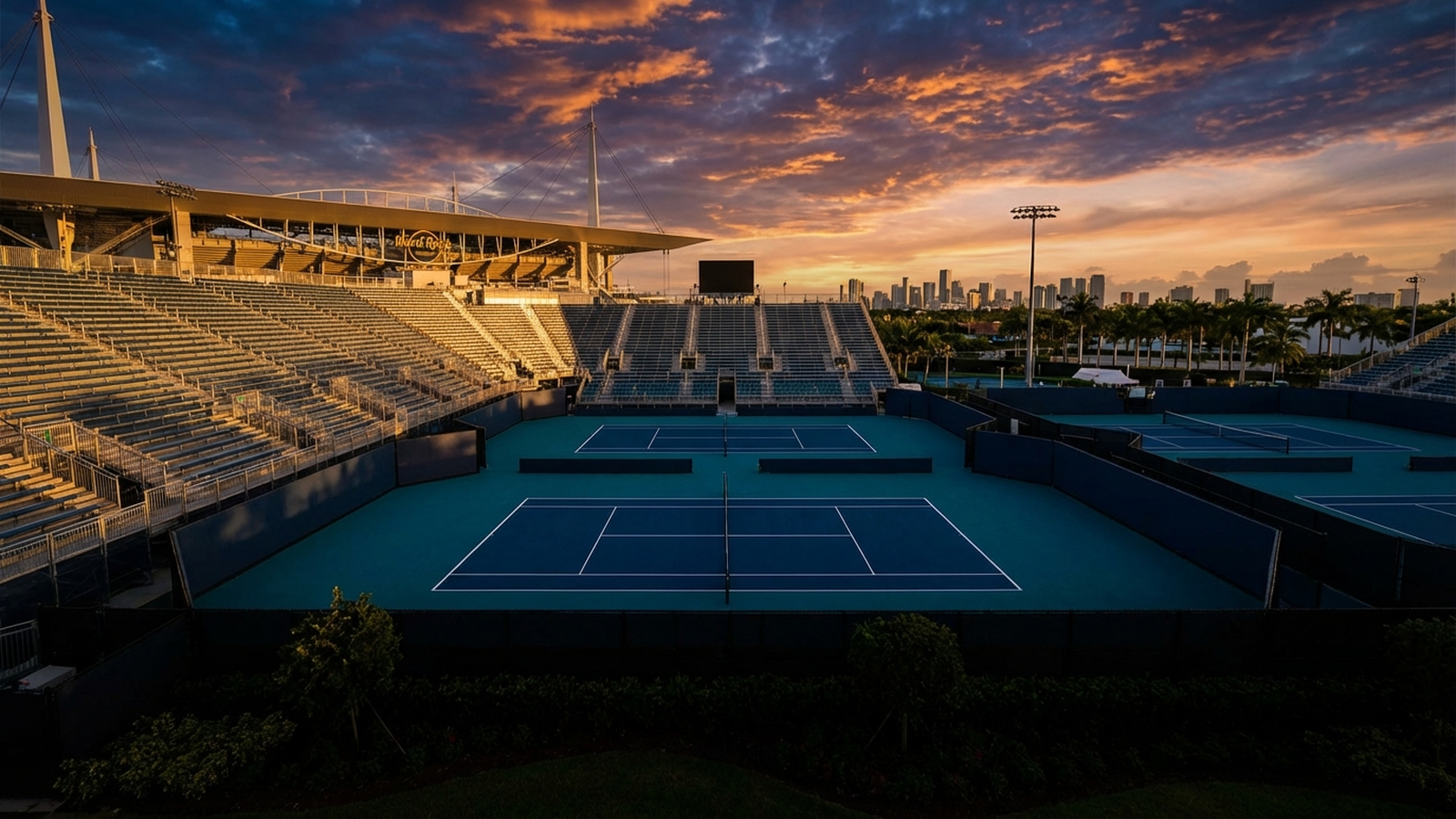
The Miami Open is one of only nine ATP Masters 1000 events and one of the most prestigious stops on both the men’s and women’s tours. According to TennisMattch.com’s database of 5,570 matches, the tournament has produced some of the sport’s most compelling statistical profiles: a tournament-wide average of just 4.33 aces per match (compared to a 5.00 tour average), a 45.21% break point conversion rate that edges the tour-wide mark of 44.33%, and finals that average a grueling 115.66 minutes. This is a tournament that rewards consistency, shot-making, and mental toughness over raw power — and the roll call of champions proves it.
Serena Williams leads all players with 8 titles, followed by Novak Djokovic and Andre Agassi with 6 apiece. Roger Federer claimed 4, while Victoria Azarenka collected 3. In 2025, the tournament shattered its own attendance record, drawing 405,448 fans to Hard Rock Stadium in Miami Gardens — the first time the event crossed the 400,000-spectator barrier. For 2026, the total prize purse climbs to $18.83 million, with the singles champions each taking home $1,151,380.
The Miami Open 2026 returns as the second half of the famed ‘Sunshine Double,’ following Indian Wells, and promises another two weeks of elite tennis under the South Florida sun. This comprehensive guide covers everything you need — from the tournament’s four-decade history and venue details to granular serve and break point data, weather forecasts, ticket information, and the storylines most likely to define the 2026 edition.
Tournament History
The Miami Open was born in 1985 from the vision of former professional player Butch Buchholz, who dreamed of creating a two-week combined event that could rival the Grand Slams in prestige and draw. Originally staged in Delray Beach before briefly relocating to Boca West, the tournament found its spiritual home at the Tennis Center at Crandon Park in Key Biscayne in 1987. For more than three decades, Key Biscayne’s waterfront courts served as the backdrop for some of tennis’s most iconic moments, earning the event the affectionate — and only semi-ironic — nickname of the Fifth Slam.
From the outset, the tournament distinguished itself by hosting both the men’s and women’s tours simultaneously across a sprawling two-week draw. That ambition paid off: it quickly became one of the largest non-Grand Slam events in the world, attracting the sport’s biggest names year after year. According to TennisMattch.com’s database, a total of 5,570 matches have been logged at the Miami Open, spanning the full evolution from the Agassi-Sampras era through Federer-Nadal-Djokovic and into the current generation.
The Key Biscayne Era (1987–2018)
The Crandon Park years cemented the tournament’s legacy. Andre Agassi was among the early dominant forces, amassing 62 wins against just 13 losses (a 82.7% win rate) en route to 3 titles. Pete Sampras collected 3 titles of his own, posting 43 wins and 11 losses across 54 matches. On the women’s side, Steffi Graf was nearly unbeatable, winning 53 of her 60 matches (an 88.3% win rate) and claiming 5 titles. Gabriela Sabatini was another Key Biscayne stalwart, with 42 wins and 8 title across 53 appearances.
But no player defined the Key Biscayne era — and then transcended it — like Serena Williams. She won her first Miami title in 2002 and would go on to lift the trophy 8 times in total, spanning from the Crandon Park courts to the modern stadium era. Her 76–10 career record at the event (88.4% win rate) is the single most dominant statistical profile in the tournament’s history, a record that stands unchallenged.
The Move to Hard Rock Stadium (2019–Present)
In 2019, seeking to modernize the fan experience and expand commercial capacity, organizers relocated the tournament to Hard Rock Stadium in Miami Gardens. The new venue — home of the NFL’s Miami Dolphins — offered vastly improved parking, hospitality, and infrastructure, with a temporary 13,800-seat center court built directly on the football field. The transition was not without growing pains; some players and fans mourned the intimate, oceanside feel of Key Biscayne. But attendance figures tell the story of the move’s success: the 2025 edition drew a record 405,448 spectators, shattering the 400,000 barrier for the first time.
The modern era has also seen a new generation make its mark. Ashleigh Barty won 2 titles before her retirement, Andy Murray collected 2, and in 2025, the 19-year-old Czech Jakub Mensik announced his arrival by claiming his first Miami crown. The tournament’s history is a living document, and 2026 promises to add another chapter.
| Year | Champion | Runner-Up | Score |
|---|---|---|---|
| 2025 | Jakub Mensik (Czech Republic) | Novak Djokovic | 2 – 0 |
| 2024 | Jannik Sinner (Italy) | Grigor Dimitrov | 6-3 6-1 |
| 2023 | Daniil Medvedev (RUS) | Jannik Sinner | 7-5 6-3 |
| 2022 | Carlos Alcaraz (Spain) | Casper Ruud | 7-5 6-4 |
| 2021 | Hubert Hurkacz (Poland) | Jannik Sinner | 7-6(4) 6-4 |
| 2019 | Roger Federer | John Isner | 6-1 6-4 |
| 2018 | John Isner | Alexander Zverev | 6-7(4) 6-4 6-4 |
| 2017 | Roger Federer | Rafael Nadal | 6-3 6-4 |
| 2016 | Novak Djokovic (Serbia) | Kei Nishikori | 6-3 6-3 |
| 2015 | Novak Djokovic (Serbia) | Andy Murray | 7-6(3) 4-6 6-0 |
| 2014 | Novak Djokovic (Serbia) | Rafael Nadal | 6-3 6-3 |
| 2013 | Andy Murray | David Ferrer | 2-6 6-4 7-6(1) |
| 2012 | Novak Djokovic (Serbia) | Andy Murray | 6-1 7-6(4) |
| 2011 | Novak Djokovic (Serbia) | Rafael Nadal | 4-6 6-3 7-6(4) |
| 2010 | Andy Roddick | Tomas Berdych | 7-5 6-4 |
| 2009 | Andy Murray | Novak Djokovic | 6-2 7-5 |
| 2008 | Nikolay Davydenko | Rafael Nadal | 6-4 6-2 |
| 2007 | Novak Djokovic (Serbia) | Guillermo Canas | 6-3 6-2 6-4 |
| 2006 | Roger Federer | Ivan Ljubicic | 7-6(5) 7-6(4) 7-6(6) |
| 2005 | Roger Federer | Rafael Nadal | 2-6 6-7(4) 7-6(5) 6-3 6-1 |
| 2004 | Andy Roddick | Guillermo Coria | 6-7(2) 6-3 6-1 RET |
| 2003 | Andre Agassi | Carlos Moya | 6-3 6-3 |
| 2002 | Andre Agassi | Roger Federer | 6-3 6-3 3-6 6-4 |
| 2001 | Andre Agassi | Jan Michael Gambill | 7-6(4) 6-1 6-0 |
| 2000 | Pete Sampras | Gustavo Kuerten | 6-1 6-7(2) 7-6(5) 7-6(8) |
| Year | Champion | Runner-Up | Score |
|---|---|---|---|
| 2025 | Aryna Sabalenka (BLR) | Jessica Pegula | 2 – 0 |
| 2024 | Danielle Collins (USA) | Elena Rybakina | 7-5 6-3 |
| 2023 | Petra Kvitova | Elena Rybakina | 7-6(14) 6-2 |
| 2022 | Iga Swiatek (Poland) | Naomi Osaka | 6-4 6-0 |
| 2021 | Ashleigh Barty | Bianca Andreescu | 6-3 4-0 RET |
| 2019 | Ashleigh Barty | Karolina Pliskova | 7-6(1) 6-3 |
| 2018 | Sloane Stephens | Jelena Ostapenko | 7-6(5) 6-1 |
| 2017 | Johanna Konta | Caroline Wozniacki | 6-4 6-3 |
| 2016 | Victoria Azarenka (BLR) | Svetlana Kuznetsova | 6-3 6-2 |
| 2015 | Serena Williams | Carla Suarez Navarro | 6-2 6-0 |
| 2014 | Serena Williams | Na Li | 7-5 6-1 |
| 2013 | Serena Williams | Maria Sharapova | 4-6 6-3 6-0 |
| 2012 | Agnieszka Radwanska | Maria Sharapova | 7-5 6-4 |
| 2011 | Victoria Azarenka (BLR) | Maria Sharapova | 6-1 6-4 |
| 2010 | Kim Clijsters | Venus Williams | 6-2 6-1 |
| 2009 | Victoria Azarenka (BLR) | Serena Williams | 6-3 6-1 |
| 2008 | Serena Williams | Jelena Jankovic | 6-1 5-7 6-3 |
| 2007 | Serena Williams | Justine Henin | 0-6 7-5 6-3 |
| 2006 | Svetlana Kuznetsova | Maria Sharapova | 6-4 6-3 |
| 2005 | Kim Clijsters | Maria Sharapova | 6-3 7-5 |
| 2004 | Serena Williams | Elena Dementieva | 6-1 6-1 |
| 2003 | Serena Williams | Jennifer Capriati | 4-6 6-4 6-1 |
| 2002 | Serena Williams | Jennifer Capriati | 7-5 7-6(4) |
| 2001 | Venus Williams | Jennifer Capriati | 4-6 6-1 7-6(4) |
| 2000 | Martina Hingis | Lindsay Davenport | 6-3 6-2 |
Venue & Playing Conditions
Since 2019, the Miami Open has been staged at Hard Rock Stadium, located at 347 Don Shula Drive in Miami Gardens, Florida. The venue is one of the most architecturally ambitious in professional tennis — a temporary 13,800-seat modular stadium is constructed directly on the playing field of a 65,000-seat NFL stadium, assembled in approximately four weeks without pouring a single slab of concrete. Dozens of additional practice and outer courts are built over the stadium’s parking lots, complete with a massive outdoor video board, and are dismantled and converted back into parking spaces once the event concludes.
Surface and Playing Conditions
The courts are Laykold hard courts, finished in exclusively designed ‘Oasis Blue’ and ‘Biscayne Blue’ color schemes that evoke the turquoise waters and clear skies of South Florida. Hard courts at the Miami Open play distinctly from other Masters 1000 events. According to TennisMattch.com’s database of 5,570 matches, the tournament yields an average of just 4.33 aces per match — well below the tour-wide average of 5.00. That gap (a 13.4% reduction) suggests the surface and conditions in Miami are not especially serve-friendly, favoring returners and baseline players more than, say, the faster hard courts of indoor events or the high-altitude conditions at some other stops.
The first serve percentage across all recorded Miami Open matches sits at 60.68%, marginally below the tour average of 61.13%. However, when players do land their first serve, they win those points at a 68.08% clip. Second-serve points won average 48.83%, which reinforces the idea that Miami’s conditions punish tentative second deliveries — a pattern consistent with the warm, humid air and moderate winds that characterize South Florida in March.
Fan Experience and Amenities
The Hard Rock Stadium campus has been designed as a festival-style experience. Beyond the tennis, attendees have access to an eclectic mix of premium South Florida dining options, live entertainment, and expansive hospitality zones. The venue’s location in Miami Gardens also provides easy access to the broader Miami area — from the Wynwood Walls art district and Little Havana’s Cuban cultural hub to the beaches and nightlife of South Beach, all within a short drive.
The Miami Open remains one of only a handful of tournaments outside the Grand Slams to feature a massive two-week combined draw for both men’s and women’s singles and doubles, giving fans the opportunity to watch the sport’s biggest names from both tours on a single campus. For 2026, that dual draw, combined with the record-setting 2025 attendance of 405,448, suggests the event will once again be the hottest ticket in American spring tennis.
Serve Dominance
The serve is the most important shot in tennis, but Miami has never been a server’s paradise. According to TennisMattch.com’s database of 5,570 matches, the Miami Open produces an average of 4.33 aces per match — a full 13.4% below the tour-wide average of 5.00. That gap is significant and consistent, pointing to a combination of surface speed, atmospheric conditions, and the caliber of returners who tend to thrive at this event.
First Serve Efficiency
Players at the Miami Open land their first serve at a rate of 60.68%, just under the tour average of 61.13%. The difference is marginal — less than half a percentage point — but the downstream effects compound. When the first serve goes in, players win those points at a rate of 68.08%. That number, while solid, tells us the surface doesn’t offer the kind of free points that faster courts do. Servers must place precisely and generate significant kick or slice to gain an advantage; flat power alone is frequently neutralized by Miami’s warm, humid conditions, which cause the ball to sit up slightly more than it would in cooler, drier environments.
Second Serve Vulnerability
The second serve data is where the real story emerges. Across all matches, the average second-serve points won percentage is 48.83% — meaning that when a player misses the first delivery and drops to a second serve, they lose the point more often than they win it. This is a critical threshold: it means that double-fault avoidance is essential in Miami, and aggressive returning can tilt rallies almost immediately. The tournament-wide average of 3.21 double faults per match is actually slightly below the tour average of 3.35, which suggests players adjust their second-serve approach at Miami, trading pace for reliability.
Ace Trends Over Time
Examining annual trends reveals a fascinating trajectory. In 2009, aces per match averaged just 3.70. By 2010, that crept up to 3.92. The number climbed gradually through the decade, reaching 4.81 in 2024 before spiking to 5.98 in 2025. That 2025 figure — which actually exceeded the tour-wide average for the first time in recent memory — may reflect the influence of bigger-serving young players entering the draw, improved racket technology, or simply a statistical fluctuation over one tournament edition. Whether the 2026 edition regresses toward the historical mean of 4.33 or continues the upward trend will be one of the more intriguing statistical storylines to follow.
Player-Specific Serve Profiles
Among the tournament’s all-time leaders, Serena Williams averaged a towering 7.18 aces per match — 65.8% above the tournament-wide average. Roger Federer posted 6.61 aces per match, while Venus Williams averaged 4.86. On the men’s side, Novak Djokovic — a six-time champion — averaged just 4.59 aces per match, barely above the tournament average. This is telling: Djokovic’s dominance (51 wins, 8 losses, an 86.4% win rate) was built on return and baseline play, not serving prowess. In contrast, Rafael Nadal, who played 55 matches in Miami without ever winning the title, averaged only 3.00 aces per match — well below average — underscoring how even elite players with modest serve numbers can compete but may ultimately fall short at the critical moments.
| Player | Record | Titles | Avg Aces |
|---|---|---|---|
| Serena Williams | 76W-10L | 8 | 7.2 |
| Venus Williams | 67W-19L | 3 | 4.9 |
| Andre Agassi | 62W-13L | 6 | — |
| Roger Federer | 56W-14L | 4 | 6.6 |
| Steffi Graf | 53W-7L | 5 | — |
| Novak Djokovic (Serbia) | 51W-8L | 6 | 4.6 |
| Victoria Azarenka (BLR) | 44W-12L | 3 | 2.0 |
| Pete Sampras | 43W-11L | 3 | — |
| Gabriela Sabatini | 42W-11L | 1 | — |
| Rafael Nadal | 42W-13L | 0 | 3.0 |
| Svetlana Kuznetsova | 35W-16L | 1 | 3.2 |
| David Ferrer | 35W-17L | 0 | 2.5 |
| Tomas Berdych | 35W-14L | 0 | 6.7 |
| Jennifer Capriati | 34W-13L | 0 | — |
| Jim Courier | 33W-12L | 1 | — |
Break Point Battles
If serving is muted in Miami, the corollary is that returning is amplified — and break point data confirms it. According to TennisMattch.com’s database of 5,570 matches, the Miami Open’s average break point conversion rate is 45.21%, nearly a full percentage point above the tour-wide average of 44.33%. That gap may sound small in isolation, but across thousands of break point opportunities over four decades, it represents a meaningful structural advantage for returners and a correspondingly challenging environment for servers.
Why Breaks Happen More in Miami
The elevated break point conversion rate aligns with the serve statistics: with aces 13.4% below the tour average and second-serve points won hovering below 50%, Miami creates more break opportunities and rewards returners who can capitalize. The Laykold surface, combined with warm and often breezy conditions, gives the ball enough hang time for elite returners to read spin and direction — and then punish second serves aggressively. Players who rely on holding serve comfortably through sheer power often find themselves facing more pressure games in Miami than at other Masters 1000 events.
Year-by-Year Break Point Trends
The annual data reveals interesting fluctuations. In 2008, break point conversion was 46.16% — one of the highest marks in the database — coinciding with an era when the Big Four’s elite returning was at its zenith. By 2024, the rate had dipped to 41.35%, the lowest in the dataset, potentially reflecting a generation of bigger servers making the conversion harder. In 2025, the pendulum swung back toward equilibrium at 44.97%. In 2023, the rate was 46.07%, suggesting that year-to-year variation is significant and often driven by draw composition and which players advance deep into the tournament.
Champions Who Thrived on the Return
Serena Williams converted break points at an extraordinary 54.06% across her 86 career matches in Miami — nearly 9 percentage points above the tournament average. That number is staggering: it means that when Williams had a chance to break, she took it more than half the time. This relentless conversion rate, combined with her 7.18 aces per match on the serving end, created an almost impossible dual threat. It’s no accident she won 3 titles.
Victoria Azarenka, a 3-time champion, posted the highest first serve percentage among top players at 67.73%, well above the tournament average of 60.68%. Her consistency in getting the first serve in reduced her exposure to break points, while her aggressive baseline game allowed her to convert on the other side. Novak Djokovic, similarly, leveraged a 63.52% first serve rate — the highest among male champions in the database — to protect his service games while weaponizing his return to devastating effect.
| Year | Matches | Avg Aces | Avg DFs | 1st Serve % | BP Conv % |
|---|---|---|---|---|---|
| 2025 | 372 | 6.0 | 3.0 | — | 45.0% |
| 2024 | 378 | 4.8 | 2.4 | 64.9% | 41.4% |
| 2023 | 376 | 5.1 | 3.0 | 62.5% | 46.1% |
| 2022 | 376 | 3.9 | 2.4 | 63.5% | 45.7% |
| 2021 | 374 | 4.1 | 3.0 | 62.7% | 47.3% |
| 2019 | 190 | 6.0 | 3.0 | 61.7% | 43.1% |
| 2018 | 190 | 5.3 | 3.5 | 59.5% | 40.1% |
| 2017 | 190 | 4.9 | 3.1 | 58.1% | 41.5% |
| 2016 | 190 | 5.3 | 3.4 | 58.0% | 44.5% |
| 2015 | 380 | 3.6 | 3.6 | 61.1% | 49.0% |
| 2014 | 364 | 4.3 | 3.4 | 60.2% | 45.2% |
| 2013 | 364 | 3.6 | 3.7 | 58.0% | 46.9% |
| 2012 | 362 | 3.5 | 3.4 | 59.0% | 44.3% |
| 2011 | 358 | 3.5 | 3.4 | 60.4% | 46.8% |
| 2010 | 372 | 3.9 | 3.3 | 59.1% | 44.8% |
| 2009 | 366 | 3.7 | 3.7 | 59.2% | 45.0% |
| 2008 | 368 | 4.2 | 3.4 | 60.1% | 46.2% |
Match Duration
Tennis at the Miami Open is not a sprint. According to TennisMattch.com’s database of 3,860 matches with recorded duration data, the average match lasts 98.42 minutes — just over an hour and 38 minutes. The median sits at 92 minutes, indicating that while most matches cluster in a manageable window, a long tail of extended battles pulls the average upward. This is a tournament where stamina, hydration, and mental endurance are not abstract concepts — they are survival requirements.
Duration by Round
Match length increases predictably as the tournament deepens. Early rounds (R128) average 97.72 minutes, while R64 matches are actually slightly shorter at 96.41 minutes — likely reflecting the higher number of mismatches in qualifying and first-round play where top seeds dominate. The R32 and R16 rounds converge around 100.4 minutes, suggesting more competitive matchups as the draw narrows. Quarterfinals average 101.50 minutes, semifinals 103.28 minutes, and finals stretch to a demanding 115.66 minutes — nearly two hours of elite-level tennis at the sharp end of a two-week event.
That 18-minute gap between the average first-round match and the average final is significant. Players who reach the championship match have typically played six or seven rounds over 12 days, often in punishing heat. The physical toll is cumulative, and the duration data suggests that finals are not only longer but more physically taxing than any other round, demanding a different kind of fitness.
The Longest Match in Tournament History
The longest match in the Miami Open’s database is a legendary encounter: the 2005 final between Roger Federer and Rafael Nadal, which lasted 223 minutes — three hours and 43 minutes. Federer won 2-6 6-7(4) 7-6(5) 6-3 6-1 in a five-set epic that saw Nadal, then just 18 years old, take a commanding two-set lead before the Swiss maestro engineered one of the great comebacks in Masters 1000 history. The match encapsulates everything that makes Miami special: the heat, the drama, the tactical chess, and the physical demands of closing out a two-week event against a player of generational talent.
For context, that 223-minute final is more than double the tournament-wide average of 98.42 minutes and nearly twice the average final duration of 115.66 minutes. It remains a benchmark for endurance at this event.
Median match length: 92 minutes
Longest match: Roger Federer d. Rafael Nadal 2-6 6-7(4) 7-6(5) 6-3 6-1 (223 min, F 2005)
Year-by-Year Trends
The Miami Open’s statistical profile is not static — it shifts year to year, reflecting broader changes in the sport’s playing style, racket technology, and the composition of each edition’s draw. According to TennisMattch.com’s database, the annual trends over the past two decades reveal a tournament in transition.
The Ace Revolution
The most dramatic trend is the rise in aces per match. In 2009, the average was just 3.70 aces per match. By 2010, it nudged up to 3.92. The number remained relatively stable through much of the 2010s, then began a sharper ascent: 5.10 in 2023, 4.81 in 2024, and a tournament-high 5.98 in 2025. That 2025 figure represents a 61.6% increase from 2009 — a generational shift in serving power that mirrors the broader tour trend toward bigger, more athletic players who can generate significant pace off the ground and behind the serve.
Double Faults: Declining Risk
Interestingly, double faults have moved in the opposite direction. In 2009, the tournament averaged 3.73 double faults per match. By 2024, that had dropped to 2.41 — a 35.4% decline. The 2025 figure of 3.04 represents a partial rebound but remains well below the earlier baseline. This pattern suggests that while serving has become more aggressive (more aces), it has also become more precise (fewer double faults). Modern serve coaching, biomechanical analysis, and the emphasis on second-serve placement over spin-and-pray have all contributed.
First Serve Percentage Stability
First serve percentage has remained remarkably stable over time. In 2008, the average was 60.11%. In 2024, it was 64.87%. In 2023, 62.52%. The tournament-wide historical average is 60.68%. This consistency suggests that while the outcomes of serves have changed (more aces, fewer double faults), the fundamental approach — landing roughly 60-65% of first serves — has been a constant across eras.
Break Point Conversion Volatility
Break point conversion shows the most year-to-year variability. The 2024 edition posted just 41.35%, the lowest in the dataset, while 2008 saw 46.16% and 2023 reached 46.07%. The tournament average of 45.21% sits above the tour-wide mark of 44.33%, but individual years can swing by nearly 5 percentage points. This volatility is partly driven by the depth of the draw: in years when multiple elite servers advance deep, conversion rates dip; when baseline grinders dominate, they spike. The 2026 edition’s break point profile will likely be determined by which players navigate the first week successfully and set the tone for the second.
Match Counts and Draw Size
The number of matches per year has been remarkably consistent, typically hovering between 366 and 378. In 2025, the count was 372; in 2024, 378; in 2023, 376. This stability reflects the standardized draw sizes of an ATP Masters 1000 / WTA 1000 combined event and ensures that year-over-year comparisons are meaningful rather than distorted by format changes.
King of the Miami Open
Serena Williams is the undisputed queen of the Miami Open, with 8 titles — more than any other player in the tournament’s history and more than some of the sport’s all-time greats combined. According to TennisMattch.com’s database, her record in Miami stands at 76 wins and just 10 losses, an 88.4% win rate across 86 career matches that is the single most dominant profile the event has ever produced.
A Reign of Sustained Excellence
Williams’s title years — 2002, 2003, 2004, 2007, 2008, 2013, 2014, and 2015 — span 13 seasons, an almost unfathomable duration of dominance at a single tournament. Her first three-peat (2002–2004) established her as Miami’s defining player. After a brief interruption, she reclaimed the crown in 2007 and 2008 for a second consecutive-title stretch. Then, after a five-year gap, she launched another three-peat from 2013 to 2015. No other player — male or female — has managed even two three-peats at any Masters 1000 event.
The Numbers Behind the Dominance
Williams’s statistical profile in Miami is extraordinary in its completeness. She averaged 7.18 aces per match — 65.8% above the tournament-wide average of 4.33. On the return side, she converted break points at a 54.06% clip, nearly 9 percentage points above the tournament average of 45.21%. Her first serve percentage of 58.14% was actually below the tournament average of 60.68%, suggesting she sacrificed accuracy for power — and the tradeoff paid off spectacularly, because when her first serve landed, the point was essentially over.
What makes her Miami record truly exceptional is the combination of power and clutch play. The 54.06% break point conversion rate means she seized the decisive moments in matches more than half the time, while her ace rate ensured she could serve her way out of trouble when pressured. The 88.4% win rate is the highest among any player with 50+ matches in the database, surpassing even Steffi Graf (88.3% with 53 wins, 7 losses, 6 titles) and Novak Djokovic (86.4% with 51 wins, 8 losses, 6 titles).
Putting It in Context
To understand the scale of Williams’s achievement, consider the competition. Novak Djokovic has won 6 titles and posted a remarkable 51–8 record (86.4% win rate). Andre Agassi also won 3 titles with 62 wins and 13 losses (82.7%). Steffi Graf won 5. Roger Federer won 4. Venus Williams, Serena’s sister, won 3 with 67 wins and 19 losses (77.9%). Victoria Azarenka won 3 with 44 wins and 12 losses (78.6%). Pete Sampras won 3 with 43 wins and 11 losses (79.6%). All of these are hall-of-fame caliber records — and Serena surpasses every single one.
Her 8 titles also set a record for any player at any single Masters 1000 / Premier Mandatory event, male or female. It is a record that, barring extraordinary circumstances, may never be matched. As the Miami Open enters its 2026 edition, Williams’s shadow looms long — a reminder of what sustained, dominant excellence looks like when applied to one specific tournament over the arc of a career.
Greatest Upsets
For all the dominance of its champions, the Miami Open has also produced some of the most memorable upsets in Masters 1000 history. The tournament’s two-week format, combined with the heat, humidity, and demanding conditions of South Florida, creates a fertile environment for underdog victories — particularly in the early rounds, when top seeds are still finding their rhythm and lower-ranked players have nothing to lose.
The Structure of Surprise
According to TennisMattch.com’s database of 5,570 matches, the Miami Open’s statistical profile reveals why upsets happen here more than casual fans might expect. With aces per match averaging just 4.33 — well below the tour’s 5.00 — the serve is less of a weapon, and matches are more likely to be decided in rallies. The break point conversion rate of 45.21% (above the 44.33% tour average) means that once an underdog earns a break opportunity, they convert it at a meaningfully higher rate than at most other events. And with matches averaging 98.42 minutes, there is ample time for the pressure to build on a favored player, particularly in the sweltering early-afternoon sessions.
Rafael Nadal: The Greatest Upset by Omission
Perhaps the most remarkable upset narrative in Miami Open history isn’t a single match — it’s an entire career. Rafael Nadal, one of the greatest players in tennis history, played 55 matches at the Miami Open, winning 42 and losing 13, but never won the title. Not once. His 0-title record at this event — despite his dominance elsewhere — is one of the sport’s enduring anomalies. His average of just 3.00 aces per match (31% below the tournament average) and a first serve percentage of 67.21% (well above average, suggesting he played conservatively) paint a picture of a player who adapted tactically but couldn’t find the final gear in Miami’s specific conditions.
Federer-Nadal, 2005 Final: The Comeback
The 2005 final between Roger Federer and Rafael Nadal stands as both the tournament’s longest match (223 minutes) and one of its greatest upset comebacks. Nadal, then 18, stormed to a two-set lead (6-2, 7-6) and appeared on the verge of claiming a title that would elude him for his entire career. Federer, already the world No. 1, rallied from the brink to win 2-6, 6-7(4), 7-6(5), 6-3, 6-1 — a five-set reversal that remains one of the most dramatic in Masters 1000 history. From Nadal’s perspective, it was a devastating loss that foreshadowed years of near-misses in Miami.
The Early-Round Shock Culture
Miami’s draw structure — with 96 players on the men’s side and a similarly deep women’s draw — means top seeds often face dangerous opponents by the third or fourth round. The R32 and R16 rounds average 100.37 and 100.47 minutes respectively, both above the overall tournament average of 98.42, indicating these are the rounds where matches become most competitive and upsets most likely. The elevation of match length in these middle rounds suggests that when upsets do happen, they often come after prolonged battles rather than one-sided routs — making them all the more dramatic for fans in attendance.
Rivalries
The Miami Open has served as a crucible for some of tennis’s most enduring rivalries, its two-week draw and prestigious status guaranteeing that the sport’s top players face each other at critical junctures year after year.
Federer vs. Nadal: Miami’s Defining Rivalry
No rivalry has been more consequential to the Miami Open’s history than Roger Federer vs. Rafael Nadal. Their 2005 final — a 223-minute epic that saw Federer claw back from two sets down to win 2-6, 6-7(4), 7-6(5), 6-3, 6-1 — remains the longest match in tournament history and one of the most iconic encounters in Masters 1000 tennis. That match was a microcosm of their broader rivalry: Nadal’s relentless intensity, Federer’s sublime shotmaking, and a see-sawing battle that redefined what was possible at this event. Federer’s Miami record — 56 wins, 14 losses, 4 titles, with an average of 6.61 aces per match and a 62.37% first serve rate — speaks to a player who was almost perfectly calibrated for the conditions. Nadal’s record — 42 wins, 13 losses, 0 titles — speaks to the cruel specificity of the surface and setting.
The Williams Sisters
The Williams sisters’ rivalry took on special resonance in Miami, where both built extraordinary records. Serena Williams (8 titles, 76–10) and Venus Williams (8 titles, 67–19) combined for 11 of the tournament’s women’s singles titles. Their head-to-head encounters in Miami added a layer of family drama to an already intense event. Serena’s statistical superiority — a higher win rate (88.4% vs. 77.9%), more aces (7.18 vs. 4.86 per match), and a higher first serve percentage margin — didn’t always predict the outcome of their individual encounters, which were often defined by emotional intensity and familiarity.
Djokovic’s Era of Control
Novak Djokovic’s 6 titles and 51–8 record made him the most successful men’s player in Miami Open history by title count. His rivalry with Federer, Nadal, and later Andy Murray (2 titles) played out across multiple Miami draws. What made Djokovic distinctive was his statistical profile: just 4.59 aces per match (barely above the tournament average) but a 63.52% first serve rate (well above average) and the kind of return game that made him a break-point machine. His matches against the other members of the Big Four in Miami were often tactical masterclasses, decided by margins of a few critical points in key games.
Azarenka and the WTA Power Shift
Victoria Azarenka, with 3 titles and a 44–12 record, established herself as one of the WTA’s most formidable Miami performers. Her first serve percentage of 67.73% — the highest among top players in the database — made her serve one of the most reliable weapons in the women’s draw. Her rivalries with the Williams sisters and later players like Ashleigh Barty (2 titles) represented the generational transition on the women’s tour, with Miami serving as the stage where new champions announced themselves.
Looking Ahead to 2026
The next generation of rivalries is still being written. Jakub Mensik’s 1 title in 2025 may mark the beginning of a new era, but the field is deep and the conditions demanding. Whether the 2026 edition produces a repeat champion or a fresh rivalry will depend on which players can navigate two weeks of relentless competition, convert their break points at rates approaching the tournament’s 45.21% average, and ultimately outlast their opponents in Miami’s unforgiving conditions.
Prize Money & Points
The Miami Open 2026 offers a total prize purse of $18.83 million, with singles champions on both the men’s and women’s sides each taking home $1,151,380. That figure cements the event’s status as one of the most lucrative stops outside the Grand Slams and reflects the tournament’s continued commercial growth under the stewardship of its primary presenting sponsor, Itaú.
Prize Money in Context
The $18.83 million total places the Miami Open firmly among the highest-paying Masters 1000 and WTA 1000 events on the calendar. For comparison, the Grand Slams offer significantly more — the Australian Open and US Open each exceeded $50 million in recent years — but among the non-Slam tier, Miami’s purse is at or near the top. The equal prize money structure for men’s and women’s champions ($1,151,380 each) reflects the tournament’s long-standing commitment to a combined event that values both tours equally.
Sponsors and Commercial Partnerships
The tournament’s financial health is underwritten by a deep roster of blue-chip sponsors. Itaú serves as the presenting sponsor, with additional partnerships from the Public Investment Fund (PIF), Lacoste, Emirates, Cadillac, DoorDash, and Santa Margherita. This diverse portfolio — spanning finance, fashion, aviation, automotive, food delivery, and wine — reflects the Miami Open’s positioning as both a world-class sporting event and a premium lifestyle experience. The PIF’s involvement in particular signals the broader trend of sovereign wealth investment in elite tennis properties, a dynamic that has reshaped the sport’s economic landscape in recent years.
What It Means for Players
Beyond the champion’s check, the prize money distribution cascades through the draw. Early-round losers still receive meaningful payouts, which is particularly significant for the lower-ranked players who fight through qualifying rounds. For those players, a first-round win at a $18.83 million event can cover several months of touring expenses. The financial incentive structure also explains why the Miami Open consistently attracts the deepest draws in non-Grand Slam tennis — the money, combined with the ranking points available at a Masters 1000/WTA 1000 event, makes skipping Miami a costly decision for anyone in the top 50.
Weather & Conditions
Weather is not a footnote at the Miami Open — it is a central character. The tournament takes place in late March and early April, squarely in the transition between South Florida’s dry winter season and its humid spring. For the 2026 edition, both forecast models and historical climate data paint a vivid picture of the conditions players and fans should expect.
Temperature and Heat
Based on the 14-day forecast for the 2026 tournament window, average high temperatures are projected at 27.1°C (80.8°F), with average lows of 22.0°C (71.6°F). Historical climate data over the past five years shows average highs of 27.8°C (82.0°F) and lows of 18.4°C (65.1°F). The 2026 forecast is therefore slightly cooler than the five-year average for daytime highs but warmer overnight, suggesting a narrower temperature range and potentially more persistent warmth throughout the day and into evening sessions.
For players, the heat is cumulative. Matches averaging 98.42 minutes mean sustained exposure to direct sunlight and elevated temperatures, particularly in the early-afternoon sessions that dominate the first week’s schedule. Hydration, recovery protocols, and heat acclimatization are critical preparation factors. Players who arrive in Miami directly from the cooler conditions at Indian Wells (held in the California desert, where March nights can dip below 10°C) face a particularly challenging adjustment.
Wind: Miami’s Hidden Variable
Wind is perhaps the most underappreciated factor in Miami tennis. The 2026 forecast projects average wind speeds of 26.3 km/h — significantly higher than the five-year historical average of 19.3 km/h. If those projections hold, the 2026 edition could feature the windiest conditions in recent memory. Wind at those speeds affects ball toss on the serve, alters the trajectory of baseline shots, and makes drop shots and touch play unreliable. Players who can keep the ball low, drive through the wind with heavy topspin, and adjust their toss on the fly will have a significant advantage.
The elevated wind forecast also helps explain the tournament’s relatively low ace count (4.33 per match versus 5.00 tour-wide). When the wind is gusting, first-serve accuracy drops, and even well-struck aces can be pushed wide or long. Returners, meanwhile, have extra time to read the ball as the wind slows it slightly, further tilting the balance toward the returning team.
Rain and Precipitation
The 2026 forecast shows an average precipitation probability of 34.6% across the 14-day window. Historical data shows average daily precipitation of just 2.8 mm over the past five years, suggesting that while rain is possible on any given day, extended washouts are rare. The hard courts at Hard Rock Stadium dry relatively quickly, and the tournament’s scheduling flexibility — with matches spread across numerous courts — allows play to resume promptly after brief showers. That said, afternoon thunderstorms are a hallmark of South Florida spring weather, and players should be prepared for potential delays, particularly during the second week when the stakes are highest.
Playing Conditions Summary for 2026
In aggregate, the 2026 Miami Open is likely to feature warm but not extreme temperatures, potentially gusty winds that could suppress serving effectiveness and elevate break point opportunities, and a moderate chance of afternoon rain interruptions. These are conditions that historically favor counterpunchers, returners, and physically fit players who can endure long rallies and adapt tactically to shifting weather within a single match. For fans attending in person, light clothing, sunscreen, and a rain poncho should all be considered essential items.
Records & Fun Facts
The Miami Open’s four-decade history has produced a treasure trove of records, milestones, and oddities. Here are some of the most compelling, drawn from TennisMattch.com’s database and the tournament’s institutional history.
Records and Milestones
Serena Williams stands alone as the most decorated player in Miami Open history, and her 8 titles are the most by any player at a single Masters 1000 / WTA 1000 event. Her 76–10 record (88.4% win rate) is the highest among any player with 50+ matches in the Miami database. She is also the tournament’s all-time leader in aces per match among champions, averaging 7.18 — a figure that would be impressive on the men’s tour, let alone the women’s.
Steffi Graf’s 88.3% win rate (53–7) narrowly trails Williams and represents the second-most dominant profile in tournament history. Graf won 8 titles in Miami, all during the Key Biscayne era.
The longest match in the database is the 2005 final between Roger Federer and Rafael Nadal: 223 minutes, a five-set marathon that Federer won 2-6, 6-7(4), 7-6(5), 6-3, 6-1 after trailing by two sets.
Venue Trivia
The center court at Hard Rock Stadium is built directly on the field of a 65,000-seat NFL stadium, utilizing a temporary 13,800-seat modular structure that takes approximately four weeks to assemble — and requires no concrete. After the tournament ends, the entire tennis facility is dismantled and the football field is restored.
Dozens of practice and outer courts are constructed temporarily over the Hard Rock Stadium parking lots, complete with a massive outdoor video board and player amenities. Once the event concludes, these courts vanish, and the lots return to their original purpose as parking spaces for Dolphins games and other stadium events.
Statistical Oddities
The tournament-wide average of 4.33 aces per match is 13.4% below the tour average of 5.00. Despite this, Serena Williams averaged 7.18 aces per match — 43.6% above the tour average and 65.8% above the Miami average. She essentially existed in a different statistical universe than the rest of the field.
Rafael Nadal’s 0 titles across 55 matches is one of the sport’s most baffling statistical anomalies. He won 42 matches in Miami — enough to produce a respectable 76.4% win rate — but could never put together the seven consecutive wins required to lift the trophy.
The 2025 edition set an all-time attendance record of 405,448 fans, the first time the event crossed the 400,000-spectator threshold. It also produced the highest single-year ace average in the database: 5.98 per match.
Victoria Azarenka’s first serve percentage of 67.73% is the highest among all top players in the database — nearly 7 full percentage points above the tournament average of 60.68%.
The ‘Sunshine Double’
The Miami Open forms the second half of the famed Sunshine Double, following the BNP Paribas Open at Indian Wells. Completing the Sunshine Double — winning both Indian Wells and Miami in the same year — is one of tennis’s most demanding achievements, requiring six weeks of sustained excellence across two different tournament environments. The few players who have accomplished the feat are enshrined in a select club that speaks to the grueling nature of the spring hard court swing.
Past Champions
| Year | Champion | Runner-Up | Score |
|---|---|---|---|
| 2025 | Jakub Mensik (Czech Republic) | Novak Djokovic | 2 – 0 |
| 2024 | Jannik Sinner (Italy) | Grigor Dimitrov | 6-3 6-1 |
| 2023 | Daniil Medvedev (RUS) | Jannik Sinner | 7-5 6-3 |
| 2022 | Carlos Alcaraz (Spain) | Casper Ruud | 7-5 6-4 |
| 2021 | Hubert Hurkacz (Poland) | Jannik Sinner | 7-6(4) 6-4 |
| 2019 | Roger Federer | John Isner | 6-1 6-4 |
| 2018 | John Isner | Alexander Zverev | 6-7(4) 6-4 6-4 |
| 2017 | Roger Federer | Rafael Nadal | 6-3 6-4 |
| 2016 | Novak Djokovic (Serbia) | Kei Nishikori | 6-3 6-3 |
| 2015 | Novak Djokovic (Serbia) | Andy Murray | 7-6(3) 4-6 6-0 |
| 2014 | Novak Djokovic (Serbia) | Rafael Nadal | 6-3 6-3 |
| 2013 | Andy Murray | David Ferrer | 2-6 6-4 7-6(1) |
| 2012 | Novak Djokovic (Serbia) | Andy Murray | 6-1 7-6(4) |
| 2011 | Novak Djokovic (Serbia) | Rafael Nadal | 4-6 6-3 7-6(4) |
| 2010 | Andy Roddick | Tomas Berdych | 7-5 6-4 |
| 2009 | Andy Murray | Novak Djokovic | 6-2 7-5 |
| 2008 | Nikolay Davydenko | Rafael Nadal | 6-4 6-2 |
| 2007 | Novak Djokovic (Serbia) | Guillermo Canas | 6-3 6-2 6-4 |
| 2006 | Roger Federer | Ivan Ljubicic | 7-6(5) 7-6(4) 7-6(6) |
| 2005 | Roger Federer | Rafael Nadal | 2-6 6-7(4) 7-6(5) 6-3 6-1 |
| 2004 | Andy Roddick | Guillermo Coria | 6-7(2) 6-3 6-1 RET |
| 2003 | Andre Agassi | Carlos Moya | 6-3 6-3 |
| 2002 | Andre Agassi | Roger Federer | 6-3 6-3 3-6 6-4 |
| 2001 | Andre Agassi | Jan Michael Gambill | 7-6(4) 6-1 6-0 |
| 2000 | Pete Sampras | Gustavo Kuerten | 6-1 6-7(2) 7-6(5) 7-6(8) |
| Year | Champion | Runner-Up | Score |
|---|---|---|---|
| 2025 | Aryna Sabalenka (BLR) | Jessica Pegula | 2 – 0 |
| 2024 | Danielle Collins (USA) | Elena Rybakina | 7-5 6-3 |
| 2023 | Petra Kvitova | Elena Rybakina | 7-6(14) 6-2 |
| 2022 | Iga Swiatek (Poland) | Naomi Osaka | 6-4 6-0 |
| 2021 | Ashleigh Barty | Bianca Andreescu | 6-3 4-0 RET |
| 2019 | Ashleigh Barty | Karolina Pliskova | 7-6(1) 6-3 |
| 2018 | Sloane Stephens | Jelena Ostapenko | 7-6(5) 6-1 |
| 2017 | Johanna Konta | Caroline Wozniacki | 6-4 6-3 |
| 2016 | Victoria Azarenka (BLR) | Svetlana Kuznetsova | 6-3 6-2 |
| 2015 | Serena Williams | Carla Suarez Navarro | 6-2 6-0 |
| 2014 | Serena Williams | Na Li | 7-5 6-1 |
| 2013 | Serena Williams | Maria Sharapova | 4-6 6-3 6-0 |
| 2012 | Agnieszka Radwanska | Maria Sharapova | 7-5 6-4 |
| 2011 | Victoria Azarenka (BLR) | Maria Sharapova | 6-1 6-4 |
| 2010 | Kim Clijsters | Venus Williams | 6-2 6-1 |
| 2009 | Victoria Azarenka (BLR) | Serena Williams | 6-3 6-1 |
| 2008 | Serena Williams | Jelena Jankovic | 6-1 5-7 6-3 |
| 2007 | Serena Williams | Justine Henin | 0-6 7-5 6-3 |
| 2006 | Svetlana Kuznetsova | Maria Sharapova | 6-4 6-3 |
| 2005 | Kim Clijsters | Maria Sharapova | 6-3 7-5 |
| 2004 | Serena Williams | Elena Dementieva | 6-1 6-1 |
| 2003 | Serena Williams | Jennifer Capriati | 4-6 6-4 6-1 |
| 2002 | Serena Williams | Jennifer Capriati | 7-5 7-6(4) |
| 2001 | Venus Williams | Jennifer Capriati | 4-6 6-1 7-6(4) |
| 2000 | Martina Hingis | Lindsay Davenport | 6-3 6-2 |
Year-by-Year Statistics
| Year | Matches | Avg Aces | Avg DFs | 1st Serve % | BP Conv % |
|---|---|---|---|---|---|
| 2025 | 372 | 6.0 | 3.0 | — | 45.0% |
| 2024 | 378 | 4.8 | 2.4 | 64.9% | 41.4% |
| 2023 | 376 | 5.1 | 3.0 | 62.5% | 46.1% |
| 2022 | 376 | 3.9 | 2.4 | 63.5% | 45.7% |
| 2021 | 374 | 4.1 | 3.0 | 62.7% | 47.3% |
| 2019 | 190 | 6.0 | 3.0 | 61.7% | 43.1% |
| 2018 | 190 | 5.3 | 3.5 | 59.5% | 40.1% |
| 2017 | 190 | 4.9 | 3.1 | 58.1% | 41.5% |
| 2016 | 190 | 5.3 | 3.4 | 58.0% | 44.5% |
| 2015 | 380 | 3.6 | 3.6 | 61.1% | 49.0% |
| 2014 | 364 | 4.3 | 3.4 | 60.2% | 45.2% |
| 2013 | 364 | 3.6 | 3.7 | 58.0% | 46.9% |
| 2012 | 362 | 3.5 | 3.4 | 59.0% | 44.3% |
| 2011 | 358 | 3.5 | 3.4 | 60.4% | 46.8% |
| 2010 | 372 | 3.9 | 3.3 | 59.1% | 44.8% |
| 2009 | 366 | 3.7 | 3.7 | 59.2% | 45.0% |
| 2008 | 368 | 4.2 | 3.4 | 60.1% | 46.2% |
All-Time Player Records
| Player | Record | Titles | Avg Aces |
|---|---|---|---|
| Serena Williams | 76W-10L | 8 | 7.2 |
| Venus Williams | 67W-19L | 3 | 4.9 |
| Andre Agassi | 62W-13L | 6 | — |
| Roger Federer | 56W-14L | 4 | 6.6 |
| Steffi Graf | 53W-7L | 5 | — |
| Novak Djokovic (Serbia) | 51W-8L | 6 | 4.6 |
| Victoria Azarenka (BLR) | 44W-12L | 3 | 2.0 |
| Pete Sampras | 43W-11L | 3 | — |
| Gabriela Sabatini | 42W-11L | 1 | — |
| Rafael Nadal | 42W-13L | 0 | 3.0 |
| Svetlana Kuznetsova | 35W-16L | 1 | 3.2 |
| David Ferrer | 35W-17L | 0 | 2.5 |
| Tomas Berdych | 35W-14L | 0 | 6.7 |
| Jennifer Capriati | 34W-13L | 0 | — |
| Jim Courier | 33W-12L | 1 | — |