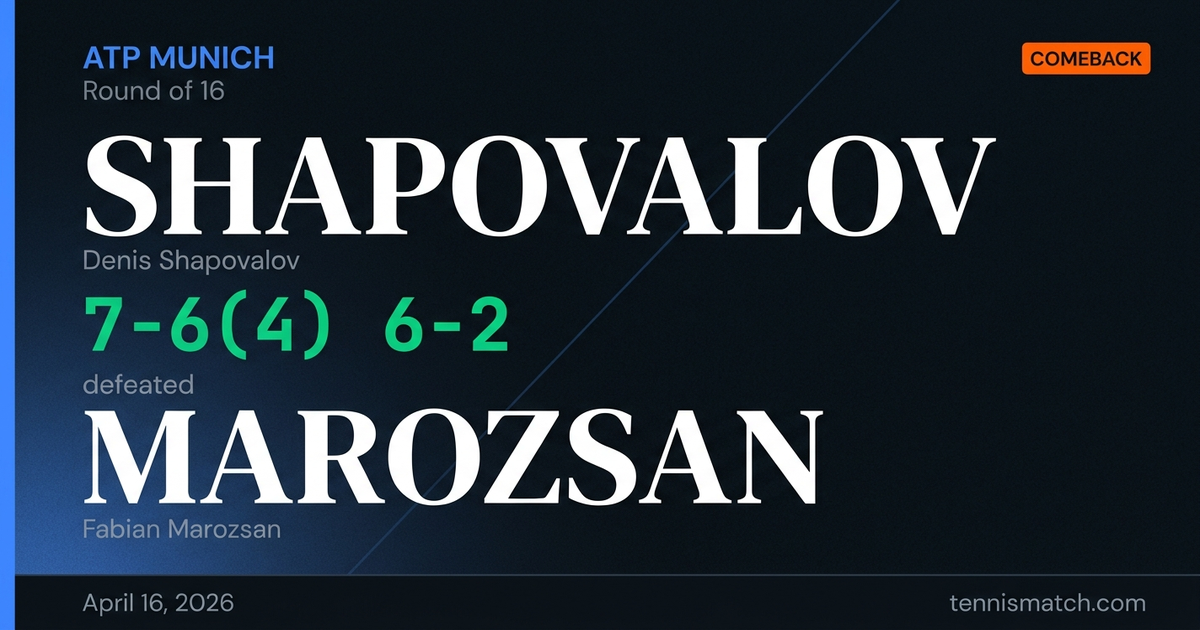



Denis Shapovalov survived a tight first set before pulling away to defeat Fabian Marozsan 7-6(4), 6-2 in the Munich Round of 16 on Thursday. The Canadian secured his fifth career title by converting his power advantage into 23 winners — nine more than Marozsan — and dominating the tiebreak to seize control of the match.
Marozsan, who upset Stefanos Tsitsipas in the previous round, kept pace through an evenly contested opening set. The Hungarian served at 73% and minimized errors with just one double fault, but Shapovalov’s aggressive returns and 79% first-serve points won forced the tiebreak. Once Shapovalov claimed the breaker 7-4, the momentum shifted decisively. The second set became a rout as the Canadian’s serve clicked into gear and Marozsan’s offensive output dried up.
Shapovalov held without facing a break point across both sets, a testament to his clutch serving despite eight double faults. He closed out the match by winning 67 of 127 total points, with Marozsan unable to recover from the first-set loss.
Key Takeaways
- Shapovalov’s 79% first-serve points won proved decisive against Marozsan’s 64%, compensating for a 16-point gap in first-serve accuracy (57% vs 73%).
- The Canadian fired 23 winners to Marozsan’s 14, matching nearly double the Hungarian’s offensive output despite only one fewer unforced error (22 vs 21).
- Neither player faced a break point in the entire match — Shapovalov 0/0, Marozsan 0/0 — making the tiebreak the sole service break of the contest and the decisive moment.
- Marozsan’s superior second-serve points won (75% vs 59%) couldn’t offset Shapovalov’s dominance behind his first delivery, highlighting the Canadian’s ability to dictate with pace when his serve found the box.
Player Analysis
Denis Shapovalov
Shapovalov’s performance reflected both his immense talent and his ongoing battle with consistency. Serving at just 57% — well below his 60% hard court average — he compensated by winning 79% of first-serve points, a mark that allowed him to hold without facing a single break point. His 23 winners showcased the aggressive baseline game that has defined his career, though eight double faults revealed the volatility that continues to shadow his results. The tiebreak execution was critical: after a nervy opening set, he raised his level when it mattered most, then rode that confidence into a dominant second set. This victory, his first after consecutive losses at Indian Wells and Miami, signals a potential return to form on hard courts.
The Canadian’s ability to hold serve under pressure — particularly without converting any break points of his own — underscored his reliance on overwhelming opponents with power rather than surgical precision. Against higher-ranked opponents in the quarterfinals, he’ll need to clean up the double faults and maintain his first-serve percentage to avoid giving better returners opportunities he couldn’t afford to offer Marozsan.
Fabian Marozsan
Marozsan’s run ended not due to poor execution, but an inability to match Shapovalov’s firepower when the match reached its critical juncture. The Hungarian served beautifully at 73% and committed just one double fault, a testament to his improved consistency on hard courts this season. His 75% second-serve points won suggested he was forcing Shapovalov into difficult returns, yet he couldn’t convert that defensive solidity into offensive opportunities. With just 14 winners compared to Shapovalov’s 23, Marozsan lacked the knockout punch needed to break through against a player who never faced a break point.
The tiebreak loss deflated Marozsan’s resistance. After pushing Shapovalov to the brink in the first set, he managed only four games in the second as the Canadian’s confidence surged. His upset of Tsitsipas in the previous round showcased his capacity to trouble elite players, but against Shapovalov’s pace and aggression, Marozsan’s more measured approach couldn’t produce enough pressure. The loss extends his career title drought to zero, though his Munich semifinal run last year suggests he remains capable of deeper results at this venue.
Match Statistics
| Denis Shapovalov | Stat | Fabian Marozsan |
|---|---|---|
| 4 | Aces | 3 |
| 8 | Double Faults | 1 |
| 57% | 1st Serve % | 73% |
| 79% | 1st Serve Points Won | 64% |
| 59% | 2nd Serve Points Won | 75% |
| 23 | Winners | 14 |
| 22 | Unforced Errors | 21 |
| 67 | Total Points Won | 60 |
Frequently Asked Questions
What was the final score of Shapovalov vs Marozsan at Munich 2026?
Denis Shapovalov defeated Fabian Marozsan 7-6(4), 6-2 in the Round of 16 at the Munich ATP tournament on April 16, 2026.
How many winners did Denis Shapovalov hit against Fabian Marozsan?
Shapovalov struck 23 winners compared to Marozsan’s 14, a significant advantage that helped him control the match after winning the first-set tiebreak.
Did either player face a break point in the Shapovalov Marozsan match?
No — neither Denis Shapovalov nor Fabian Marozsan faced a single break point during the entire match, making the first-set tiebreak the sole service break and the decisive moment.
Who won the Munich Round of 16 between Shapovalov and Marozsan?
Denis Shapovalov won, advancing to the quarterfinals by defeating Fabian Marozsan in straight sets.
What’s Next
Shapovalov advances to the Munich quarterfinals, where he will look to extend his first deep run at this tournament. The Canadian’s hard court form has been inconsistent in 2026, but this victory — his fifth in his last 10 matches — could signal renewed momentum as the season progresses.