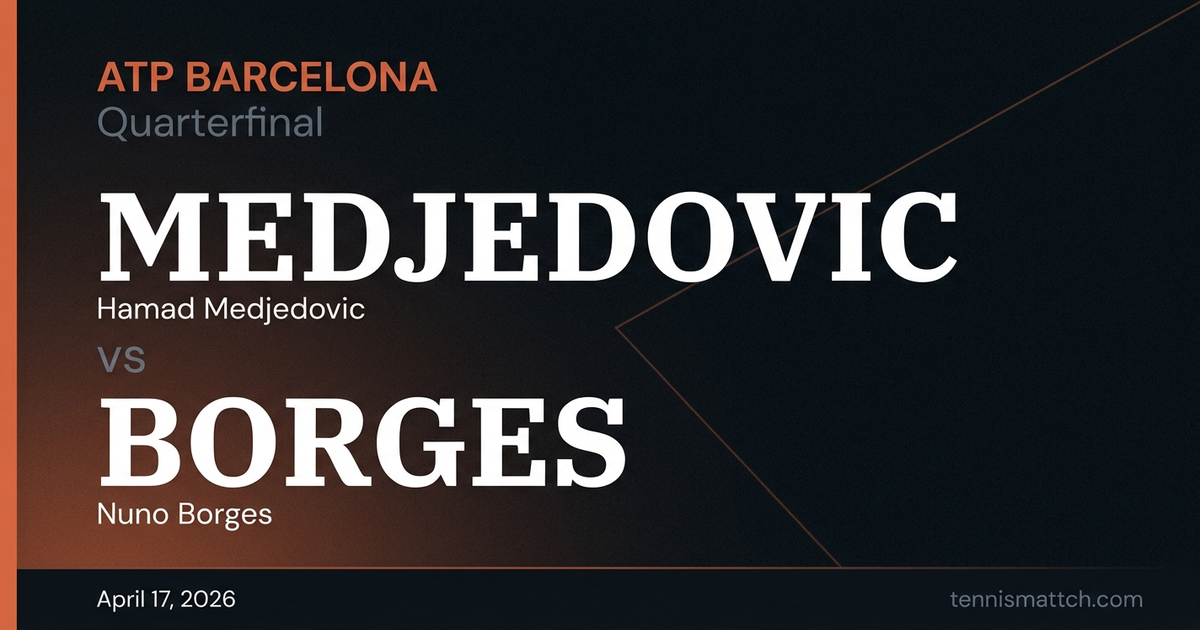



Hamad Medjedovic faces Nuno Borges in the Barcelona quarterfinals on April 17, 2026, in their first career meeting. Both arrived here with upset R16 victories—Medjedovic over Alex De Minaur, Borges over Tomas Martin Etcheverry—but their clay court profiles suggest contrasting paths to this stage. Borges enters with a 55% clay court win rate and superior serve reliability, while Medjedovic relies on aggressive baseline firepower despite a 42.3% clay record.
The Portuguese player’s 90% first serve percentage and 35.8% break point conversion rate represent substantial advantages over Medjedovic’s 70% and 25.5% respectively. Borges has compiled 22 clay court wins in his recent sample compared to Medjedovic’s 11, indicating greater comfort on the surface. Yet Medjedovic’s 39.0 average winners per match—nearly nine more than Borges—demonstrate the Serbian’s capacity to dictate when his timing clicks.
Barcelona has treated both players kindly this week, though Borges brings more tournament history to the court. His 2023 run here included matches against Carlos Alcaraz, while Medjedovic’s Barcelona ledger shows flashes of brilliance interspersed with early exits. The quarterfinal setting amplifies every statistical edge, and Borges’ steadier clay foundation positions him as the more reliable proposition in their inaugural encounter.
Key Takeaways
- Borges’ first serve percentage (90% vs. 70%) could prove decisive in dictating play, especially given clay’s emphasis on service positioning and rally construction.
- Medjedovic’s aggression differential (39.0 winners per match vs. 30.7) creates upset potential if he can sustain his attacking rhythm from the De Minaur victory.
- Break point conversion separates the two competitors significantly—Borges’ 35.8% rate versus Medjedovic’s 25.5% suggests the Portuguese player capitalizes more efficiently on opportunities.
- Neither player has carried strong recent form into Barcelona (both 2-8 in last 10 matches), making their R16 performances critical momentum indicators for this first-time matchup.
Player Analysis
Hamad Medjedovic
The Serbian’s game thrives on controlled chaos—his 39.0 average winners per match on clay reveal a player willing to take the initiative even on a surface that typically rewards patience. His R16 dismantling of De Minaur demonstrated this approach at its best, but the underlying numbers expose vulnerabilities. A 70% first serve percentage leaves too many second serves vulnerable to Borges’ return positioning, and his 25.5% break point conversion suggests he struggles to close out the critical moments that define tight clay court exchanges.
Medjedovic’s 42.3% clay win rate reflects a player still developing surface mastery. His 3.4 double faults per match, combined with 11 clay wins against 15 losses in recent competition, indicate technical inconsistencies that resurface under pressure. Barcelona represents his best recent clay result, but his 2-8 overall form preceding this week—mostly on hard courts—raises questions about match sharpness beyond the De Minaur upset.
Nuno Borges
Borges constructs his clay court success on a foundation of metronomic reliability. His 90% first serve percentage borders on exceptional for the surface, allowing him to control rally direction from the opening shot. The 2.9 double faults per match and 35.8% break point conversion rate paint the picture of a player who compounds small advantages into decisive ones—precisely the skillset quarterfinal clay matches demand. His 55% clay win rate, built across 40 matches, demonstrates genuine surface competence rather than fortunate scheduling.
The Portuguese player’s 30.7 average winners suggest a more conservative shot selection than Medjedovic, but his 22 clay victories indicate he’s learned how to finish points efficiently without unnecessary risk. His Barcelona history includes facing Alcaraz in 2023, providing big-match experience Medjedovic lacks at this venue. The clean R16 dispatch of Etcheverry, coupled with his superior statistical profile on clay, positions Borges as the player better equipped to handle quarterfinal pressure in their first meeting.
Frequently Asked Questions
Who will win Hamad Medjedovic vs Nuno Borges at Barcelona 2026?
Nuno Borges enters with statistical advantages that favor clay court success: a 55% clay win rate versus Medjedovic’s 42.3%, superior first serve percentage (90% vs. 70%), and better break point conversion (35.8% vs. 25.5%). While Medjedovic’s aggressive style (39.0 winners per match) creates upset potential, Borges’ consistency and proven clay pedigree make him the more reliable projection for the quarterfinal.
What is the head-to-head record between Medjedovic and Borges?
Hamad Medjedovic and Nuno Borges have never played each other before. This Barcelona quarterfinal will mark their first career meeting, adding an element of tactical uncertainty as neither player can reference previous matchups when preparing strategy.
Medjedovic vs Borges Barcelona 2026 quarterfinal prediction
The statistical profile favors Borges significantly. His 90% first serve percentage on clay provides a platform for control that Medjedovic’s 70% rate cannot match, while his 35.8% break point conversion dwarfs Medjedovic’s 25.5%. Medjedovic’s 39.0 winners per match offer a path to victory if he replicates his De Minaur performance, but Borges’ 22 clay court wins versus Medjedovic’s 11 suggest superior surface comfort. Expect Borges’ steadiness to outlast Medjedovic’s aggression in a competitive three-setter.
When is Medjedovic vs Borges at Barcelona 2026?
The quarterfinal match is scheduled for April 17, 2026, at the Barcelona Open. Both players won their Round of 16 matches on April 15, giving them one day of rest before this first-time meeting on clay.
What’s Next
The quarterfinal is scheduled for April 17, 2026, on the clay courts of Barcelona. The winner advances to the semifinals with a chance to build crucial clay court momentum ahead of the season’s European swing. For Borges, victory would validate his clay credentials against an aggressive opponent; for Medjedovic, it would represent a breakthrough performance confirming his De Minaur upset wasn’t an aberration.