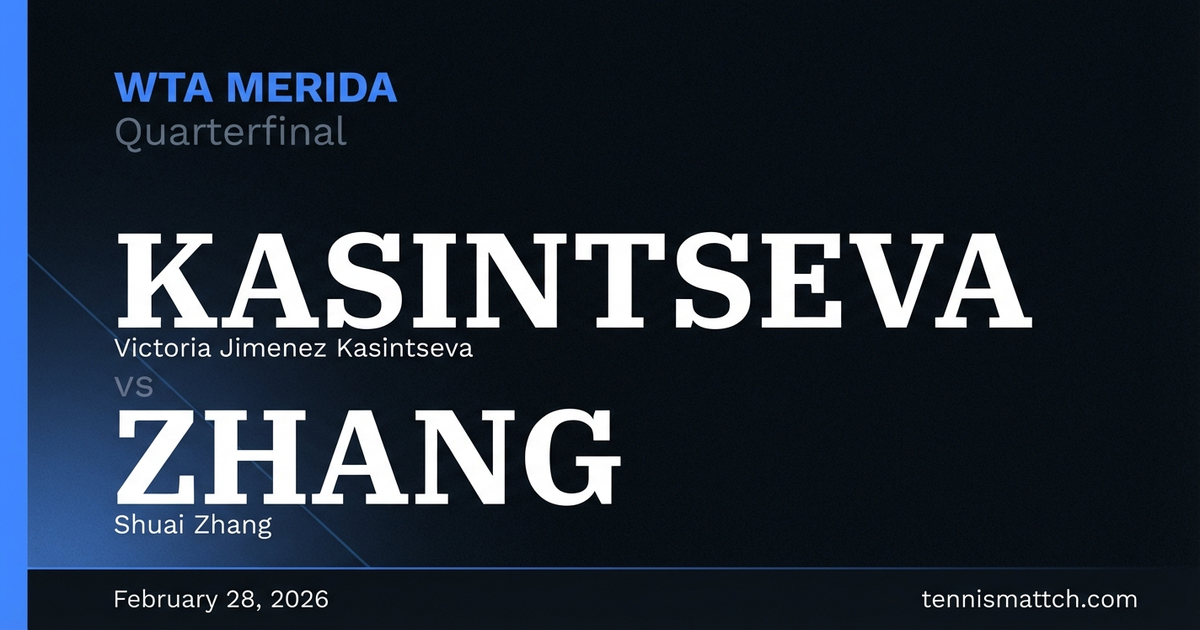


Victoria Jimenez Kasintseva faces Shuai Zhang in the WTA Merida quarterfinals on February 28, 2026, marking their first career meeting. The Andorran rising talent takes on the experienced Chinese veteran on Mexican hard courts, with both players seeking their first WTA semifinal appearance of the season.
This matchup pits contrasting styles and career trajectories against each other. Jimenez Kasintseva, known for her aggressive baseline game and emerging hard-court prowess, enters as the younger, less experienced player against Zhang, whose veteran craftiness and doubles expertise translate into creative singles tactics. With no head-to-head history to inform expectations, court positioning and first-strike tennis could prove decisive.
The hard courts in Merida favor aggressive play, potentially suiting Jimenez Kasintseva’s power-based approach. However, Zhang’s ability to absorb pace and redirect with angles has troubled similarly styled opponents throughout her career. Whichever player controls the rally length—whether through Jimenez Kasintseva’s pressure or Zhang’s tactical variety—will likely control the outcome.
Key Takeaways
- No head-to-head history means tactical adjustments will be crucial as both players scout unfamiliar tendencies in real time during the opening set.
- Jimenez Kasintseva’s aggressive baseline power could overwhelm on faster Merida hard courts if she maintains consistency and limits unforced errors.
- Zhang’s experience in high-pressure situations, including Grand Slam doubles titles, gives her mental fortitude in tight quarterfinal moments that Jimenez Kasintseva is still developing.
- First-serve percentage will be critical—the player who establishes comfort holding serve early will dictate rally dynamics and control momentum shifts.
Player Analysis
Victoria Jimenez Kasintseva
The 23-year-old Andorran represents one of the tour’s most intriguing developing talents. Her aggressive groundstrokes, particularly off the forehand wing, allow her to dictate from the baseline when dialed in. On hard courts, Jimenez Kasintseva’s flat, penetrating ball striking can overwhelm opponents who struggle with pace. Her quarterfinal run in Merida suggests growing comfort at the WTA level, though consistency remains her primary developmental challenge. Against a tactically astute opponent like Zhang, she’ll need to balance aggression with patience, choosing the right moments to pull the trigger rather than forcing low-percentage winners.
The key question is whether Jimenez Kasintseva can maintain her intensity across crucial games. Her firepower gives her a clear pathway to victory, but she must avoid the momentum-killing stretches of errors that have derailed her in previous breakthrough opportunities. If she establishes her forehand early and serves effectively, she can take Zhang out of rhythm.
Shuai Zhang
At 37, Zhang brings invaluable experience to this quarterfinal, having competed at the highest levels of both singles and doubles. Her doubles success—including Grand Slam titles—demonstrates exceptional court craft, anticipation, and tactical intelligence that translate into her singles game. Zhang excels at neutralizing power players through precise placement, change of pace, and angled returns that force opponents off the baseline. She won’t overpower Jimenez Kasintseva, but she doesn’t need to. Her ability to extend rallies, invite errors, and execute in pressure moments has carried her through similar matchups against younger, harder-hitting opponents.
Zhang’s vulnerability lies in sustained high-intensity rallies where accumulated court coverage takes its toll. If Jimenez Kasintseva can maintain relentless depth and pace, Zhang may struggle to redirect effectively. However, her mental resilience and pattern recognition give her advantages in crucial moments—precisely where less experienced players falter.
Frequently Asked Questions
Who will win Victoria Jimenez Kasintseva vs Shuai Zhang at WTA Merida 2026?
This quarterfinal could swing either direction. Jimenez Kasintseva’s aggressive power gives her weapons to dictate if she maintains consistency, while Zhang’s experience and tactical versatility provide pathways to neutralize that aggression. The faster hard-court surface in Merida may favor Jimenez Kasintseva’s first-strike game, but Zhang’s ability to execute in pressure moments gives her an edge in tight situations. First-serve percentage and break-point conversion will likely determine the outcome.
What is the head-to-head record between Victoria Jimenez Kasintseva and Shuai Zhang?
Jimenez Kasintseva and Zhang have never played each other before this WTA Merida quarterfinal. This first meeting means neither player has established patterns or tactical blueprints from previous encounters, making in-match adjustments crucial as they learn each other’s tendencies.
Victoria Jimenez Kasintseva vs Shuai Zhang WTA Merida 2026 prediction
Expect a contrast in styles with Jimenez Kasintseva bringing youth, power, and aggressive baseline play against Zhang’s veteran craft and tactical precision. The key factors include Jimenez Kasintseva’s ability to maintain aggression without excessive errors, and Zhang’s success in extending rallies to invite mistakes. On Merida’s hard courts, if Jimenez Kasintseva serves well and controls rally length, she holds an advantage. If Zhang weathers early pressure and forces Jimenez Kasintseva into longer exchanges, her experience becomes decisive.
When is Victoria Jimenez Kasintseva vs Shuai Zhang at WTA Merida 2026?
The quarterfinal match between Victoria Jimenez Kasintseva and Shuai Zhang is scheduled for February 28, 2026, at the WTA Merida tournament in Mexico. Specific match time will be confirmed closer to the date based on the tournament’s daily schedule.
What’s Next
The quarterfinal is scheduled for February 28, 2026, at the WTA Merida tournament in Mexico. The winner advances to the semifinals, marking a significant result for either player’s season momentum. For Jimenez Kasintseva, a semifinal would represent continued progress toward establishing herself as a consistent WTA-level competitor. For Zhang, it would signal that her veteran skills remain potent on tour despite her age.