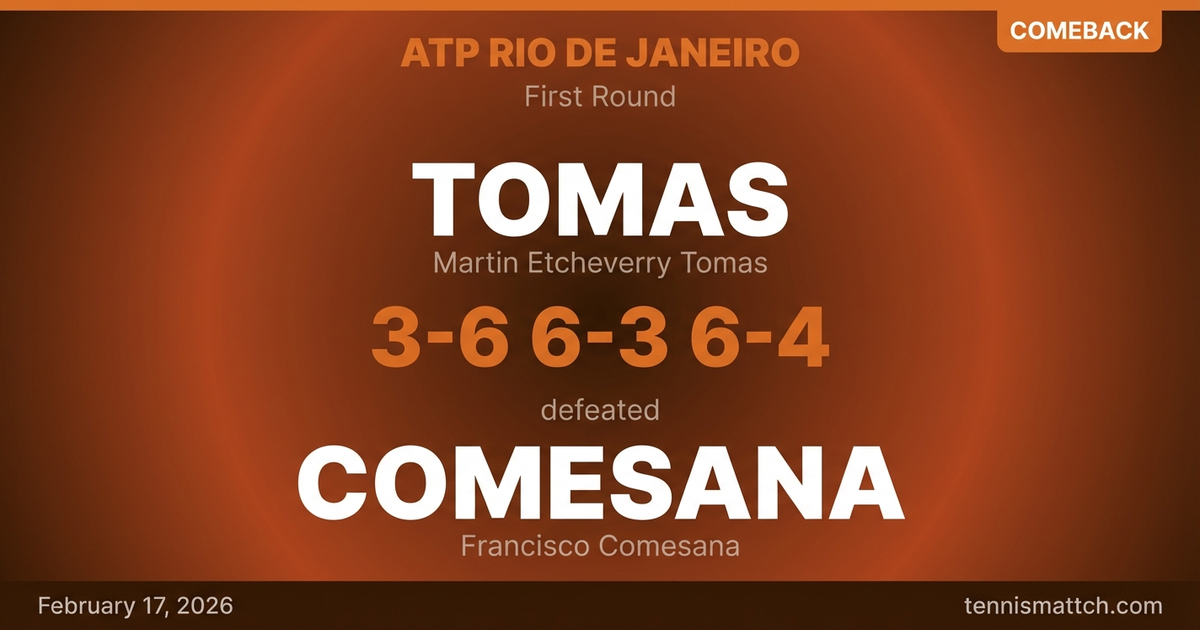



Martín Etcheverry overcame a slow start to defeat fellow Argentine Francisco Comesaña 3-6, 6-3, 6-4 in the opening round of the ATP Rio de Janeiro tournament on clay. After dropping the first set, Etcheverry tightened his second serve and improved his break point conversion to turn the match around in a contest decided by a single point—80 to 81 in total.
Comesaña controlled the early exchanges, firing 30 winners and winning 80% of first-serve points in the opening set. But his aggression came at a cost: 30 unforced errors and four double faults undermined his ability to sustain the level. Etcheverry found his rhythm in the second set, crucially winning 59% of second-serve points compared to Comesaña’s 52%, a discrepancy that proved decisive in the longer rallies characteristic of clay-court tennis.
The final set remained tight until Etcheverry secured a crucial break, converting his second of five break point opportunities while Comesaña managed just one from four chances. Despite hitting 10 fewer winners, Etcheverry’s steadier game and superior break point execution carried him through after two hours of baseline warfare between the South American compatriots.
Key Takeaways
- Etcheverry’s superior second-serve performance (59% points won vs. 52%) proved decisive in the three-set comeback, allowing him to stay competitive in return games despite Comesaña’s blistering 80% first-serve win rate.
- Break point conversion told the story: Etcheverry converted 2 of 5 opportunities (40%) while Comesaña managed just 1 of 4 (25%), a crucial edge in a match separated by a single point overall.
- Comesaña’s winner-to-error ratio of 1:1 (30 winners, 30 unforced errors) highlighted the high-risk approach that won him the first set but couldn’t be sustained across three sets on clay.
- Despite winning just 80 total points to Comesaña’s 81, Etcheverry’s ability to win the points that mattered most—particularly in the third set—showcased the tactical maturity needed to close out tight matches.
Player Analysis
Martín Etcheverry
Etcheverry demonstrated the patience and tactical flexibility that clay-court tennis demands, adjusting his game after a passive first set. His 59% second-serve points won percentage was the foundation of his comeback, allowing him to extend rallies and force Comesaña into the errors that accumulated over three sets. While his 20 winners paled in comparison to his opponent’s 30, Etcheverry kept his unforced error count to just 21, striking the right balance between aggression and consistency.
The Argentine’s break point conversion, though hardly dominant at 2 of 5, was sufficient in a match where margins were razor-thin. His ability to serve at 66% first serves while maintaining 72% points won on those deliveries gave him a reliable platform to build from, particularly in the decisive third set.
Francisco Comesaña
Comesaña’s aggressive baseline game produced spectacular moments—30 winners and eight aces—but the same approach generated 30 unforced errors and four double faults that ultimately cost him the match. His 80% first-serve points won was genuinely impressive, yet he won just 52% of second-serve points, creating a vulnerability that Etcheverry exploited relentlessly in the final two sets.
Converting only 1 of 4 break points proved fatal in a match this tight. Comesaña actually won one more total point than his opponent (81 to 80), but tennis rewards winning the important points, not the most points, and his inability to capitalize on break opportunities when they arose left him on the wrong side of the result.
Match Statistics
| Martin Etcheverry Tomas | Stat | Francisco Comesana |
|---|---|---|
| 6 | Aces | 8 |
| 2 | Double Faults | 4 |
| 66% | 1st Serve % | 64% |
| 72% | 1st Serve Points Won | 80% |
| 59% | 2nd Serve Points Won | 52% |
| 2/5 | Break Points Won | 1/4 |
| 20 | Winners | 30 |
| 21 | Unforced Errors | 30 |
| 80 | Total Points Won | 81 |
Frequently Asked Questions
What was the final score of Martín Etcheverry vs Francisco Comesaña at ATP Rio de Janeiro 2026?
Martín Etcheverry defeated Francisco Comesaña 3-6, 6-3, 6-4 in the first round of the ATP Rio de Janeiro tournament on February 17, 2026.
How many break points did Etcheverry convert against Comesaña in Rio?
Etcheverry converted 2 of 5 break point opportunities (40%), while Comesaña managed just 1 of 4 (25%), a difference that proved decisive in the three-set match.
Who won more total points in the Etcheverry vs Comesaña match?
Francisco Comesaña actually won more total points (81) than Martín Etcheverry (80), but Etcheverry won the points that mattered most to secure the 3-6, 6-3, 6-4 victory.
What round does Martín Etcheverry advance to after beating Comesaña?
Etcheverry advances to the second round of the ATP Rio de Janeiro tournament after his first-round comeback victory over Francisco Comesaña on clay.
What’s Next
Etcheverry advances to the second round of the ATP Rio de Janeiro tournament, where he will face the winner of the match between seeded players competing later in the draw. Having found his form on the South American clay swing, the Argentine will look to build momentum in front of a regional crowd.
Head-to-head history: Francisco Comesana vs Martin Etcheverry Tomas.