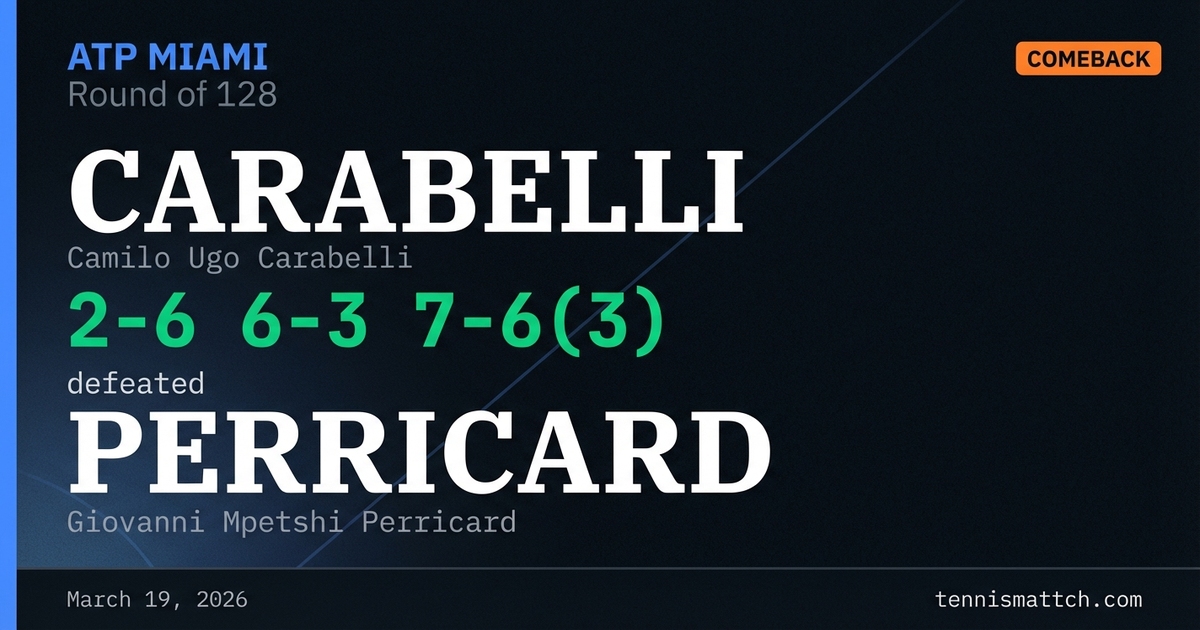



Camilo Ugo Carabelli survived a barrage of 24 aces from Giovanni Mpetshi Perricard to claim a hard-fought 2-6, 6-3, 7-6(3) victory in the Miami Round of 128 on Thursday. The Argentine snapped a three-match hard court losing streak by dominating Perricard’s vulnerable second serve, winning 59% of those points compared to the Frenchman’s meager 35%.
After being overwhelmed in a lopsided opening set where Perricard’s serve proved untouchable (86% first-serve points won), Carabelli found his rhythm in the second, breaking through to level the match at one set apiece. The momentum swing carried into the decider, where neither player faced a break point across 12 tense games. Carabelli seized control in the tiebreaker, racing to a 7-3 advantage to seal his first hard court win since early March at Indian Wells.
The contrast between Perricard’s firepower—44 winners and 24 aces—and Carabelli’s steadiness ultimately favored the grinder from Argentina. Despite losing the total points battle 89-83 and committing zero double faults to Perricard’s three, Carabelli’s ability to punish weak second serves proved decisive when the match tightened.
Key Takeaways
- Carabelli exploited Perricard’s second serve ruthlessly, winning 59% of points against it while Perricard managed just 35% on Carabelli’s second offerings—a 24-percentage-point chasm that proved decisive in a match where no break points were converted.
- Perricard’s 24 aces (six more than his hard court average of 17.9) couldn’t offset his collapse on second serves, highlighting how his power game becomes predictable when the first serve misfires—his 76% first-serve percentage still left 24% of points vulnerable.
- The tiebreaker showcased Carabelli’s superior big-moment execution: his 39.5% career break point conversion rate on hard courts dwarfs Perricard’s 22.5%, and that clutch gene surfaced when he surged to a 7-3 tiebreak lead after weathering the storm for two hours.
- Both players hit more winners than unforced errors (Carabelli 31-23, Perricard 44-30), but Carabelli’s cleaner sheet—zero double faults to Perricard’s three—epitomized the steadiness that wins tight third sets despite losing the total points count 89-83.
Player Analysis
Camilo Ugo Carabelli
The Argentine showed remarkable tactical discipline after a disastrous first set, adjusting his return position to attack Perricard’s second serves with venom. His 6 aces—more than double his hard court average of 2.7—suggested a player finally finding offensive confidence after three consecutive defeats. The 77% first-serve points won matched his opponent’s aggression when he landed his delivery, but the real story was his 59% success rate on second-serve points, which allowed him to stay in rallies and exploit Perricard’s predictable ball-bashing.
Carabelli’s 31 winners against just 23 unforced errors represented a significant uptick from his season average of 12.4 winners per match, signaling a willingness to take calculated risks rather than grind defensively. His flawless tiebreaker—winning it 7-3—validated his reputation as a solid pressure player (39.5% career break point conversion on hard courts), even if no break points materialized in this match.
Giovanni Mpetshi Perricard
Perricard’s 24 aces—30% above his already elite hard court average of 17.9—underscored why he’s one of the tour’s most dangerous first-serve weapons. His 86% first-serve points won in the opening set appeared unstoppable, and his 44 winners dwarfed Carabelli’s 31. But the Frenchman’s Achilles heel was glaring: a catastrophic 35% win rate on second-serve points that left him defenseless whenever his first delivery missed. With a 76% first-serve percentage, that still meant one in four points started from a position of weakness.
His three double faults at critical junctures—including one in the tiebreaker—exemplified the mental fragility that often accompanies big servers when momentum shifts. Perricard’s 30 unforced errors weren’t excessive, but combined with his inability to neutralize Carabelli’s returns on second serves, they exposed a one-dimensional game plan. When the tiebreaker arrived, his 22.5% career break point conversion rate on hard courts—woeful by tour standards—manifested as a 7-3 collapse, unable to create or convert pressure when the match demanded it.
Match Statistics
| Camilo Ugo Carabelli | Stat | Giovanni Mpetshi Perricard |
|---|---|---|
| 6 | Aces | 24 |
| 0 | Double Faults | 3 |
| 56% | 1st Serve % | 76% |
| 77% | 1st Serve Points Won | 86% |
| 59% | 2nd Serve Points Won | 35% |
| 31 | Winners | 44 |
| 23 | Unforced Errors | 30 |
| 83 | Total Points Won | 89 |
Frequently Asked Questions
What was the final score of Camilo Ugo Carabelli vs Giovanni Mpetshi Perricard at Miami 2026?
Camilo Ugo Carabelli defeated Giovanni Mpetshi Perricard 2-6, 6-3, 7-6(3) in the Round of 128 at the Miami Masters on March 19, 2026.
How many aces did Giovanni Mpetshi Perricard hit against Camilo Ugo Carabelli in Miami?
Giovanni Mpetshi Perricard struck 24 aces in the match, four times as many as Carabelli’s 6 aces, but still fell in three sets after losing the deciding tiebreaker 7-3.
What was the key statistic in Carabelli’s comeback win over Mpetshi Perricard?
Carabelli won 59% of second-serve return points while Mpetshi Perricard managed only 35%, a 24-percentage-point gap that proved decisive in a match where neither player converted a break point.
Did any break points occur in the Carabelli vs Mpetshi Perricard match at Miami 2026?
No, neither player created or faced a single break point across all three sets, making the third-set tiebreaker—which Carabelli won 7-3—the only service break opportunity of the entire match.
What’s Next
Carabelli advances to the Round of 64 in Miami, where he’ll seek to build on this gritty comeback performance and extend his improved tournament run—he reached the Round of 32 here in 2025. Perricard, meanwhile, exits early and must address his second-serve vulnerabilities if he hopes to translate his prodigious ace count into consistent deep runs.
Head-to-head history: Camilo Ugo Carabelli vs Giovanni Mpetshi Perricard.