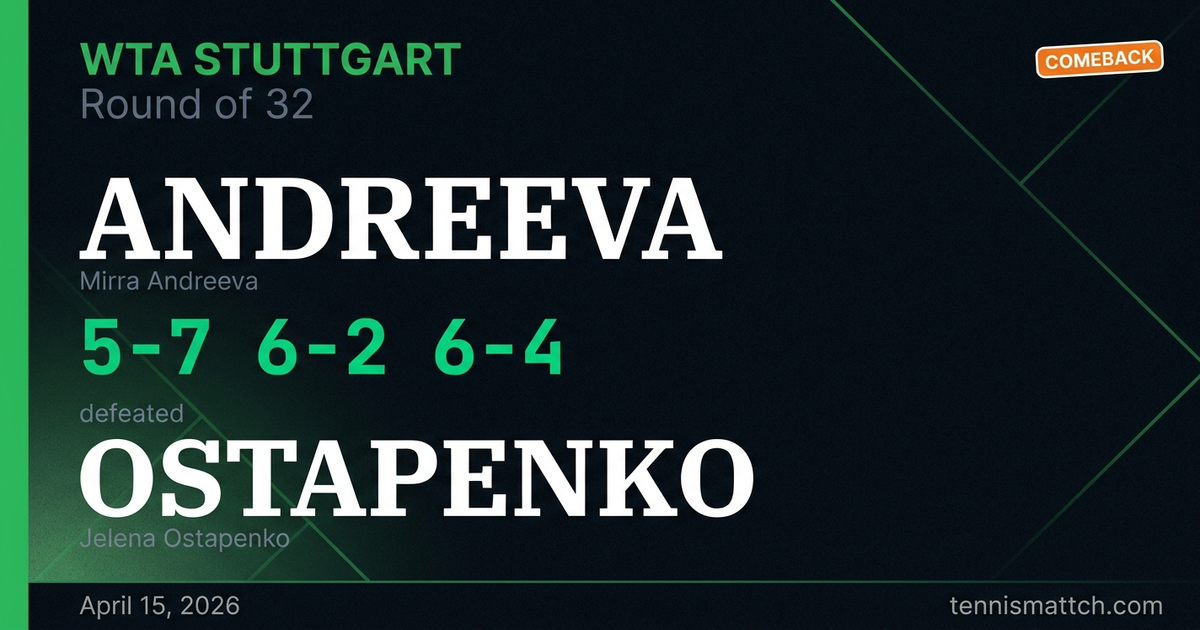



Mirra Andreeva defeated defending champion Jelena Ostapenko 5-7, 6-2, 6-4 in the Round of 32 at Stuttgart on April 15, 2026. After dropping the opening set, Andreeva dominated the next two frames behind 11 aces and superior serve effectiveness to claim her fifth career title at the WTA 500 grass-court event.
The match turned decisively in the second set, where Andreeva’s first-serve points won rate of 64% overwhelmed Ostapenko’s more erratic game. Despite landing only 57% of first serves compared to Ostapenko’s 67%, Andreeva’s ability to control rallies when the first ball landed—combined with Ostapenko’s struggles on second serve (37% points won)—created a clear tactical advantage. The Russian won 107 total points to Ostapenko’s 99, a margin that reflected her ability to seize momentum after the early setback.
Ostapenko’s 10 double faults to Andreeva’s 6 underscored the difference in execution under pressure. The former French Open champion, who defeated Aryna Sabalenka in last year’s Stuttgart final, couldn’t replicate the aggressive shot-making that characterized her 2025 title run. Andreeva closed out the match with authority, racing through the final two sets in under an hour to advance.
Key Takeaways
- Andreeva’s 11 aces were more than double her grass-court average of 4.2, demonstrating an elevated power game that overwhelmed Ostapenko’s return position throughout the deciding sets.
- The 64% to 57% edge in first-serve points won proved decisive—Andreeva converted nearly two-thirds of her first deliveries into won points despite landing only 57% of those serves in play, exploiting Ostapenko’s vulnerable return game.
- Ostapenko’s 10 double faults reflected the serving inconsistency that has plagued her recent form (4-6 record in last 10 matches), a sharp contrast to the composed serving display from her 2025 title defense that saw her defeat Swiatek, Alexandrova, and Sabalenka.
- The comeback win extended Andreeva’s grass resurgence after recent hard-court struggles—losses to Mboko, Siniakova, and Anisimova preceded back-to-back Stuttgart victories that pushed her Stuttgart trajectory from R16 in 2025 to the quarterfinals in 2026.
Player Analysis
Mirra Andreeva
The 18-year-old Russian demonstrated the tactical maturity that has defined her rise to five career titles. After conceding the first set, Andreeva adjusted her positioning on return and began targeting Ostapenko’s backhand corner with precision, neutralizing the defending champion’s power advantage. Her 11 aces—nearly triple her grass-court average—reflected aggressive intent on serve, while the 64% first-serve points won rate showed she could dominate short rallies when given the chance.
Most impressive was Andreeva’s composure after losing the opening set. She won 12 of the next 16 games, a run built on superior second-serve offense (41% to 37%) and fewer unforced errors in the decisive moments. This performance validated her 70% grass-court win rate and signaled that her recent hard-court struggles—three consecutive quarterfinal and Round of 16 exits—have not dented her confidence on faster surfaces.
Jelena Ostapenko
The 2017 French Open champion arrived in Stuttgart as the defending titlist but looked a shadow of the player who dismantled Sabalenka in last year’s final. Ostapenko’s 67% first-serve percentage—normally a strength—yielded only 57% points won, suggesting her placement and variety were lacking. The 10 double faults, double her opponent’s tally, exposed the serving fragility that has become a pattern in her 2026 season (4-6 record in last 10 matches before this loss).
Ostapenko’s trademark aggression never materialized after the first set. Where she averaged 37 winners per match on grass in recent seasons, today she couldn’t sustain the shot-making rhythm needed to overpower Andreeva’s defensive skills. Her second-serve points won rate of 37%—well below her grass average—invited pressure on nearly every service game. This early exit continues a concerning trend: losses to Baptiste, Pegula, and Kalinskaya preceded this Stuttgart disappointment, raising questions about her form heading deeper into the grass season.
Match Statistics
| Mirra Andreeva | Stat | Jelena Ostapenko |
|---|---|---|
| 11 | Aces | 4 |
| 10 | Double Faults | 6 |
| 57% | 1st Serve % | 67% |
| 64% | 1st Serve Points Won | 57% |
| 41% | 2nd Serve Points Won | 37% |
| 107 | Total Points Won | 99 |
Frequently Asked Questions
What was the final score of Mirra Andreeva vs Jelena Ostapenko at Stuttgart 2026?
Mirra Andreeva defeated Jelena Ostapenko 5-7, 6-2, 6-4 in the Round of 32 at Stuttgart on April 15, 2026.
How many aces did Mirra Andreeva hit against Jelena Ostapenko?
Andreeva struck 11 aces compared to Ostapenko’s 4, more than double her grass-court average of 4.2 aces per match and a key factor in her comeback victory.
Who was the defending champion at Stuttgart 2026?
Jelena Ostapenko was the defending champion, having won the 2025 Stuttgart title with victories over Iga Swiatek, Ekaterina Alexandrova, and Aryna Sabalenka, but she lost to Andreeva in the Round of 32.
What round did Mirra Andreeva reach at Stuttgart 2026?
After defeating Ostapenko in the Round of 32, Andreeva advanced to the quarterfinals with a subsequent victory over Alycia Parks.
What’s Next
Andreeva advances to the Round of 16, where she will face either a seeded opponent or a qualifier. With her grass-court form clicking—58.7% break point conversion rate and improved serve velocity—she enters the next round as a legitimate threat to reach the Stuttgart semifinals for the first time in her career.