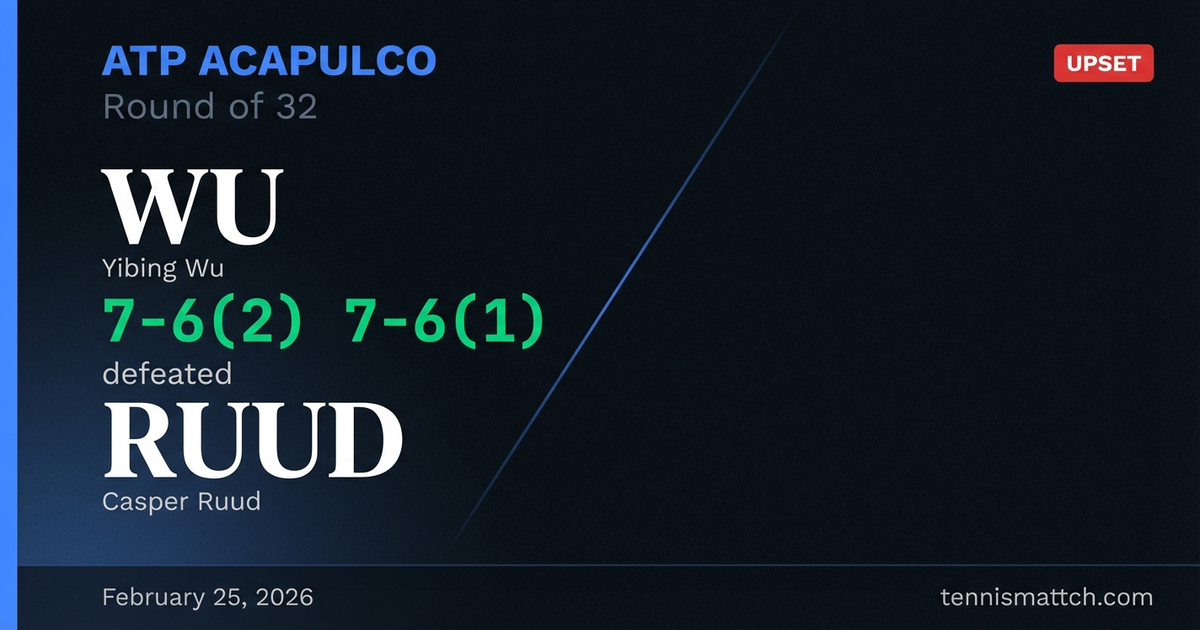


Yibing Wu produced a composed performance under pressure to defeat Casper Ruud 7-6(2), 7-6(1) in the opening round at ATP Acapulco on February 25, 2026. The Chinese player dominated both tiebreaks, winning them by a combined margin of 13-3, and converted the crucial moments despite facing a player with 14 career titles.
Neither player could establish a decisive edge in either set, with Ruud’s 12 aces countered by Wu’s aggressive baseline play. Wu struck 38 winners to Ruud’s 22, overwhelming the Norwegian in the extended rallies. The turning point came in the tiebreaks, where Wu’s precision and nerve separated him from his higher-ranked opponent.
Wu closed out the match with authority, dropping just one point in the second-set tiebreak. His ability to win 76% of first-serve points while taking 67% of second-serve points proved decisive in the marginal exchanges that defined both sets.
Key Takeaways
- Wu dominated both tiebreaks, outscoring Ruud 13-3 across the two breakers while maintaining his composure in the match’s most critical moments.
- Despite Ruud’s 12 aces — double Wu’s total — the Chinese player won more total points (84-76) by exploiting Ruud’s vulnerable second serve, winning 67% of those points compared to Ruud’s 54%.
- Wu’s aggressive approach yielded 38 winners against just 23 unforced errors, a +15 differential that contrasted sharply with Ruud’s -5 differential (22 winners, 27 errors).
- Break point conversion was nearly equal (Wu 1/7, Ruud 1/5), underscoring how the match hinged on tiebreak execution rather than service breaks.
Player Analysis
Yibing Wu
Wu’s victory was built on controlled aggression and exceptional tiebreak play. His 38 winners demonstrated a willingness to take calculated risks, and his clean serving — zero double faults — kept Ruud from gaining cheap points. The 67% win rate on second-serve points was particularly impressive, showing Wu’s ability to capitalize when Ruud’s serve lost pace.
His tiebreak dominance (13-3 across both) revealed a player unfazed by pressure. Wu converted the one break point that mattered and never allowed Ruud to gain momentum in the extended rallies that defined both sets.
Casper Ruud
Ruud’s 12 aces kept him competitive, but his inability to finish points in tiebreaks proved fatal. The Norwegian won 73% of first-serve points, just three percentage points behind Wu, yet his second serve crumbled under pressure — winning only 54% of those points. Three double faults at inopportune moments compounded the issue.
Ruud’s winner-to-error ratio was concerning: 22 winners against 27 unforced errors suggests a player tentative rather than aggressive. In a match decided by eight total points across two tiebreaks, that hesitation was the difference between advancing and an early exit.
Match Statistics
| Yibing Wu | Stat | Casper Ruud |
|---|---|---|
| 6 | Aces | 12 |
| 0 | Double Faults | 3 |
| 62% | 1st Serve % | 68% |
| 76% | 1st Serve Points Won | 73% |
| 67% | 2nd Serve Points Won | 54% |
| 1/7 | Break Points Won | 1/5 |
| 38 | Winners | 22 |
| 23 | Unforced Errors | 27 |
| 84 | Total Points Won | 76 |
Frequently Asked Questions
What was the final score of Yibing Wu vs Casper Ruud at ATP Acapulco 2026?
Yibing Wu defeated Casper Ruud 7-6(2), 7-6(1) in the Round of 32 at ATP Acapulco on February 25, 2026. Wu dominated both tiebreaks decisively.
How many winners did Yibing Wu hit against Casper Ruud?
Yibing Wu struck 38 winners compared to Casper Ruud’s 22, a 16-winner advantage that proved crucial in the tiebreak-decided match.
Who won the ATP Acapulco 2026 Round of 32 match between Wu and Ruud?
Yibing Wu won, upsetting Casper Ruud in straight sets by winning both tiebreaks. Wu won 84 total points to Ruud’s 76.
How many aces did Casper Ruud serve against Yibing Wu at Acapulco?
Casper Ruud served 12 aces, double Yibing Wu’s total of 6, but it wasn’t enough as Wu excelled in the critical tiebreak moments.
What’s Next
Wu advances to the Round of 16 at ATP Acapulco, where his tiebreak mastery will be tested again. Ruud, meanwhile, exits early from a tournament where his clay-court credentials typically translate well to slower hard courts, raising questions about his form heading into the North American hard-court swing.