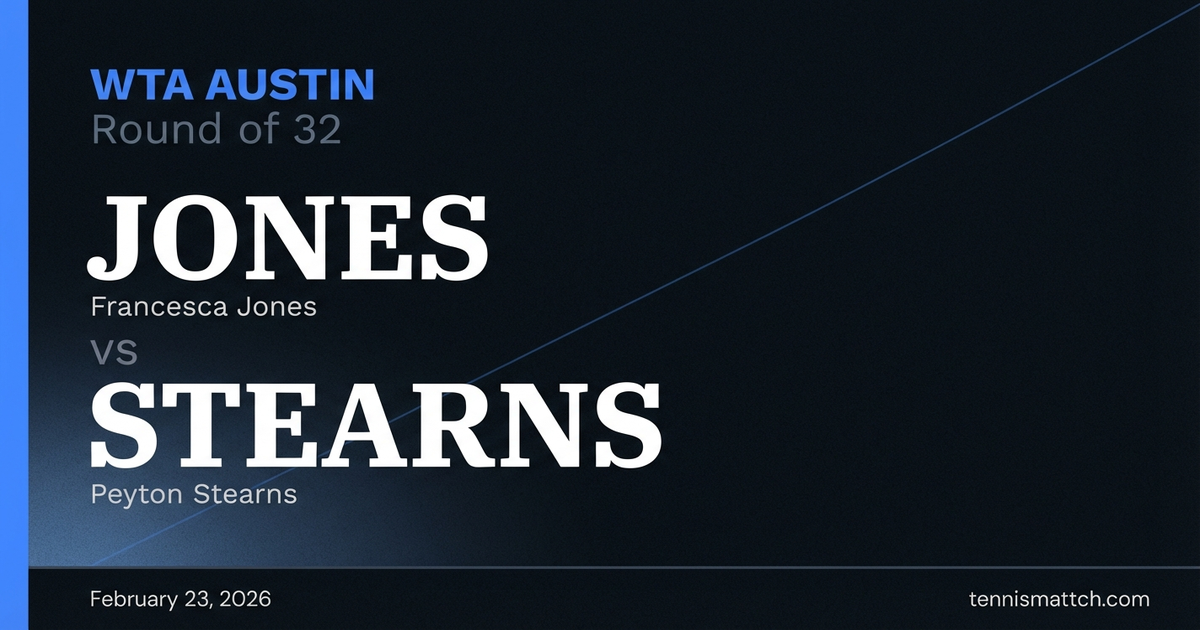



Francesca Jones faces Peyton Stearns in the Round of 32 at the WTA Austin on February 23, 2026, marking their first career meeting on the hard courts of Texas. With no head-to-head history to dissect, this matchup becomes a pure tactical puzzle: Jones’s gritty baseline consistency against Stearns’s aggressive, power-first approach.
The absence of prior encounters means both players enter with strategic uncertainty, but the hard-court surface at Austin typically rewards the player who can dictate with their serve and forehand. Stearns’s bigger weapons give her the theoretical edge in power baseline exchanges, yet Jones has built her game around neutralizing stronger hitters through superior court coverage and counterpunching precision. Whichever player can impose their preferred tempo early will likely control the narrative.
Recent form and match fitness will prove crucial in a first-time meeting where psychological familiarity offers no advantage to either competitor. Jones’s resilience has earned her reputation as a difficult opponent to break down, while Stearns must balance her aggression with the discipline needed on faster hard courts where margins narrow considerably.
Key Takeaways
- First career meeting eliminates H2H patterns — tactical adaptability becomes paramount with no historical blueprint to follow.
- Hard-court surface favors first-strike tennis, potentially suiting Stearns’s power game if she can control baseline exchanges and dominate behind serve.
- Jones’s counterpunching style could frustrate Stearns’s rhythm if the American overextends on her bigger shots and accumulates unforced errors.
- Serve efficiency will be decisive — whoever establishes a comfortable hold percentage can dictate match pressure and force the opponent into chasing breaks.
Player Analysis
Francesca Jones
The British competitor brings a defensive foundation built on exceptional court coverage and the ability to extend rallies until opponents crack under pressure. Jones thrives when she can absorb pace and redirect it with interest, using her consistency to gradually drain confidence from power hitters who expect quick points. Her forehand, while not a knockout punch, becomes effective when she can establish position and work angles, particularly on hard courts where the ball sits up for her strike zone.
Against an opponent like Stearns, Jones must weather early aggression without gifting cheap points through passive defense. Her second serve could become a liability if Stearns times her returns well, meaning Jones needs high first-serve percentages to avoid defensive scrambling from the opening shot of each point. The key question: can she disrupt Stearns’s timing before the American finds her groove?
Peyton Stearns
The American arrives with evident weapons — a serve capable of producing free points and a forehand that can end rallies from seemingly neutral positions. Stearns’s game plan typically revolves around shortening points through aggressive baseline positioning and taking the ball early, preventing opponents from establishing defensive patterns. On hard courts, her flat power should generate ample opportunities to attack, provided she can maintain accuracy on her bigger swings.
The challenge against Jones lies in patience and shot selection. Stearns must resist the temptation to overhit when Jones inevitably extends rallies, knowing that one or two errors could shift momentum toward the grinder across the net. Her serve becomes doubly important as a platform for offense — if she can consistently set up 1-2 punch combinations behind first serves, Jones’s defensive skills become less relevant. The American’s physical and mental discipline over the course of potentially long games will determine whether her firepower translates into scoreboard success.
Frequently Asked Questions
Who will win Francesca Jones vs Peyton Stearns at WTA Austin 2026?
This first career meeting between Jones and Stearns presents a classic styles clash on hard courts. Stearns holds the edge in raw power and weapons, with her serve and forehand capable of dictating play if she maintains accuracy. However, Jones’s defensive consistency could neutralize those advantages if Stearns’s aggression produces unforced errors. The matchup likely hinges on Stearns’s ability to execute her game plan with discipline rather than overextension, while Jones must prevent early deficits that allow the American to play freely ahead.
What is the head-to-head record between Francesca Jones and Peyton Stearns?
Jones and Stearns have never faced each other in professional competition, making their Round of 32 encounter at WTA Austin 2026 their first career meeting. The absence of head-to-head history means neither player can reference previous tactical successes, placing greater emphasis on real-time adaptation and match management.
Francesca Jones vs Peyton Stearns WTA Austin 2026 prediction
Stearns’s power baseline game appears better suited to hard courts when functioning properly, giving her the theoretical advantage in a first meeting. However, the prediction must account for Jones’s proven ability to frustrate aggressive players through defensive tenacity and forcing opponents into low-percentage risks. If Stearns serves well and controls the center of the court, she should advance. If the match extends into competitive third-set territory, Jones’s resilience becomes the X-factor. Expect a competitive encounter that reveals which player handles the uncertainty of unfamiliarity more effectively.
When is Francesca Jones vs Peyton Stearns at WTA Austin 2026?
Jones and Stearns are scheduled to play on February 23, 2026, in the Round of 32 at the WTA Austin tournament. Specific match times will be announced as the tournament progresses through the opening rounds.
What’s Next
Jones and Stearns take the court on February 23, 2026, in the Round of 32 at the WTA Austin, with a spot in the Round of 16 awaiting the victor. As both players seek momentum on the North American hard-court swing, this first meeting could establish bragging rights for future encounters while offering valuable ranking points in the competitive mid-tier of women’s professional tennis.