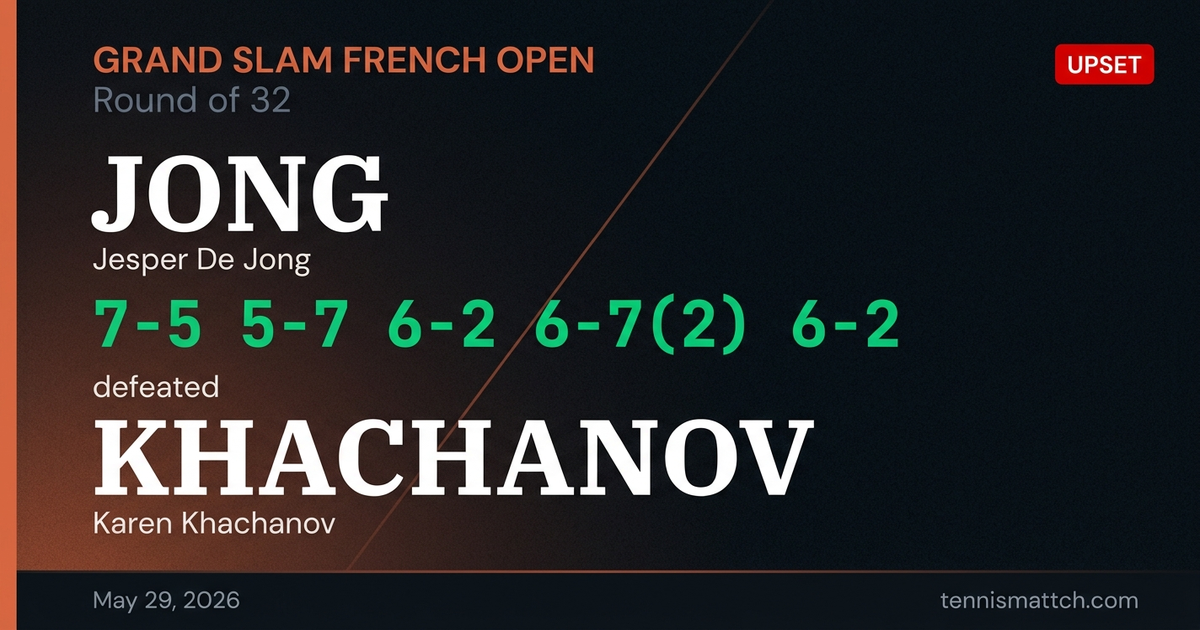



Jesper De Jong pulled off a stunning upset at Roland Garros, defeating seven-time ATP titlist Karen Khachanov 7-5, 5-7, 6-2, 6-7(2), 6-2 in the Round of 32. The Dutchman’s superior break point conversion—7 of 12 compared to Khachanov’s 3 of 13—proved decisive in a match that swung wildly across five sets and nearly four hours.
After trading the opening two sets, De Jong seized control in the third, breaking twice to establish a 6-2 advantage. Khachanov fought back in the fourth, dominating the tiebreak 7-2 to force a decider. But the Russian’s resistance crumbled in the fifth. De Jong broke early and never looked back, closing out the final set 6-2 with a flurry of winners—finishing with 61 to Khachanov’s 60—while the more experienced clay courter’s unforced error count ballooned to 53.
De Jong fired 17 aces but paid for 9 double faults, a telling contrast to Khachanov’s cleaner 15 aces and just 2 double faults. Yet when it mattered most, De Jong’s first serve clicked at 81% points won, overwhelming Khachanov’s 68%. The Dutchman, still searching for his first career title, now advances to the third round with momentum and belief that his Grand Slam form can carry him deeper into the tournament.
Key Takeaways
- De Jong’s break point conversion (58%) dwarfed Khachanov’s woeful 23% (3 of 13), a gap that ultimately decided this five-setter on the clay.
- The Dutchman hit 17 aces—more than four times his clay court average of 3.9—showing he elevated his serve on the Grand Slam stage despite 9 costly double faults.
- Khachanov’s 53 unforced errors undid his cleaner service game (just 2 double faults), as the Russian’s consistency abandoned him in the decisive fifth set where De Jong broke twice.
- De Jong won 16 more total points (165-149) across a marathon that saw him dominate on first serve (81% points won) while struggling badly on second serve (46%).
Player Analysis
Jesper De Jong
The title-less Dutchman produced the performance of his career, backing up two commanding early-round wins with a statement victory over a far more accomplished opponent. His 81% first serve points won rate was elite, compensating for a shaky second serve that won just 46% of points. De Jong’s aggression never wavered—61 winners against 41 unforced errors represents a positive differential that kept Khachanov on the defensive throughout. The break point conversion tells the story: 7 of 12 chances taken, including crucial breaks in the third and fifth sets when the match hung in the balance.
What’s most impressive is how De Jong handled adversity. After losing a tiebreak 7-2 in the fourth set—a moment that could have shattered confidence—he immediately broke Khachanov to open the decider and never allowed the Russian back into the match. His serve, despite 9 double faults, delivered 17 aces, well above his clay court average of 3.9. For a player with a 6-7 clay season record coming into Roland Garros, this was a masterclass in raising one’s level when the stakes are highest.
Karen Khachanov
The seven-time tour champion squandered a golden opportunity, undone by a shocking inability to convert break points. Converting just 3 of 13 chances (23%) is simply not good enough at this level, particularly when facing an opponent with far less clay court experience. Khachanov’s serve was statistically superior—66% first serves in, only 2 double faults—but his return game let him down badly. He couldn’t consistently hurt De Jong’s second serve (55% points won on his own second serve, but clearly struggled to capitalize on De Jong’s weaker 46% second serve percentage).
The unforced error count of 53 tells a damning tale. Khachanov matched De Jong for winners (60 to 61) but leaked 12 more errors, many coming in the crucial third and fifth sets where De Jong pulled away. After dominating the fourth set tiebreak, the Russian had all the momentum—and promptly dropped serve immediately in the fifth. That mental lapse, combined with his break point woes, cost him a winnable match against a less experienced clay courter.
Match Statistics
| Jesper De Jong | Stat | Karen Khachanov |
|---|---|---|
| 17 | Aces | 15 |
| 9 | Double Faults | 2 |
| 61% | 1st Serve % | 66% |
| 81% | 1st Serve Points Won | 68% |
| 46% | 2nd Serve Points Won | 55% |
| 7/12 | Break Points Won | 3/13 |
| 61 | Winners | 60 |
| 41 | Unforced Errors | 53 |
| 165 | Total Points Won | 149 |
Frequently Asked Questions
What was the final score of Jesper De Jong vs Karen Khachanov at French Open 2026?
Jesper De Jong defeated Karen Khachanov 7-5, 5-7, 6-2, 6-7(2), 6-2 in the Round of 32 at the 2026 French Open.
How many break points did De Jong convert against Khachanov?
De Jong converted 7 of 12 break point opportunities (58%), while Khachanov managed only 3 of 13 (23%)—a decisive advantage in the five-set match.
Who won the French Open 2026 Round of 32 match between De Jong and Khachanov?
Jesper De Jong won the match in five sets, pulling off an upset over the more experienced Karen Khachanov.
How many aces did Jesper De Jong hit against Karen Khachanov at Roland Garros?
De Jong fired 17 aces compared to Khachanov’s 15, though De Jong also committed 9 double faults to Khachanov’s 2.
What’s Next
De Jong advances to the third round at Roland Garros, where he’ll face a top seed or another dangerous floater. With two dominant wins in rounds one and two, plus this comeback triumph, the Dutchman has found his best form on the Parisian clay just when it matters most.
Follow all results: French Open 2026.
Head-to-head history: Jesper De Jong vs Karen Khachanov.