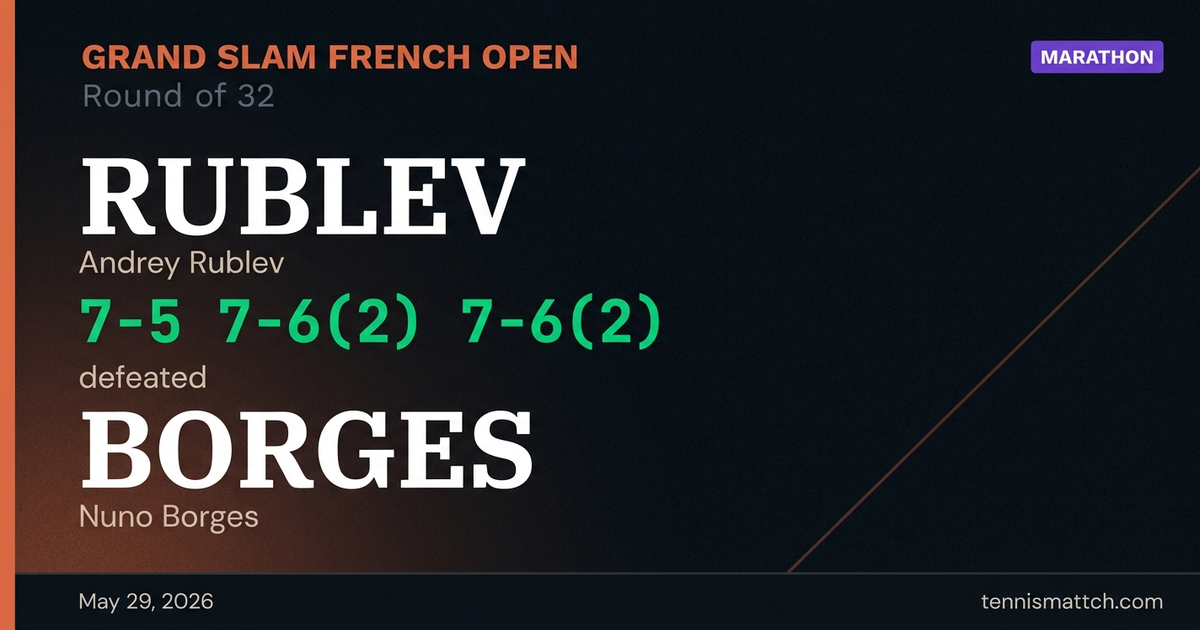



Andrey Rublev withstood a fierce challenge from Nuno Borges to advance 7-5, 7-6(2), 7-6(2) in the French Open third round on Friday. The Russian eighth seed fired 12 aces and won 75% of first-serve points to edge the Portuguese contender in a match decided by marginal differences in the pressure moments.
Neither player could establish separation on Court Philippe-Chatrier. Borges matched Rublev’s aggression throughout—hitting 28 winners to Rublev’s 44—but failed to capitalize on break opportunities in the tiebreaks. Rublev converted three of ten break chances to Borges’ two of five, with that extra conversion proving decisive. The second and third sets followed identical patterns: tight service holds punctuated by Rublev’s superior execution in the breakers, where he won 14 of 18 points.
Rublev’s serve commanded the crucial moments. His 12 aces—well above his clay-court average of 7.6—overwhelmed Borges’ defense in the tiebreaks, where the Russian dictated terms with first-strike tennis. Borges, despite a higher first-serve percentage (69% to 63%), couldn’t match Rublev’s 57% success rate on second serves. The final point total—119 for Rublev, 110 for Borges—reflected how narrow the margin proved between advancing and elimination.
Key Takeaways
- Rublev’s 12 aces marked a significant uptick from his 7.6 per-match clay average, providing crucial service holds in a match where neither player faced more than one break per set.
- The Russian dominated both tiebreaks with identical 7-2 scorelines, winning 14 of 18 tiebreak points by leveraging his superior second-serve effectiveness (57% points won versus Borges’ 50%).
- Borges’ cleaner error count (31 unforced errors to Rublev’s 39) and higher first-serve percentage (69% to 63%) kept the match competitive, but his 28 winners couldn’t offset Rublev’s 44-winner onslaught.
- Rublev’s nine-point margin in total points won (119-110) reflected the razor-thin nature of the contest—a match where experience and big-moment execution trumped statistical balance.
Player Analysis
Andrey Rublev
The Russian’s 17th career title chase remains alive, built on his ability to elevate in tiebreaks. His 12 aces—58% more than his clay average—delivered free points when margins tightened. The 75% success rate on first serves gave him a foundation, but his 57% second-serve points won proved more important. That seven-percentage-point edge over Borges on second serves translated to control in extended rallies, where Rublev’s 44 winners (compared to his 30.0 per-match average) showcased increased aggression. His 30% break-point conversion rate lagged his 35.2% clay norm, suggesting room for improvement if he’s to navigate tougher opponents ahead.
Rublev’s .667 career clay win rate underpinned his composure in the deciders. The three double faults—slightly above his 1.9 average but minimal in context—never derailed momentum. His willingness to dictate with the forehand, even at the cost of 39 unforced errors, reflected the calculated risk required to overcome Borges’ defensive resolve.
Nuno Borges
The Portuguese pushed Rublev to the brink but couldn’t manufacture the breakthrough. His 69% first-serve percentage bettered Rublev’s 63%, yet the 70% first-serve points won still trailed the Russian by five percentage points—a narrow but decisive gap. Borges’ 28 winners fell short of his 30.7 clay average, suggesting he couldn’t consistently impose his game against Rublev’s power. The two-of-five break-point conversion matched his aggressive baseline identity, but failing to create more chances—only five opportunities all match—limited his pathways to victory.
Borges’ lone double fault and 31 unforced errors demonstrated exceptional discipline, particularly against an opponent generating 44 winners. His inability to win tiebreak points (0-4 across the two breakers) exposed the experience differential between a player with 17 career titles and one seeking to break through at the sport’s highest level. The .545 career clay win rate spoke to his growing competence on the surface, but Roland Garros demands more than competence—it demands ruthlessness in moments like 5-6, 0-40 on serve, moments Borges couldn’t navigate.
Match Statistics
| Andrey Rublev | Stat | Nuno Borges |
|---|---|---|
| 12 | Aces | 6 |
| 3 | Double Faults | 1 |
| 63% | 1st Serve % | 69% |
| 75% | 1st Serve Points Won | 70% |
| 57% | 2nd Serve Points Won | 50% |
| 3/10 | Break Points Won | 2/5 |
| 44 | Winners | 28 |
| 39 | Unforced Errors | 31 |
| 119 | Total Points Won | 110 |
Frequently Asked Questions
What was the final score of Andrey Rublev vs Nuno Borges at the French Open 2026?
Andrey Rublev defeated Nuno Borges 7-5, 7-6(2), 7-6(2) in the third round of the French Open on May 29, 2026.
How many aces did Andrey Rublev hit against Nuno Borges?
Rublev struck 12 aces compared to Borges’ 6, doubling his opponent’s ace count and exceeding his own 7.6 per-match clay-court average by nearly 60%.
Who won the French Open 2026 Round of 32 match between Rublev and Borges?
Andrey Rublev won, advancing to the Round of 16 after winning two tiebreaks 7-2 and taking the opening set 7-5.
What was the key statistic in Rublev’s victory over Borges?
Rublev’s 75% first-serve points won and 57% second-serve points won gave him a seven-percentage-point advantage on second serves, which proved decisive in the two tiebreaks he won 7-2.
What’s Next
Rublev advances to the French Open Round of 16, where he’ll face a yet-to-be-determined opponent. With three consecutive three-set victories to start the tournament, the Russian will need cleaner break-point conversion—today’s 30% fell short of his 35.2% clay average—to sustain his deep-run ambitions at Roland Garros.
Head-to-head history: Andrey Rublev vs Nuno Borges.