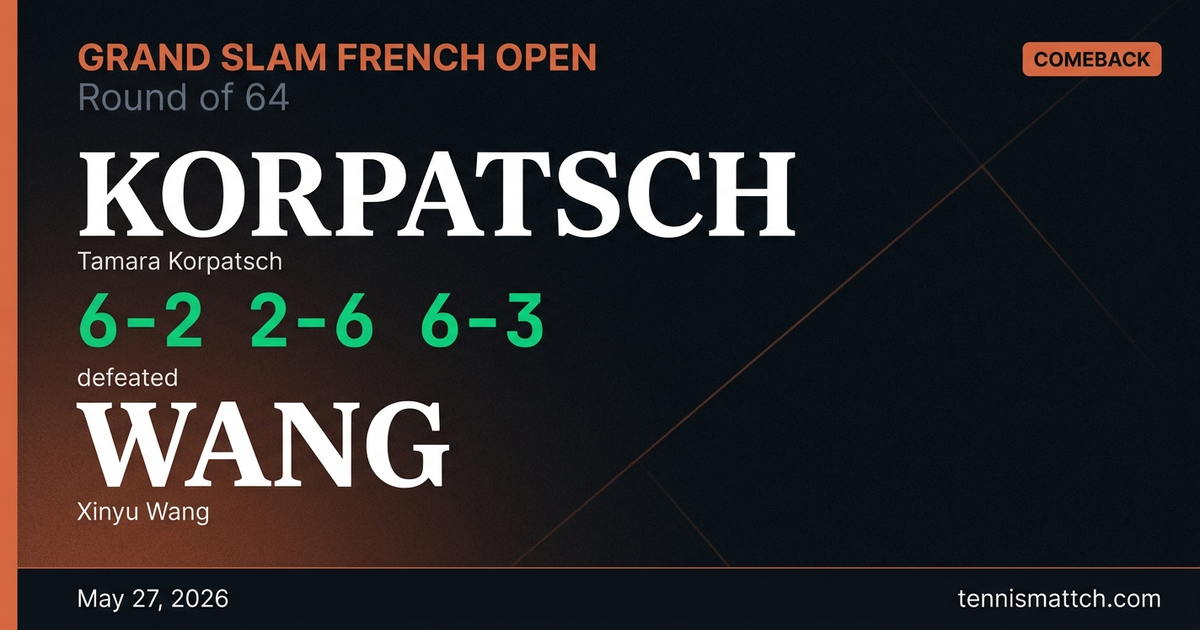


Tamara Korpatsch weathered an inconsistent three-set battle to defeat Xinyu Wang 6-2, 2-6, 6-3 in the first round of the French Open on Tuesday. The German converted 5 of 8 break points and forced Wang into 65 unforced errors to secure her second-round berth at Roland Garros.
Korpatsch dominated the opening set, breaking serve three times while Wang struggled to find her range. The Chinese player flipped the script in the second, rediscovering her aggressive baseline game to hit 16 winners and level the match. But Wang’s shot-making came with catastrophic inconsistency — her 65 unforced errors, nearly double Korpatsch’s 33, ultimately decided the contest. The German steadied in the decider, breaking twice and holding firm to close out the match.
Korpatsch’s first-serve effectiveness proved the crucial difference. She won 63% of points behind her first delivery compared to Wang’s meager 49%, compensating for an otherwise modest service performance. Wang’s 34 winners to Korpatsch’s 18 illustrated her greater firepower, but she couldn’t sustain accuracy long enough to overcome the German’s superior consistency.
Key Takeaways
- Korpatsch’s break point conversion (63%, 5 of 8) was more than double Wang’s dismal 27% (4 of 15), allowing the German to seize control in the first and third sets despite creating fewer opportunities.
- Wang’s 65 unforced errors — nearly twice Korpatsch’s 33 — overwhelmed her 34 winners, a stark reminder that her aggressive clay game (averaging 46 winners per match on the surface) requires far better execution against steady opponents.
- Despite identical first-serve percentages (63% vs 64%), Korpatsch dominated behind her delivery, winning 63% of first-serve points compared to Wang’s feeble 49%, a 14-percentage-point chasm that dictated service hold patterns throughout.
- This victory marks Korpatsch’s first French Open win since her 2024 first-round comeback against Ashlyn Krueger (4-6, 6-4, 7-6), snapping a brutal 1-9 stretch across all surfaces and validating her superior clay pedigree (19-24 career record) against Wang’s minimal experience (1-4).
Player Analysis
Tamara Korpatsch
The 29-year-old German showed why clay remains her best surface, even after a nightmarish recent run. Her 63% conversion rate on break points was clinical, and she avoided the double-fault trap that has plagued her on clay this season — just 3 double faults compared to her 5.8-per-match average. More importantly, Korpatsch never panicked after dropping the second set. She reverted to her defensive baseline game, forcing Wang to earn every point and trusting her opponent would crack first. That patience paid off: Wang’s error count ballooned in the decider while Korpatsch stayed within herself, grinding out holds and pouncing on the two break chances she needed.
Her first-serve dominance (63% points won) compensated for an otherwise underwhelming service performance. Korpatsch didn’t blow Wang off the court — she simply made fewer mistakes and converted when it mattered. Securing her second career Grand Slam main draw victory at Roland Garros is a confidence boost, but the real test comes in round two, where consistency must improve if she hopes to advance further.
Xinyu Wang
Wang’s performance encapsulated the volatility that has defined her brief clay career. The Chinese player’s 34 winners demonstrated legitimate firepower — more than double Korpatsch’s output and right in line with her 46-per-match clay average. Her second-set explosion (6-2) showed what happens when her timing clicks: flat, penetrating groundstrokes that pinned Korpatsch behind the baseline. But those glimpses of brilliance were sabotaged by staggering inconsistency. Sixty-five unforced errors is an astonishing total, especially against an opponent who hit just 18 winners. Wang essentially beat herself, gifting Korpatsch nearly two-thirds of the points she needed to win.
Her inability to convert break points (27%, 4 of 15) was equally damaging. Wang generated nearly twice as many break chances as her opponent yet converted fewer total breaks, a pattern that reflects poor shot selection under pressure. Until she develops the tactical discipline to sustain her aggressive game without self-destructing, Wang will struggle on clay’s slower, margin-demanding surface. The talent is undeniable; the execution remains far too fragile.
Match Statistics
| Tamara Korpatsch | Stat | Xinyu Wang |
|---|---|---|
| 1 | Aces | 2 |
| 3 | Double Faults | 0 |
| 63% | 1st Serve % | 64% |
| 63% | 1st Serve Points Won | 49% |
| 46% | 2nd Serve Points Won | 57% |
| 5/8 | Break Points Won | 4/15 |
| 18 | Winners | 34 |
| 33 | Unforced Errors | 65 |
| 98 | Total Points Won | 88 |
Frequently Asked Questions
What was the final score of Tamara Korpatsch vs Xinyu Wang at the French Open 2026?
Tamara Korpatsch defeated Xinyu Wang 6-2, 2-6, 6-3 in the first round of the French Open 2026 on May 27.
How many unforced errors did Xinyu Wang commit against Tamara Korpatsch?
Xinyu Wang hit 65 unforced errors in the match, nearly double Tamara Korpatsch’s 33, which proved to be the decisive factor in her loss.
What was Tamara Korpatsch’s break point conversion rate at the French Open 2026 first round?
Korpatsch converted 5 of 8 break points (63%) against Wang, more than doubling Wang’s 27% conversion rate (4 of 15).
Who won the French Open 2026 first round match between Korpatsch and Wang?
Tamara Korpatsch won the match in three sets, claiming the first set 6-2, dropping the second 2-6, then securing the decider 6-3.
What’s Next
Korpatsch advances to the second round at Roland Garros, where she will seek to build on this victory and extend her run into the tournament’s second week. For Wang, an early exit continues a frustrating clay season defined by flashes of brilliance undermined by unforced-error avalanches.
Follow all results: French Open 2026.
Head-to-head history: Tamara Korpatsch vs Xinyu Wang.