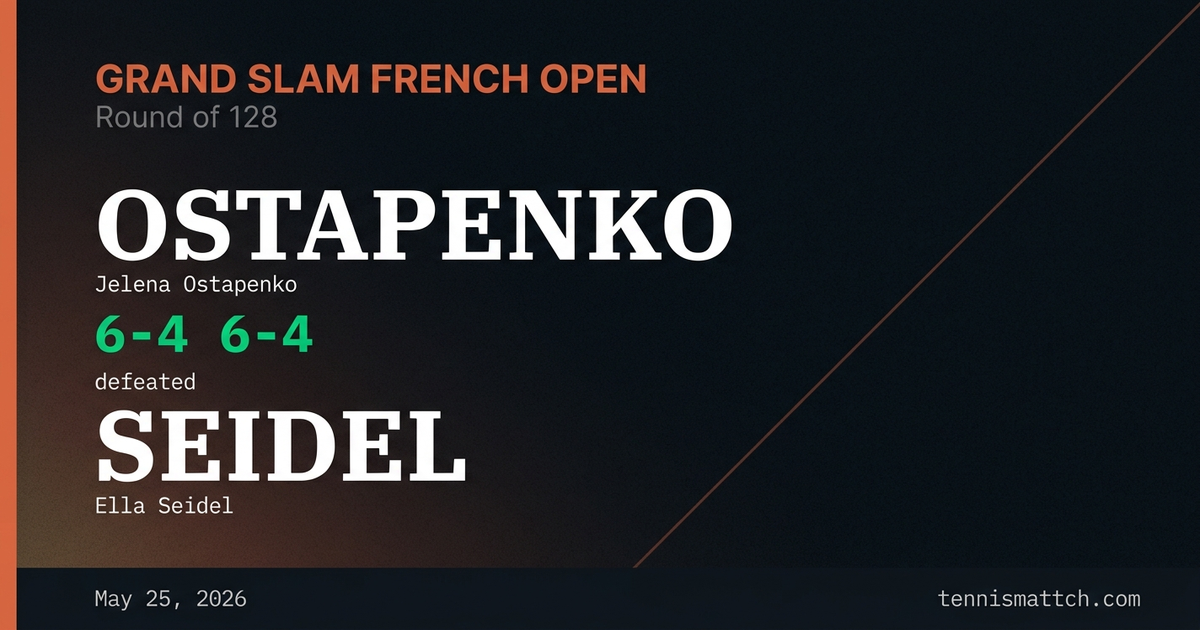



Jelena Ostapenko defeated Ella Seidel 6-4, 6-4 in the French Open first round on May 25, powering through with 31 winners and converting four of seven break points to set up a second-round clash at Roland Garros.
The Latvian’s aggressive baseline game proved decisive despite a ragged serving performance. Ostapenko landed just 47% of first serves but dominated when she found the box, winning 79% of those points. More crucially, she converted four break chances to Seidel’s two, seizing control in both sets at 4-4 to close out straight-sets victories. The pattern repeated twice: Ostapenko broke serve at 4-all in the opening set, then replicated the feat in the second to advance without facing a deciding set.
Seidel, making her French Open debut, struggled to match Ostapenko’s firepower. The American won 70% of first-serve points and landed 60% of her first deliveries—13 percentage points higher than her opponent—but managed only 14 winners to Ostapenko’s 31. When forced to rally on second serves, Seidel won just 31% of points, a vulnerability Ostapenko exploited ruthlessly. The match concluded after 76 total points for Ostapenko to Seidel’s 65, with the 2017 champion’s willingness to flirt with danger ultimately separating the two.
Key Takeaways
- Ostapenko’s aggression yielded a 31-14 winner advantage, more than doubling Seidel’s shot-making output despite committing 43 unforced errors to the American’s 24.
- Break point conversion decided the match: Ostapenko won 4 of 7 opportunities (57%), matching her 58.3% clay-court average, while Seidel managed just 2 of 4 (50%) and couldn’t capitalize when serving to stay in sets.
- Seidel’s second-serve vulnerability proved fatal—winning only 31% of those points allowed Ostapenko to attack relentlessly and seize control of neutral rallies.
- Despite landing 60% of first serves compared to Ostapenko’s woeful 47%, Seidel couldn’t convert the serve-percentage advantage into holds when it mattered, losing serve twice at 4-4 in consecutive sets.
Player Analysis
Jelena Ostapenko
Ostapenko’s performance embodied the high-risk, high-reward philosophy that carried her to the 2017 French Open title. She blasted 31 winners—eight above her recent clay average of 28.7 per match—but paid the price with 43 unforced errors. Seven double faults matched her recent average, yet she never allowed serving struggles to derail her. When the first serve landed, she was nearly untouchable at 79% points won, and her ability to break serve at 4-all in both sets showcased the clutch gene that defines Grand Slam champions. This was textbook Ostapenko: messy, thrilling, effective.
The Latvian’s second-serve performance (49% points won) prevented Seidel from mounting sustained pressure. After recent losses to Cirstea in Rome and Baptiste in Miami, Ostapenko needed a confidence-building win, and her willingness to go for lines—even when trailing in games—paid dividends. She converted 4 of 7 break points, in line with her 58.3% clay-court conversion rate, and never faced a break point deficit she couldn’t recover from.
Ella Seidel
Seidel’s French Open debut exposed the gap between solid serving and finishing ability. She landed 60% of first serves—13 percentage points better than Ostapenko—and won 70% of those points, but couldn’t sustain pressure when the Latvian elevated. Managing only 14 winners across two sets left Seidel reactive rather than proactive, and her 31% second-serve points won became a glaring vulnerability Ostapenko attacked without mercy. Arriving on a four-match losing streak with a 1-9 record in her last 10 matches, Seidel needed precision to offset Ostapenko’s power, but the firepower simply wasn’t there.
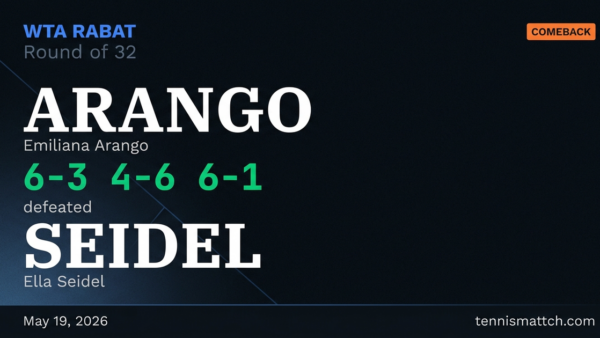
Credit Seidel for fighting to 4-all in both sets, but twice she failed to consolidate at the critical juncture. Converting just 2 of 4 break points (50%) wasn’t enough against an opponent who punishes hesitation. The 24 unforced errors represented disciplined play compared to Ostapenko’s 43, yet without the winner count to match, Seidel couldn’t seize control of rallies. For a player with limited clay experience (4-3 career record on the surface), this was a tough draw—facing a nine-time title winner and former French Open champion in the opening round offered little margin for error.
Match Statistics
| Jelena Ostapenko | Stat | Ella Seidel |
|---|---|---|
| 4 | Aces | 2 |
| 7 | Double Faults | 5 |
| 47% | 1st Serve % | 60% |
| 79% | 1st Serve Points Won | 70% |
| 49% | 2nd Serve Points Won | 31% |
| 4/7 | Break Points Won | 2/4 |
| 31 | Winners | 14 |
| 43 | Unforced Errors | 24 |
| 76 | Total Points Won | 65 |
Frequently Asked Questions
What was the final score of Jelena Ostapenko vs Ella Seidel at the French Open 2026?
Jelena Ostapenko defeated Ella Seidel 6-4, 6-4 in the first round of the French Open 2026 on May 25.
How many winners did Jelena Ostapenko hit against Ella Seidel?
Ostapenko hammered 31 winners compared to Seidel’s 14, more than doubling her opponent’s shot-making output despite committing 43 unforced errors.
Who won the French Open 2026 first round match between Ostapenko and Seidel?
Jelena Ostapenko won in straight sets, converting four break points and dominating with aggressive baseline play to advance to the second round.
What was Ella Seidel’s first serve percentage against Ostapenko at the French Open?
Seidel landed 60% of her first serves, 13 percentage points higher than Ostapenko’s 47%, but won only 70% of those points and couldn’t capitalize on the serve advantage.
What’s Next
Ostapenko advances to the second round at Roland Garros, where she will look to build on this win and continue her quest for a deep run at the tournament she conquered in 2017.
Follow all results: French Open 2026.