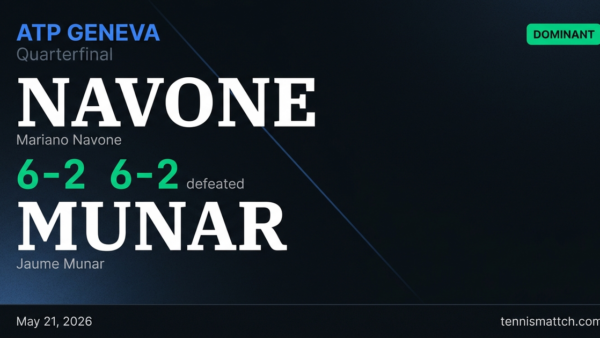



Mariano Navone faces Jaume Munar in the Geneva quarterfinals on May 21, 2026, their first career meeting. The prediction model heavily favors Munar with a 77% win probability, driven by a 157-point Elo rating advantage on hard courts and cleaner statistical profile across serve and error rates.
Both players arrive with two-match winning streaks at Geneva, but their paths tell contrasting stories. Navone’s week includes a gutsy comeback from a set down against Rodionov, while Munar has dominated with clinical scorelines—6-0, 6-3 against Kotov and 6-4, 6-4 over Comesana. The underlying numbers suggest Munar’s efficiency on hard courts gives him structural advantages that Navone, despite his fighting spirit, will struggle to neutralize.
The model’s simulation projects 24.6 total games with a 57% probability of a straight-sets outcome, most likely 2-0 in Munar’s favor. Navone’s 37.5% hard court season win rate contrasts sharply with Munar’s cleaner ball-striking profile, which produces 97% more aces and 36% fewer unforced errors per match.
Key Takeaways
- Munar’s serving edge is decisive: he averages 8.1 aces per match compared to Navone’s 4.1, nearly doubling his opponent’s output while committing 35% fewer double faults (3.2 vs 4.9). On a fast Geneva hard court, this margin severely limits Navone’s break opportunities.
- The error differential heavily favors Munar, who commits 20.9 unforced errors per match against Navone’s 32.5—a 36% gap that compounds on hard courts where mistakes are magnified. Munar also hits 35% more winners (28.5 vs 21.1), indicating a cleaner, more aggressive baseline game.
- The prediction model’s 77-23% split reflects Munar’s 157-point surface Elo advantage (1566 vs 1429) and projects a 57% chance of straight sets. Monte Carlo simulations favor a 2-0 scoreline 48% of the time, with Navone’s best path requiring a three-set grind he historically struggles to execute on hard courts.
- Recent form patterns diverge: while both are 2-0 at Geneva, Munar’s last 10 matches show 50% effectiveness compared to Navone’s 10%, and the Spaniard arrives on a two-match win streak while Navone enters on a four-match losing streak outside this tournament bubble.
Player Analysis
Mariano Navone
The Argentine’s Geneva run demonstrates his tenacity—erasing a 5-7 first-set deficit against Rodionov before dominating 7-5, 6-1 suggests mental resilience under pressure. His straight-sets dismissal of Cameron Norrie (6-4, 6-4) further proves he can handle respectable opposition when his game clicks. However, these isolated wins mask deeper structural weaknesses on hard courts, where his 18-30 season record (37.5%) reveals consistent vulnerability.
Navone’s serve becomes a liability in tight moments: 4.9 double faults per match paired with just 60% first-serve percentage means he’s frequently defending second serves against quality returners. His 32.5 unforced errors per match suggest a baseline game prone to breakdowns when opponents apply consistent pressure. Against Munar’s cleaner ball-striking and superior court positioning, Navone will need to manufacture break chances from limited opportunities—a tall order given his 36.7% break point conversion rate. His best hope lies in replicating the Rodionov comeback formula: extend rallies, force Munar into extended baseline exchanges, and capitalize on rare defensive lapses.
Jaume Munar
The Spaniard’s Geneva performances reveal a player hitting peak form at the ideal moment. His 6-0, 6-3 demolition of Pavel Kotov showcased total court control—dominating with aggressive returns and minimal errors. The subsequent 6-4, 6-4 win over Francisco Comesana demonstrated consistency against varied opposition. Munar’s 8.1 aces per match on hard courts provide cheap points his opponent cannot match, while his 60% first-serve percentage combined with just 3.2 double faults creates a platform for offensive baseline play.
What separates Munar is error discipline: 20.9 unforced errors per match represents elite control, allowing him to construct points aggressively without gambling. His 28.5 winners per match suggest he’s not grinding defensively but rather dictating exchanges with precise shot-making. The 1566 hard court Elo reflects a player who understands surface dynamics—he compresses the court with flat, penetrating groundstrokes that deny opponents rhythm. Against Navone’s looser ballstriking, Munar should find consistent opportunities to attack second serves and exploit forehand vulnerabilities. His 32.1% break point conversion trails Navone’s slightly, but with more break opportunities likely, volume becomes an advantage.
Match Prediction
| Mariano Navone | Jaume Munar | |
|---|---|---|
| Elo Rating | 1475 | 1631 |
| Hard Elo | 1429 | 1566 |
| Last 10 Win% | 10% | 50% |
Frequently Asked Questions
Who will win Navone vs Munar at Geneva 2026?
The prediction model favors Jaume Munar with a 77% win probability based on his 157-point hard court Elo advantage (1566 vs 1429) and superior statistical profile. Munar averages 97% more aces (8.1 vs 4.1) and commits 36% fewer unforced errors (20.9 vs 32.5) per match on hard courts. Monte Carlo simulations project a 48% chance of a 2-0 Munar victory. However, Navone’s recent form at Geneva—including a comeback win over Rodionov—suggests he possesses the fighting qualities to extend the match if he can neutralize Munar’s serve and force extended rallies.
What is the head-to-head record between Navone and Munar?
Mariano Navone and Jaume Munar have never played each other professionally, making this their first career meeting. With no historical data to reference, the matchup relies on surface-specific form and playing style analysis. Both players are clay court specialists by preference but are competing at Geneva’s hard court event, where Munar holds statistical advantages in serve efficiency and error control.
Navone vs Munar Geneva 2026 prediction
Simulation data projects Jaume Munar as the clear favorite with 77% win probability and an expected scoreline of 24.6 total games—suggesting either a tight straight-setter or a competitive three-set match. The 57% probability of straight sets points toward a 2-0 Munar outcome as most likely, though Navone’s 36.7% break point conversion rate could produce a set if Munar’s first-serve percentage dips below his 60% average. Key factors include Munar’s serving dominance (8.1 aces vs 4.1) and Navone’s ability to sustain his Geneva momentum against statistically superior opposition. Munar’s cleaner ball-striking profile (35% more winners, 36% fewer errors) aligns with hard court dynamics favoring aggression over defense.
When is Navone vs Munar at Geneva 2026?
The quarterfinal match is scheduled for May 21, 2026, at the Geneva ATP tournament. Exact match time will depend on the daily order of play, which typically features quarterfinal matches in daytime or early evening slots. The winner advances to the Geneva semifinals, positioning themselves one match away from the final in this pre-Roland Garros hard court event.
What’s Next
Navone and Munar meet in the Geneva quarterfinals on May 21, 2026, with a semifinal berth at stake. The winner advances to face either a seeded opponent or another quarterfinal surprise, with the Geneva title offering crucial ranking points in the pre-Roland Garros swing. Given Geneva’s positioning on the ATP calendar, both players are using this event as hardcourt preparation heading into the clay season’s marquee events.