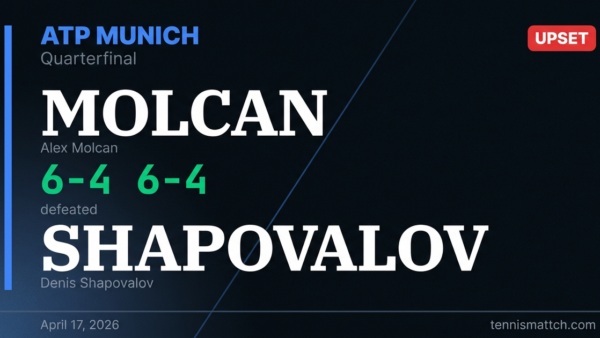


Denis Shapovalov meets Alex Molcan in the Munich quarterfinals on April 17, 2026, with the Canadian carrying a 1-0 head-to-head advantage and significant momentum on hard courts. Shapovalov enters off a dominant Round of 16 victory over Fabian Marozsan, while Molcan’s recent hard court activity remains unclear, raising questions about match sharpness on this surface.
The prediction model assigns Shapovalov a 67.5% win probability, driven by a 34-point surface Elo advantage and superior recent form (60% vs 50% in last 10 matches). Their sole previous encounter came in Doha’s Round of 16 in February 2022, where Shapovalov prevailed in straight sets. However, Molcan arrives on a three-match win streak, suggesting he’s found form despite limited recent hard court evidence in the data.
This quarterfinal presents contrasting profiles: Shapovalov’s aggressive serving (10.1 aces per match) versus Molcan’s superior break point conversion (41.4% vs 35.3%). The model projects 24.8 total games with a 53% probability of a straight-set finish, though Molcan’s defensive capabilities could extend the match if he neutralizes Shapovalov’s serve.
Key Takeaways
- Shapovalov’s serve dominance could prove decisive — he averages 10.1 aces per match on hard courts compared to Molcan’s 3.8, providing consistent free points and service hold leverage.
- Surface familiarity tilts heavily toward Shapovalov, who recently defeated Marozsan at this venue and holds a 45-33 hard court record since 2024, while Molcan’s most recent hard court result dates to August 2023.
- The model’s 67% simulation win rate for Shapovalov reflects both the 1-0 H2H record and a 34-point surface Elo gap (1646 vs 1612), though straight sets aren’t guaranteed with only 53% probability.
- Molcan’s 41.4% break point conversion rate substantially exceeds Shapovalov’s 35.3%, offering a tactical pathway if he can force extended rallies and capitalize on the Canadian’s 31.7 unforced errors per match.
Player Analysis
Denis Shapovalov
The Canadian arrives in Munich with exactly the form pattern he needs: consecutive hard court wins, including victories over Stefanos Tsitsipas and Tomas Martin Etcheverry at Indian Wells before falling to Jannik Sinner. His 10.1 aces per match illustrate the firepower that makes him dangerous on faster surfaces, though his 60% first serve percentage suggests room for improvement in consistency. Shapovalov’s 31.7 unforced errors per match remain a vulnerability — when the aggression misfires, he can hand opponents extended service games and break opportunities.
His straight-sets dismantling of Marozsan in the previous round demonstrates he’s striking the ball cleanly and moving well. Against Molcan, Shapovalov will look to dictate from the baseline with his forehand and use his lefty serve to pull opponents wide. The quarterfinal setting at a tournament where he’s previously competed provides additional comfort, and his 1-0 career record against Molcan — albeit from four years ago — establishes psychological precedent.
Alex Molcan
The Slovak qualifier presents an intriguing puzzle. His three-match win streak indicates he’s playing with confidence, yet the absence of recent hard court results in the available data raises legitimate questions about match sharpness on this surface. Molcan’s 41.4% break point conversion rate is genuinely impressive and suggests a player who raises his level in crucial moments. If he can force Shapovalov into extended rallies and create return opportunities, that efficiency could neutralize the Canadian’s serve advantage.
Molcan’s strategic path to victory requires patience and precision. He’ll need to minimize first-serve returns that allow Shapovalov to attack, extend rallies to exploit those 31.7 unforced errors, and convert the break chances that come. His 3.8 aces per match won’t win free points, so consistency on serve becomes paramount. The challenge is significant: Molcan must overcome both the surface Elo deficit and limited recent evidence of hard court form while facing an opponent who’s proven he can execute on this surface.
Head-to-Head Record
| Date | Tournament | Surface | Winner | Score |
|---|---|---|---|---|
| 2022-02-16 | Doha | Hard | Denis Shapovalov | 2-0 |
Match Prediction
| Denis Shapovalov | Alex Molcan | |
|---|---|---|
| Elo Rating | 1642 | 1609 |
| Hard Elo | 1646 | 1612 |
| Last 10 Win% | 60% | 50% |
Frequently Asked Questions
Who will win Shapovalov vs Molcan at Munich 2026?
The prediction model favors Denis Shapovalov with a 67.5% win probability, driven by his superior surface Elo rating (1646 vs 1612), stronger recent hard court form, and 1-0 head-to-head record. Shapovalov’s aggressive serve (10.1 aces per match) and recent momentum at this venue provide tangible advantages. However, Molcan’s 41.4% break point conversion rate and three-match win streak suggest he can exploit opportunities if Shapovalov’s 31.7 unforced errors per match become problematic. The model projects this as likely straight sets (53% probability), though Molcan’s defensive capabilities could extend it to three.
What is the head-to-head record between Shapovalov and Molcan?
Denis Shapovalov leads the career head-to-head 1-0, with their only previous meeting occurring at the Doha Round of 16 in February 2022. Shapovalov won that hard court encounter in straight sets (2-0). They have never met on clay or grass, making this their second career meeting and first in four years.
Shapovalov vs Molcan Munich 2026 prediction
Monte Carlo simulation data projects Shapovalov to win 67% of the time, with 24.8 expected total games suggesting a competitive but controlled match. The most likely scoreline is 2-0 (38% probability), followed by 2-1 (29%). Key factors favoring Shapovalov include his serve dominance, venue familiarity (recent win over Marozsan), and 34-point surface Elo advantage. Molcan’s path requires exceptional break point conversion and forcing extended rallies to capitalize on Shapovalov’s unforced error tendency. Recent hard court form disparity represents the most significant variable — Shapovalov has clear match sharpness while Molcan’s adjustment to the surface remains uncertain.
When is Shapovalov vs Molcan at Munich 2026?
The quarterfinal match is scheduled for April 17, 2026, at the Munich ATP tournament. The match will be played on hard courts, with the winner advancing to face either the winner of the opposite quarterfinal pairing in the semifinals.
What’s Next
Shapovalov and Molcan take the court for their Munich quarterfinal on April 17, 2026. The winner advances to the semifinals with a chance to reach their first final at this ATP event. For Shapovalov, a semifinal berth would continue his resurgence on hard courts; for Molcan, it would represent a breakthrough result on a surface where recent competitive reps appear limited.