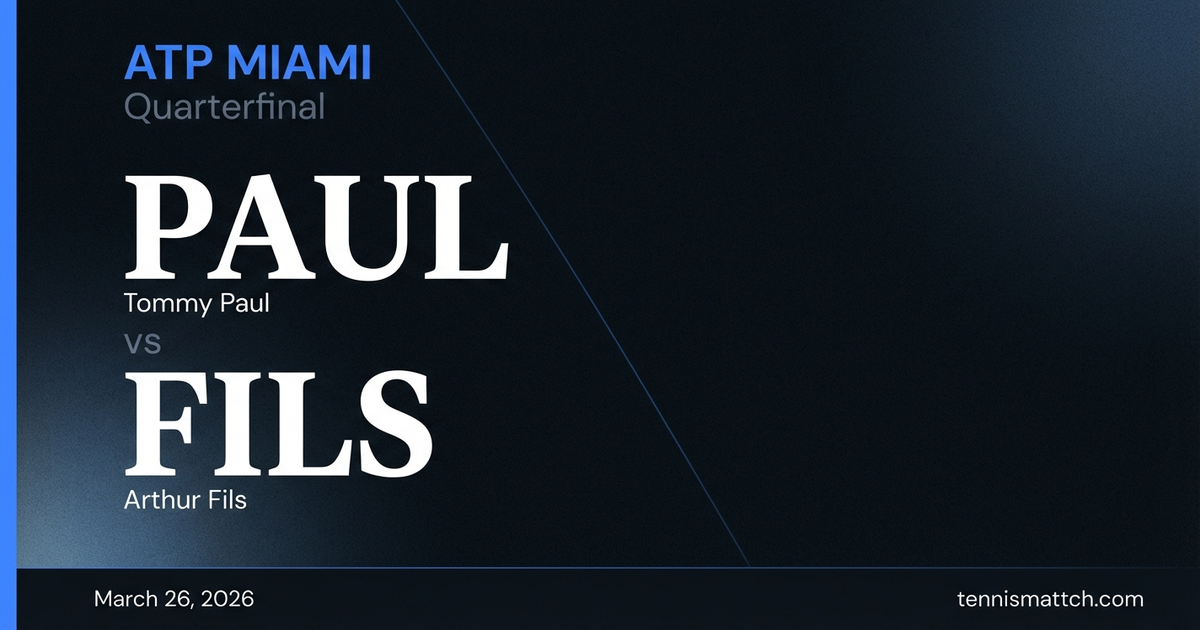



Tommy Paul and Arthur Fils meet in the Miami quarterfinals on March 26, 2026, in a hard-court showdown the prediction model rates a virtual toss-up: Paul holds a marginal 51.3% win probability despite leading their head-to-head 1-0 from Shanghai 2023. Both players arrive on two-match winning streaks, but Fils’s 80% recent form and elite break point conversion could neutralize Paul’s firepower advantage.
The tactical chessboard favors contrasting styles. Paul generates 29.7 winners per match — seven more than Fils — but that aggression comes at a cost: 30.1 unforced errors versus Fils’s 27.6. The Frenchman’s 42.9% break point conversion rate dwarfs Paul’s 31.6%, and with Paul’s first serve landing at just 60% compared to Fils’s 70%, the American’s service games will face relentless pressure. Fils dismantled Tsitsipas 6-0, 6-1 in the Round of 16, while Paul cruised past Etcheverry 6-1, 6-3 — both showcasing peak form at different ends of the style spectrum.
The model projects 26 total games with a 50% probability of straight sets, suggesting whichever player establishes early rhythm could dictate terms. Paul’s lone H2H win came in a three-setter in Shanghai over two years ago, offering minimal predictive value on a different continent and court speed. Fils has proven his credentials as an upset specialist here, reaching the 2025 Miami quarterfinals and nearly toppling Zverev at Indian Wells just weeks ago.
Key Takeaways
- Fils’s break point conversion advantage (42.9% vs. 31.6%) could prove decisive given Paul’s 30.1 unforced errors per match — the model’s narrow 51.3% edge for Paul reflects this vulnerability.
- Paul’s seven-winner-per-match advantage (29.7 vs. 22.6) must be managed carefully: his higher error count means he needs 60%+ first serve percentage to protect holds, yet he’s averaging just 60% compared to Fils’s 70%.
- Fils’s recent form (80% win rate over last 10 matches) and momentum from demolishing Tsitsipas suggest he’s peaking at the right time, while Paul’s 70% recent form includes a quarterfinal loss to Fonseca at Indian Wells.
- The model projects equal likelihood of 2-0 and 2-1 outcomes (26% each for Paul winning both scorelines), indicating the slightest execution edge in tight moments will separate these evenly matched Elo ratings (Paul 1722, Fils 1712 on hard).
Player Analysis
Tommy Paul
Paul’s Miami campaign has showcased his best attributes: aggressive baseline striking that produced 29.7 winners per match and a dominant 6-1, 6-3 dismantling of Etcheverry in the Round of 16. His 1767 Elo rating reflects a player who can dictate with pace and finish at net, but the statistics reveal a high-wire act. That 30.1 unforced error average — coupled with a 60% first serve percentage that’s 10 points below Fils — means his margin for error shrinks against elite returners. His 31.6% break point conversion rate has cost him in big moments, including that Indian Wells quarterfinal loss to Fonseca. Against Fils’s 70% first serve accuracy and defensive consistency, Paul must land first serves in clusters to set up his forehand and avoid extended rallies where errors accumulate.
Historically, Paul has struggled at Miami (Round of 16 in 2023, losing to Alcaraz), and his sole H2H win over Fils came in Shanghai 2023 — a three-setter on faster courts that offers limited predictive value here. The pressure falls squarely on his ability to manage aggression: if his winner-to-error ratio tilts positive early, he can overwhelm Fils’s more conservative game, but any first-set wobble invites the break point vulnerability Fils exploits ruthlessly.
Arthur Fils
Fils arrives in career-best form, riding a 7-2 hard court record over his last 10 matches and fresh off a 6-0, 6-1 annihilation of Tsitsipas that announced his arrival as a legitimate threat. His 42.9% break point conversion rate — 11.3 percentage points superior to Paul’s — is the foundation of his game: relentless returning, elite court positioning, and the patience to wait for opponents’ errors rather than force winners. That 70% first serve percentage gives him a defensive shield Paul lacks, while his 27.6 unforced errors per match suggest a player who values precision over pyrotechnics. The model’s 48.7% win probability undersells his recent trajectory: he pushed Zverev to the brink at Indian Wells and reached the Doha final, losing only to Alcaraz.
His 2025 Miami quarterfinal run proves he thrives on this stage, and his statistical profile matches up beautifully against Paul’s vulnerabilities. Where Paul generates seven more winners per match, Fils commits 2.5 fewer errors — a net swing that compounds over 26 projected games. His 1762 Elo rating sits just five points below Paul’s, but his 80% recent form and two-match winning streak suggest upward momentum. The tactical blueprint is clear: extend rallies, force Paul into 10+ shot exchanges where errors creep in, and pounce on second serves with that lethal 42.9% break conversion rate.
Head-to-Head Record
| Date | Tournament | Surface | Winner | Score |
|---|---|---|---|---|
| 2023-10-09 | ATP Shanghai | Hard | Tommy Paul | 2-1 |
Match Prediction
| Tommy Paul | Arthur Fils | |
|---|---|---|
| Elo Rating | 1767 | 1762 |
| Hard Elo | 1722 | 1712 |
| Last 10 Win% | 70% | 80% |
Frequently Asked Questions
Who will win Tommy Paul vs Arthur Fils at Miami 2026?
The prediction model gives Tommy Paul a marginal 51.3% win probability versus Arthur Fils’s 48.7%, reflecting their near-identical Elo ratings (Paul 1722, Fils 1712 on hard courts). Paul’s aggression (29.7 winners per match) contrasts with Fils’s efficiency (42.9% break point conversion vs. Paul’s 31.6%), making this a tactical coin flip. Fils’s superior recent form (80% vs. 70% over last 10 matches) and 70% first serve percentage could neutralize Paul’s firepower if the American’s unforced errors (30.1 per match) accumulate in tight moments. The model projects 26 total games with 50% probability of straight sets, suggesting early rhythm will determine the outcome.
What is the head-to-head record between Tommy Paul and Arthur Fils?
Tommy Paul leads the head-to-head 1-0, with his sole victory coming in the Round of 16 at the 2023 ATP Shanghai Masters (October 9, 2023) in a three-set match. That result occurred over two years ago on faster indoor hard courts, limiting its relevance to this outdoor Miami quarterfinal on slower hard courts. Both players have evolved significantly since then — Fils reached the Doha final in 2026 and quarterfinals at Miami in 2025, while Paul improved his hard court record to 58-28 (.674) in 2024. The historical edge offers Paul minimal psychological advantage given the time gap and surface differences.
Tommy Paul vs Arthur Fils Miami 2026 prediction
Monte Carlo simulations give Paul a 51.4% win probability, with the most likely outcomes being 2-0 (26%), 2-1 (26%), or 1-2 (24%) — all near-equal probabilities that underscore how evenly matched these players are. The key battleground is break points: Fils’s 42.9% conversion rate versus Paul’s 31.6% creates asymmetrical pressure, especially since Paul’s 60% first serve percentage trails Fils’s 70%. Paul must generate quick holds and press Fils’s second serve to avoid extended rallies where his 30.1 unforced errors per match become liabilities. Fils’s path to victory runs through his recent form (80% win rate, demolished Tsitsipas 6-0, 6-1) and defensive consistency that turns Paul’s aggression into errors. Expect a tactical battle decided by Paul’s ability to manage risk versus Fils’s patience in waiting for mistakes.
When is Tommy Paul vs Arthur Fils at Miami 2026?
The match is scheduled for March 26, 2026, as part of the Miami Masters ATP 1000 quarterfinals. Both players enter on two-match winning streaks: Paul defeated Etcheverry 6-1, 6-3 in the Round of 16, while Fils dismantled Tsitsipas 6-0, 6-1. The winner advances to the semifinals and is guaranteed a top-tier ranking boost, with both players seeking their first Masters 1000 semifinal appearance at this venue.
What’s Next
The match is scheduled for March 26, 2026, as part of the Miami Masters quarterfinals. The winner advances to the semifinals and moves within two victories of a Masters 1000 title — a career milestone for either player. Paul seeks his first Masters 1000 semifinal appearance at a venue where he’s historically underperformed, while Fils aims to surpass his 2025 Miami quarterfinal finish and cement his status among the tour’s rising stars.